Know your Townland – Rathluby/Ráth Lúbaigh
This townland is located at the south eastern edge of the parish of Quin, at the turn-off for Craggaunowen. Sadliers Cross Road is the name of this junction. No record can be found for the family names of Ó Lúbaigh or Sadlier having resided here. A gate lodge was located here for the Rathluby estate and the one-time resident may have inspired this placename. This small townland is best identified by the large lough taking its name from the townland and by the demesne that once dominated it.
Ó Lúbaigh, a rare and scattered surname, now most numerous in Tipperary’.
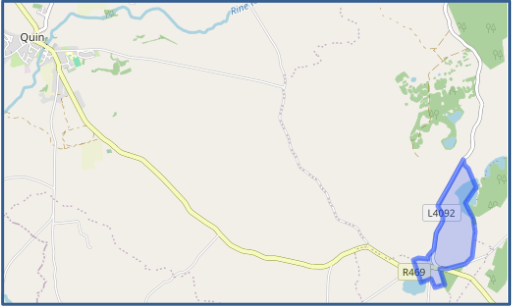
50.3 hectares/124 acres
1659 Census Records (Rathlubby, Ballyroughane, Cullane)
Tituladoes Murrogh O’Bryen; Population: 5 Irish
1855 Griffiths Valuation
Landlord: Eliza Piercey. Tenants: Henry Bridgeman (Head tenant), Patrick Neill, John Rourke.
Landlord: Henry Bridgeman. Tenant: Patrick Neill
Landlord: James Murphy. Tenant: John Rourke
A St John Bridgeman was residing at Rathluby in 1799 and is also named as liable for tithe payment in 1825. In the mid 19th century Henry Bridgeman held Rathluby from Eliza Piercey. In December 1861 the estate of Jane Piercy (a daughter of John Westropp of Fort Anne) at Cappagh in the barony of Lower Connello, Limerick, and at Rathluby were advertised for sale in the Landed Estates Court. The sale rental records that Henry Bridgeman’s lease had just expired. By the end of the 18th century, in the possession of the Bridgeman family, the buildings were valued at £5 at the time of Griffith’s Valuation. Henry Bridgeman occupied the house which he held from Eliza Piercey and it continued to be a Bridgeman home until the end of the 19th century. It was not unusual for the Protestant landowners to let parts of their property to others of their class, who often sublet the poorer land to the locals.
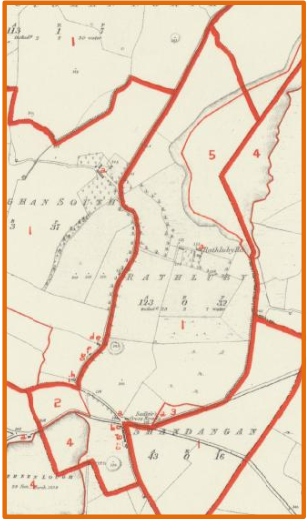
Census Records for Rathluby 1841-1891
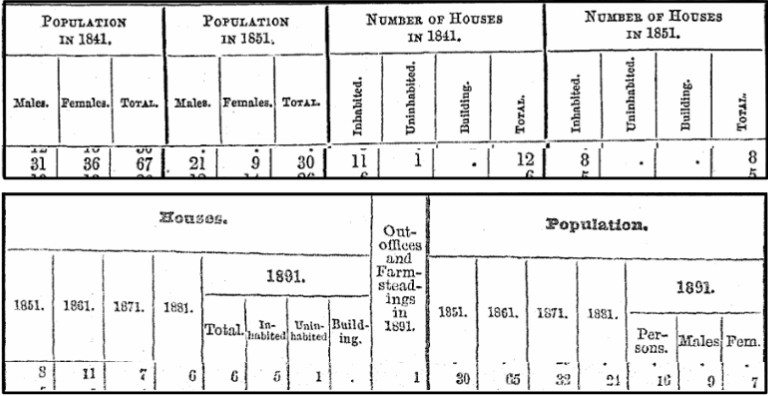
1841 Population: 67; Households: 11
1851 Population: 30; Households: 8
1861 Population: 65; Households: 11
1871 Population: 32; Households: 7
1881 Population: 21; Households: 6
1891 Population: 16; Households: 5
Comment:
The sudden drop in population in 1851, can be explained as a result of the recent famine. The return to a similar size in 1861 and another sudden drop by half in 1871 is much less obviously explained. Perhaps it was a result of emigration for a better life or a change in agricultural practices which resulted in a move from growing to grazing?
1901 Census Records Households 5; Population 14
John & Ellen Conlon, son Thomas, daughter Bridget.
William & his sister Rosanna McNamara.
James Droney
Ann McNamara, mother Bridget Fox, sons Patrick, Martin.
James McInerney, servants Kate Walters, Margaret Neville.
1911 Census Records Households 5; Population 11
John Conlon, son Thomas, daughter-in-law Mary.
William McNamara.
James McInerney, sons John, Michael, James, daughter Mary.
Margaret Neville.
Ann McNamara.
1918 Subscribers to Major Redmond Memorial Fund
James McInerney, William McNamara
1926 Census Records Households 5; Population 11
Thomas & Mary Conlon.
Rose McNamara, daughter Bridget.
Bridget Murphy & sister Margaret Murphy.
Margaret Callaghan, sons James, John, daughter Molly.
Patrick Pewter.
Comment:
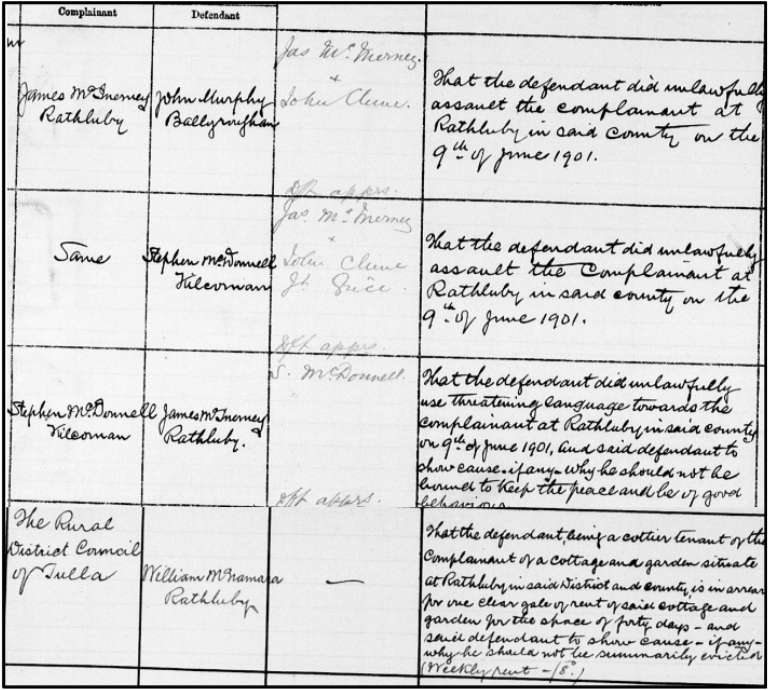
Many of the same family names will be seen in the ‘Baptismal Records’ and the ‘Petty Sessions Cases’ further below in this post such as Conlon, McNamara, McInerney, Pewter.
Rathluby House
Associated Families: Molony, McGann, Piercy, Bridgeman, McMahon
Features: Rathluby House was an eighteenth-century, rectangularly shaped residence, facing north-north-east over Rathluby Lough. The yard and utility buildings stood to the west, and to the south was a large water-garden. The front of the house was approached by a drive from the south-east. Another drive approached from the south where there was once a gate lodge at Sadleirs Cross.
History: In the mid eighteenth century, James Massy Molony of the Cragg family, whose father Andrew Molony died in 1724 and whose mother was Arabella Massy, lived here with his wife, Susanalva Molony. They had one daughter. In 1799, St J. Bridgeman of Rahloba (sic) was in favour of the legislative Union of Ireland with Great Britain. Henry Bridgeman is shown as leasing the property from Eliza Piercey in 1855 together with almost one hundred acres.
A tombstone in Kilseilly graveyard (Broadford) records a ‘Colonel George Frost, I.M.S., in memory of his uncle Thomas Bridgeman of Rathluby d. 1894’. Above the words is a shield parted per pale with the Bridgeman arms on the sinister (left) side. There is also above the shield the family crest. Nearby is another stone: ‘Henry and Eleanor Bridgeman, Al Wall and Ames Wall. Henry’s brothers: William, Winter and Carre 1714’. The Bridgemans had been in the area since circa 1659 when Henry Bridgeman was Tituladoe of a number of townlands in Killuran parish to the north-east. At the turn of the century, Rathluby was acquired by James McMahon of Newmarket House. The house no longer remained occupied. The property is still in the hands of the McMahons. Rathluby house was demolished in 1948.
Courtesy of Hugh Weir – Houses of Clare.
National Monuments
CL043-011 Enclosure, CL043-013 Enclosure
Quin Petty Sessions – Sample Cases
Baptismal Records from 1800’s for Rathluby
The population of the townland peaked at 67 in 1841, hence the large numbers of recorded baptisms in this period. Prominent family names such as MacNamara, McInerney, Conlon (and variations in spelling), Pewter recorded below are still to be found in records right up to 1926. Note the record containing Margaret Sadler and witness Daniel Sadler.
| Date | Child’s name | Father | Mother’s name | Sponsors | ||
| 26.11.1839 | Patt | (?) | Patt | (?) | Peggy | John McMahon, Peggy (?) |
| 25.07.1820 | Thomas | Calnan | Thomas | (?) | Biddy | John Ryan |
| 11.05.1837 | John | Connelan | Thomas | Corbett | Bridget | Michael Gleeson, Anne Cain |
| 03.11.1833 | Bridget | Connellan | Tom | Corbett | Bridget | Eliza Griffey |
| ??.09.1833 | Bridget | Donohoe | James | Fox | Margaret | William and Mary thFox |
| 13.07.1845 | Michael | Gorman | Thomas | Malone | Betty | Thady and Catherine Ryan |
| 03.05.1843 | Bidy | Gorman | Thomas | Molone | Betty | Denny(?) Ryan |
| 24.06.1841 | James | Griffy | Patt | Tobin | Mary | Thady Duggan, Mary Mulquiny |
| 08.04.1852 | Kitty | Holiday | Glin(?) | Biddy | Mary McNamara | |
| 25.11.1819 | Timothy | Kean | John | Hinsy(?) | Bridget | Patt Lynch, Bridget Brown |
| 11.04.1845 | Patt | Keeffe | John | Hease | Honora | Martin Gleeson, Sally Fox |
| 19.05.1818 | James | MacInerny | Thomas | Crohan | Anne | Tim Meany |
| 21.07.1819 | Thomas | McEnerkny | Thomas | Crowlan | Nancy | John Hicky, Johanna Ryan |
| 17.11.1845 | Sally | McInerny | James | Conlon | Honor | Bridget Corbett |
| ??.11.1835 | Martin | McInerny | Patrick | Kenna | Margaret | Mary Halloran |
| 10.06.1823 | Anne | McInerny | Thomas | Croghan | Nancy | Dennis Meaney |
| 06.07.1846 | Daniel | McMahon | James | Fox | Judy | Tom and Bridget Lillis |
| ??.06.1836 | Briget | McMahon | James | Griffy | Elizabeth | James Gorman, Bridget Glynn |
| 10.06.1838 | John | McMahon | James | Elizabeth | Pat Griffy, Catherine Glynn | |
| 26.11.1829 | John | Morrissy | Michael | Sadler | Margaret | Daniel Sadler(?), Bridget – |
| 12.04.1847 | Daniel | Neil | Pat | Cullinan | Hanah | Bidy Neil |
| 23.07.1824 | Mary | Neil | Patrick | Quillinan | Anne | Mary Quillinan |
| ??.04.1835 | James | O’Neal | (?) | Widow Ryan, the aunt of James | ||
| 06.01.1839 | Mary | O’Neill | James | Cain | Mary | Honora Fall |
| 05.09.1847 | John | Pewter | Peter | Sharry | Susan | Michael Pewter, Mary Markham |
| 04.11.1849 | Anne | Pewter | Peter | Sharry | Susan | Honor Pewter |
| 24.02.1846 | Ellen | Ryan | Pat | Fahy | Anne | Michael Conlan, Mary Ryan |
| 14.01.1850 | Bridget | Ryan | Patt | Neill | Jane | Anne Neill |
| ??.09.1834 | (?) | Shaughnessy | Pat | Fox | Brigid | Margaret O’Neal |
| 25.07.1852 | Robert | Stafford | Michael | Stafford | Serah | John McMahon, Anne Fox |
| 07.01.1818 | Denis | Tasler(?) | John | Mulcandry(?) | Anne | Pat Glyn |
| 29.07.1866 | Thomas | Conlan | John | Kenny | Ellen | Margaret Bridgman |
| 15.05.1859 | Bridget | Conlan | Michael | Loughlin | Mary | Ellen Kenny |
| 14.03.1863 | Patt | Conlon | John | Kenny | Ellen | Mary Griffy |
| 19.01.1861 | Thomas | Conlon | Michael | Loftus | Mary | Jaems Callinan |
| 20.02.1870 | Bridget | Connelan | Tom | Kenny | Ellen | Sarah McInerny |
| 22.12.1857 | Elizabeth | Connellan | Michael | Loftus | Mary | Michael Burke, Mary Burke |
| 02.07.1859 | Peter | Mac | Michael | Shaughnessy | Anne | Pat Peper, Mary Morissy |
| 13.08.1864 | Anne | Mack | Michael | Fox | Anne | Margaret Pepper(?) |
| 12.09.1869 | Margaret | Mack | Michael | Mack | Anne | Mary Mack, Patt Moylan |
| 17.03.1867 | Patt | Mack | Michael | O’Shaughnessy | Anne | Bridget Haneen |
| 24.06.1856 | Mary | McInerney | James | Connellan | Honora | Bridget Connellan |
| 09.09.1860 | James | McInerny | James | Conlan | Honora | Patt Haneen, Margaret Neville |
| 27.09.1857 | Michael | McInerny | James | Connellan | Honor | Martin McInerny, Maria Droney |
| 02.05.1865 | Martin | McInerny | Martin | Neville | Mary | Bridget McEnerny |
| 02.11.1879 | Martin | McNamara | Michael | Fox | Anne | Pat Pewter, Bridgid Liddy |
| 02.09.1871 | Michael | McNamara | Michael | O’Shaughnessy | Anne | Ellen Lifford |
| 03.07.1875 | Patrick | McNamara | Michael | O’Shaughnessy | Anne | John McNamara, Anne McNamara |
| 14.09.1861 | Bridget | McNamara | Michael | Shaughnessy | Anne | Mary Neville |
| 15.03.1873 | William | McNamara | Michael | Shaughnessy | Anne | Bridget Strafford |
| 03.10.1869 | James | Quigly | Andy | Mack | Eliza | Michael O’Brien, Kate O’Brien |
| 24.03.1858 | Mary | Ryan | Patt | Fahy | Anne | Margaret Neville |
| 01.01.1861 | Bridget | Ryan | Patt | Fahy | Anne | Michael Gorman, Mary Griffy |
| ??.05.1855 | Ellen | Strafford | Michael | Conlan | Sarah | Ellen Kenny |
| 29.09.1860 | Bridget | Strafford | Michael | Conlon | Sarah | Thomas Griffy, Anne Stafford |
| ??.12.1857 | Thomas | Strafford | Michael | Connelan | Sally | Thomas Griffy, Mary Griffy |
| 31.05.1862 | Michael | Tierney | Mathew | Ryan | Bridget | John Hanneen, Margaret Hanneen |
| 10.02.1867 | Mary Anne | Tierney | Matt | Ryan | Bridget | Ellen Ryan |
| 12.06.1859 | Bridget | Tierney | Matthew | Ryan | Bridget | Patrick Hannan, Mary Hannan |