Following the defeat of Richard De Clare in 1318 at Dysert, the Dalcassian families enjoyed a period of relative peace. During this period, alliances were formed through marriage and co-operative ventures between the old Gaelic families and the old English who were now settled into their new homelands. Below is an example of one such alliance between the O’Brien/MacNamara sept, the Butlers of Ormond and the Burkes(Burghs) of Clanricarde in Galway:
Extract from ‘The Story of an Irish Sept’, by N.C. MacNamara, Published 1896 P. 144-147
The “Four Masters” state that in 1428, Macnamara, chief of Clancuilein, died; a charitable and truly hospitable man, who suppressed robbery and theft, and established peace and tranquillity in his territories.”
In A.D. I444 these annalists have another entry, to the effect that Sioda Macnamara died. ” He was the chief protector of the men of Ireland,” and he is also referred to in the annals of Ulster, and of Munster as having been renowned for his hospitality.
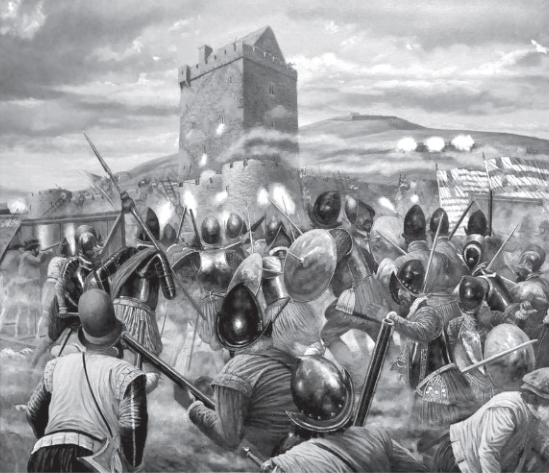
The fifteenth century, so far as Clare was concerned, was not destined to close in peace. Sir James Ormond, a natural son of the sixth Earl of Ormond arrived in the West of Ireland, claiming to be the heir to the title and lands of his father. Sir James was received by the O’Briens and Macnamaras, and also by the Clanricardes, these three families being closely related in marriage with the late Earl, were glad to support an Ormond, in opposition to the Earl of Kildare, who since Ormond’ death had assumed paramount power over Ireland, and had been appointed Lord Deputy of that country by Henry the Seventh. Kildare however, had been recalled to England by the king. While there he married the sister of the lawful heir to the Ormond estates in Ireland.
On the Lord Deputy’s return to Dublin he raised a pretext for quarrelling with the O’Briens, his real motive being to punish them for their support they had afforded to Sir James Ormond. Kildare marched with his forces into Clare and surprised the strong castle of Ballycullen, which belonged to Finn Macnamara.
Leaving a garrison in this place, he moved on to Quin, where he was met by Conor O’Brien, who had hastily summoned the Macnamara and other Dalcasian septs to his aid, in order to oppose the progress of the Lord Deputy. After a fiercely contested battle Kildare was utterly routed by the Irish, and with difficulty made good his escape with the remnants of his troops across the Shannon. This battle was fought in A.D. 1499, and in the same year Conor O’Brien died. He was succeeded by his nephew Torlogh, who married Finola, a daughter of Rory Macnamara, by whom he had five sons, the two eldest respectively became rulers of Thomond; the second son, Morrogh, however, resigned the chieftainship of the Principality, and became Earl of Thomond during the reign of Henry VIII.
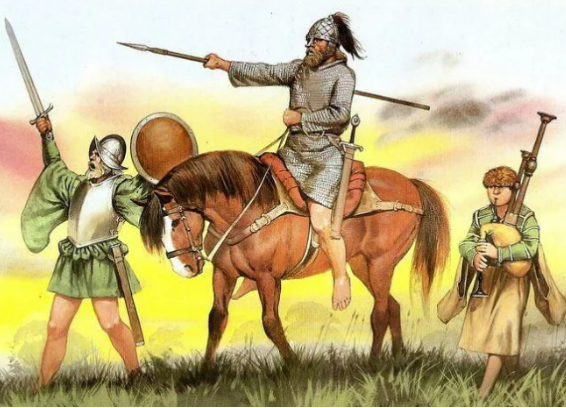
Torlogh O’Brien had hardly been appointed chief of the Dalcais before he was attacked by the Earl of Ormond, who was driven out of Thomond with considerable loss. Torlogh was destined, however, together with the Macnamaras, to be engaged in more serious military operations, in consequence of their relationship, by marriage, with the Clanricardes. The chief of that clan was at this time Ulick Bourke, whose first wife had been a daughter of Sioda Macnamara; she died in A.D. 1498.
Ulick subsequently married a daughter of the Lord Deputy Kildare; but he is accused of having ill-treated this lady. At any rate, she left him, and so angry was Kildare that he determined to be revenged on his daughter’s husband; and at the same time he hoped by weakening the Bourkes’ power in the West of Ireland, to enable the English more effectually to humble the O’Briens and other septs of Thomond. Kildare persuaded the chiefs of the North of Ireland to espouse his cause.
THE BATTLE OF KNOCKTOW
On the other hand, Clanricarde and the O’Briens obtained the aid of the southern chiefs; so that the whole of the Irish of the northern part of the country were brought into battle array against the natives of the southern half of the island. What is more remarkable, the commander of the Irish of the northern part of the island was an Englishman, the Earl of Kildare, and the commander of the southern forces was Clanricarde, of Anglo-Norman descent. It is hardly possible to conceive a more desperately hopeless condition of things than this; that the Irish, or any other people, should thus have been divided and brought into the hold of battle by commanders of a different and hostile race, whose object was to urge on the natives to destroy one another, so that the English might profit by this act of national suicide.
Kildare no doubt to some extent made Clanricarde’s treatment of his daughter the ostensible cause of the conflict; but in the hour of battle he withdrew his English troops from the field, and allowed the Irish of the north and south to tear each other to pieces; which they did in a most effectual and satisfactory manner, according to the idea of those who stood on one side to watch the conflict.
The armies under Clanricarde, and Kildare, met at a place called Knocktow, near Galway, on the nigth of August 1504. “The Four Masters ” record that a victory was gained over Clanricarde and the South of Ireland, and that of nine divisions which were drawn up in battle array in the army of the South, there survived the action but one broken battalion. The northern Irish also suffered so terribly that they were unable to follow up their victory, but after collecting their scattered forces retired from the field. It is said that at this moment Lord Gormanston proposed to Kildare that the English should “consummate their good fortune by slaughtering the remainder of the Northern army who had fought for them.
The Earl of Kildare does not seem to have taken advantage of the weakened condition in which the Dalcasians must have been left after the battle of Knocktow; nevertheless, he felt that so long as this famous tribe remained supreme in the West of Ireland, there could be no security for his countrymen living within the Pale, and still less for extending their rule over the country. In A.D. I5I0 the Lord Deputy erected a fortress in the parish of Kilteely, Co. Limerick, in spite of the opposition of the Irish. Having secured this place as a base for his operations, ” attended by the chiefs of the English and Irish of Leinster, and O’Donnell from Donegal, Kildare advanced with his forces into South Munster,” with the intention of weakening the power of the chiefs of Munster before striking his final blow at Thomond. Having effected this object, the Lord Deputy passed into the county of Limerick, where he mustered all the English of Munster, Meath, and Leinster, and proceeded to the town of Limerick.
From “The Four Masters” we learn that “Torlogh O’Brien, Lord of Thomond, with all his forces, together with the Macnamaras and the Clanricardes, mustered another army to oppose Kildare. The Earl, that is, the Lord Justice, marched with his army until he arrived at the wooden bridge which O Brien had constructed over the Shannon, and he broke down the bridge.” Kildare’s object was to attack the O Carrolls of Ely and other clans of East Thomond before they could unite their forces with those of O’Brien in Clare. Torlogh, however, with his followers forded the Shannon, and coming up to Kildare’s army, encamped close to them, so that, as “The Four Masters” state: “the two forces could hear each other’s voices and conversation during the night. On the morrow Kildare marshalled his army, placing the English and Irish of Munster in the van, and the English of Meath and Dublin in the rear. O’Brien’s army attacked the English and slew the Barons Kent, and Barnewall, with many other men of distinction. The English only escaped by flight, and the army of ‘Brien returned home in triumph with great spoil.”
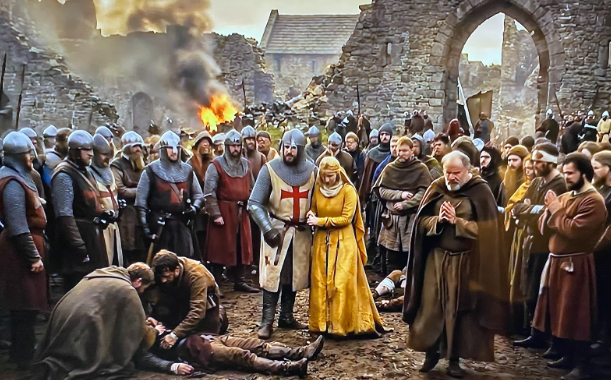
Kildare made no further effort to conquer the Dalcasians west of the Shannon, but in 1513 he laid siege to Leap Castle, the residence of the ‘Carroll’s of Ely’. Failing to take the place by escalade, ” and being unprovided with heavy ordnance, he was obliged to raise the siege for the purpose of procuring artillery; he was, however, taken ill, and died in September 1513.
Clare for some years enjoyed peace and hardly appears on the pages of Irish history. We are told that in 1528 one of the inhabitants of this province, O’Daly of Corcomroe, a poet, died; he was famed, among other qualities, in that he ” kept a house of general hospitality”. In the year 1522 Teigie O’Brien, while leading an attack in support of the O’Carrolls, was killed ” by the shot of a ball.” We have already referred to the fact that Kildare had to raise the siege of Leap Castle for want of artillery, which at this time seems to have come into use in Ireland; it was gunpowder and the cannon of the early part of the sixteenth century that sealed the fate of that country, for the native chiefs had no means of obtaining firearms, and as opposed to such weapons their swords and spears were useless. The last battle had been fought under the old style of warfare by the O’Briens and Macnamaras against the English, and, as on so many previous occasions, they had driven back their foes and so preserved their lands and homes in Clare.
Torlough O’Brien died in the year 1538, and was succeeded by his son Conor, who was married first to a daughter of Clanricarde, and secondly to a Desmond. The condition of Ireland at this time is described in the State Papers of the reign of Henry VIII., where it is stated that the country was under the rule of some sixty chief captains or princes.