
Quin School Feaghquin
The first recorded ‘National school’ in Quin was opened in the year 1856. The school, known locally as a “Reading House,” was situated where Malachy Hassett has his stables in Feaghquin. The home of the late Mrs. Muriel O’Neill was at that time the residence of the teacher. The last teacher to live there was Mrs. Lena Weldon – Helena Degidon of Rylane and her husband John Weldon, aka the writer Brinsley MacNamara. The first recorded enrolment in the “Male School” in the year 1863 was Michael Clune – Carhugar – farmer, aged 15. In 1871, there is a record of the first infant, William Considine-aged six, whose father is registered as a teacher. Situated in Feaghquin, the ‘Old School’ was built in 1896. The boys and girls schools were amalgamated on April 1st 1928. Up to that year they were separate schools.The last significant upgrade was in 1960 at Newline. It was occupied in 1964. The old school was used by the local Macra na Feirme as a garage and training workshop for skills such as welding and mechanics for many years afterwards.It waas converted to a private home in the 1990’s and continues to be in private ownership to this day.
Brinsley MacNamara
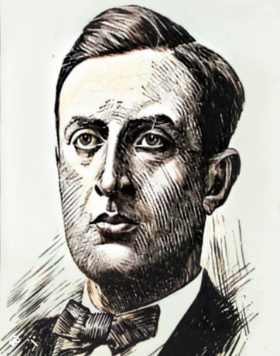
This was the pen-name of John Weldon a writer, playwright and registrar of the National Gallery of Ireland. He was the author of several novels, the best known was his first, The Valley of the Squinting Windows (1918). The book caused a furore in his native Westmeath on its publication, to the extent that Brinsley had to retreat from his home place of Delvin. He continued to write for many years after his controversial first work. Among his plays are ‘The Glorious Uncertainty’ (1923) and ‘Look at the Heffernans’ (1926). On the 23rd of June 1920 MacNamara married local Quin girl, Helena Degidon of Rylan, in Clooney Church. Helena was a school teacher. The couple lived in Feaghquin next door to the school.
Born John Weldon, McNamara grew up in the small town of Delvin, Co. Westmeath, where his father was the schoolmaster. His work of fiction, ‘The Valley of the Squinting Windows,’ was written in 1916 and lambasted the gossip and crushing conformism which he felt exemplified rural Ireland at that time. Garradrimna, the small town featured in the book, was a hotbed of gossip and scandal. Its description in the book, even down to its population and layout, seemed to resemble Delvin closely. As for the characters, the men were cruel drunks while the women were invariably judgmental and unpleasant. The schoolmaster was one of the few local people with redeeming features.
In 1918, the book finally made its way to Delvin where it was read publicly by groups of horrified townspeople. Many locals reportedly recognised themselves in the text and a group of men accosted James Weldon, the author’s father, roughing him up. He only escaped due to police intervention. They also sought out Brinsley McNamara, who was in the town but had been forewarned. He fled through the countryside, later stating that he believed he would have been killed had he been caught that night. The protestors had to make do with burning a copy of the book in a tar barrel in the town.The criticism extended beyond Delvin.The author was castigated for the negative portrayal of Ireland and the frank discussion of sexuality in the book. As one newspaper thundered: ‘It is a downright shocking book. The marrow of a cynicism, uncalled for, captious, sullen, vicious, currish and the meanly sordid is writ large upon its every page.The author does not seem to have caught the small beauty of Irish village life. Rather, beetle-like, he has chosen to immerse himself in the fetid sordid meanness and reeking moral filth.’
Back in Delvin, a boycott of the family began when the shops in the town refused any of the Weldons service. The school in which Brinsley McNamara’s father taught was also boycotted with pickets placed outside the building. Half of the students were withdrawn in a boycott that lasted seven years and only ended when the Weldon family was forced to move away.Brinsley McNamara himself went on to become a well-known actor in Dublin and the registrar of the National Gallery of Ireland. His publishers had withdrawn his book from circulation, however, and the controversy had a profound effect on his family and the town of Delvin. It is likely that neither he, nor the village of Delvin, never forgot the reaction to ‘The Valley of the Squinting Windows.’ It is likely, also, that other Irish authors of the era thought twice before writing a negative portrayal of their homeland after such a reaction.