
From ‘The Man In The Big House’. Stories collected by Eddie Lenihan from the late Jimmy Armstrong of Ballyroughan.
“There was an old man living by himself at Ballykilty, an to go to his house you’d pass down at the back of the old Quin school, down a place they call Rine. Below Rine was the townland of Ballykilty, an’ you pass down Ballykilty on the road to Mooghaun. There was a road then, turning to the right just below Ballykilty wood, an that was a continuation, I’d say, of the old road that was made in Brian Boru’s time. “Twas going on to Ard Solas, that old road. But ’twas on that old road that this old man lived.
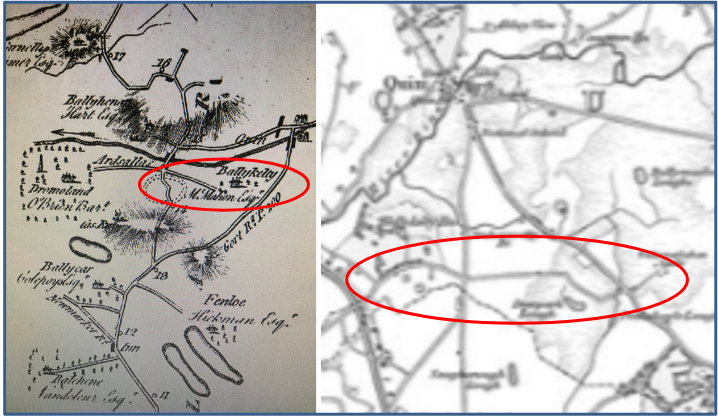
The old road that was made in Brian Boru’s time, shown here on the left, went from Ballymarkahan Castle to Ardsollus.
‘But, this fellow I knew well, now, we’ll call him Tom, he was workin’ with a local farmer an’ maybe three or four nights in the week he’d go to this old man, you see, to keep him company. Anyway, ‘twould be after Christmas one year, in January, that Tom went to the old man and this night he was tellin’ him that there was a ruin of an old house about seventy or eighty yards from the fort that was in his field. An’ Tom knew the field as well as he knew his left hand; ’twas across the road from the gate of the farmer ne was workin’ for. I spose thered be about ten or twelve acres in the field, an ’twas at the far side o’ the field from the road the fort was. Now, about seventy or eighty yards from the fort there was a ruin of an old house, an’ the old man told him that there was supposed to be gold buried under the flag of the entrance door to this old house, but a life would have to be lost in the getting of it.
“T’would be got alright but there would have to be a life lost in the getting of it. Anyway, Tom said no more, but the followin’ day he was tellin’ some o the boys around Quin about what the old man was tellin’ him about the gold being buried under the flag o the door of this ruin of the old house. But anyway, Tom, one evenin’ that he was goin’ home he went to inspect it an’ outside the door the entrance door o’ the old house, there was a heap o’ stones, and, coverin’ these stones there was moss and grass.
‘Now, to describe the house to you. An I saw the house! T’was down to the tops o’ the windows. The formations of the windows were there but the top lintels were gone off of ’em, you see. One gable end of the house was standin’ an the other was knocked.
An I spose twould be about forty yards at the Moohaun side of the oul house this old man, he had a galvanised shed made for calves there, an’ he had a door in the house an’ all.
‘But at the back, then, ổ the ruin ở the oul house there was what I could call a haggart where, I suppose, the occupants, they had a garden. This was enclosed by another wall. Well, from the end of the ruin o the oul house up to the old man’s house that he had made for the calves, there was a double wall; ’twas built with dry stones, an’ there’d be rough stones on top of it.
‘Anyway when Tom told the boys around Quin about the yarn that the old man told him about the gold bein buried they made up a plan, that some night they’d go to dig for it. An’ they’d have to wait, o course, until everyone was in bed, the old man in particular. “Twas on his land, you see. But they agreed, anyway, to go of a moonlight night in June or July that year.
‘So, they waited until the month o July, and one night that there was a full moon, an’ Tom, Christy, Joe, Martin an’ another John— we’ll leave their family names out of it ‘cos some of ’em are still alive – they went an’ they armed with pickaxes an’ shovels. An’ Martin, he brought a bottle o’ holy water in case of any evil spirits. But anyway, they went at about eleven o’ clock or half eleven, when they thought that everyone was in bed, you see. An’ they went to this old house an’ they started rootin’. They rooted down, rooted the heap o’ stones that was in the front o’ the entrance door, an’ what was mixed with the heap o’ stones, Tom told me, was old lime mortar, an’ the stones weren’t very big.
‘Anyway, they went down about four feet an John threw up loose stones out of the hole with a shovel. The next thing he came a big flag (stone).’
“The flag was bigger than the hole that they had made so he started rootin’ down one side o’ the hole to make it wider, d’you see, so that he’d come to the edge o’ the flag. While he was rootin down one side o the hole what came along the top o the wall from the old man’s house only what they thought was a white cat. An’ he jumped up on the wall o the ruin o the old horse an’ jumped across the formation o’ the windows until he came between the first window from the door an the second window.
He sat there above on top o’ the wall an’ he started spittin’ at ’em, Tom told me. A cat spittin’, now, did you ever hear him?
“Tssshhh! “Tssshhh! An every spit that hed give, Tom told me the sparks o fire used to come out of his mouth. An didn’t the boys start peltin’ him with stones. An’ he jumped across the window again an’ ran along the top o the double stone wall that the old man, I s’pose, built. He went up on the galvanised the house that the old man had for the calves an’ sat above on the galvanised about forty yards away from ’em, an he spittin. An’ the boys started peltin’ him with stones again so he went up the roof the house an’ down the other side an’ they saw no more of him.
‘But John, anyway, he was below in the hole an he throwin’ up the loose stones out of it, an’ the mortar, an’ he came to the side o the flag. There was a hole down an’ a stone fell down, an fell down the hole. Now, surely to goodness, Tom told me, that from once the stone fell down until it reached the bottom it took about a minute to fall. “Twas unknown the depth of it!
John, anyway, he said that they’d get up the flag whatever depth it was. So he started at the other side o’ the hole an’ as soon as he started at that side, in from the fort came what they though was a sheep. An’ the sheep came slowly in from the fort, an’ when ’twas about halfway between the fort an’ the hole they were opening the sheep took a jump an’ landed into the hole by the side of John. John, he was pitched, I s’pose, about forty yards away with the shovel in his hand, whatever it was that put him out of the hole an ilyin’ though the air. They all ran, out to the road, an left shovels an’ hacks an’ all after ’em. “Twas Martin that had the bottle o holy water but ‘twas Christy that got the contents o’ the bottle goin’ out the field. When they went out on the road they didn’t know what to do. When the old man would come next day an see the hole open an the heap o stones up out of it there’d be holy murder. But, John agreed to go back an’ close the hole some hour ‘ the morning, I s’pose it might be three or four ‘ clock in the morning, for fear the old man might see it. So he did; he went back an’ he brought a crowbar an’ three shovels an a pickaxe out with him. He left’em at a house in Quin until they’d give ’em back to the owners?
“Another place they thought to find something was at Quin Ab-bey. Oh, they did. Now, under Quin Abbey there’s supposed to be a cellar, and, in the cellar the ware of the abbey is supposed to be, cups an’ saucers an’ mugs an’ jugs an’ teapots, an unknown what. ‘Tis unknown, I spose, what they’d be worth now.
‘But didn’t some ‘ the boys, they thought to look for ’em one night. At the back o the abbey, now, facing Daingean Breac castle, there’s an arch. You can see it plain. Well, at the outer portion of the arch there’s a building, a square building. Up about the height of an ordinary man’s chest, under the arch, there’s a window, an’ you can look down an I spose ‘twould be ten or twelve feet down to the bottom. Now, below, if you look down the window, you can see the formation of a door below at the bottom, an above on top then ’tis the sky you’ll see when you look up. You can get at this building from above too. If you go up the stairs when you go in the entrance gate o the abbey you’ll go up to a green patch. Continue on over straight, an’ there’s a drop down then, beyond, down in this square building, an’ a couple of iron bars goin’ across ‘But, what did they do, these three fellows? They thought the formation o’ the door below, you see, was the entrance to the cellar, an’ they brought in a ladder one night, an a crowbar, when all the boys in Quin were in bed, an’ the girls as well. They brought up the ladder up the stairs, anyway, an they put it down from the green patch, down to the bottom. One of ’em went down with his crowbar an’ he took two or three stones out o’ the top o this entrance door. An’ whatever look he gave wasn’t there a friar standing by the side of him. He left the crowbar there. He told me he didn’t know how he went up the ladder. An’ himself an’ another one of ’em, they pulled up the ladder an’ off with ’em as fast as ever they could. I can tell you they went out of the abbey a lot faster than they came in. An’ that finished ’em with the cellar an the ware. But later on they had to come back again, bring ladder an’ all, put it down again an’ bring up the crowbar for fear anyone might see it below an’ know what was being done. I don’t know which of ’em went down for it, though. I’d say it wasn’t the man that saw the friar. If ’twas myself that was in it I’d leave the oul crowbar there to the devil.