
Cathreim Thoirdhealbhaigh, or Triumphs of Torlough, is a historical account written in the 14th century in Irish by Seán mac Ruaidhrí MacCraith, chief historian to the Uí Bhriain. It depicts the wars between the Uí Bhriain and the Norman De Clare’s for control Thomond. Much of the following information is drawn from this source.
The Annals of Inisfallen record an entry that ‘The castle of Cuinche was begun by Thomas de Clare, and as he was engaged in building it the sons of Tadc Ó Briain, viz. Tairdelbach and Domnall, went to attack him by night, and he (Thomas de Clare) was nearly killed. He escaped to Bun Raite, and his entire army, including barons, knights, and warriors, was slain. And for a long time afterwards, none dared approach that place on account of the stench of the dead and the great number of them.’
Thomas De Clare died in 1287 and his son Richard died in 1318 during the Battle of Dysert (see previous post relating to Normans in Quin).
1280—At the insistence of MacCarthy Mor, a division was made of Thomond between Turlogh and Donogh, the latter getting the western portion.
He did not survive for long to enjoy his acquisition, as he was drowned in the Fergus within three years. His brother Donald having come to Quin, “close to that town where he brought wine for the nobles who came on a visit to his house”. He was, for some unexplained reason, stabbed in the groin by “a soldier of the English garrison of the strong-walled castle of Quin.” He returned the blow with equal effect, both wounds proving mortal.
1281 ‘Domnall, son of Tadc Ó Briain, was treacherously slain by a Maitsiunach in Cuinche as he was drinking [from] a barrel of wine. The churl dealt him a thrust of a knife there unawares to himself or to his followers, and he (Domnall) forthwith drew upon that churl and mortally wounded him with a single thrust of a knife. And one of his (Domnall’s) followers slew his companion, i.e. another Maitsiunach who was with him. And the said Domnall was tanist of Tuadmumu and a master in valour and prowess’.
https://clarelibrary.ie/eolas/coclare/archaeology/parish_quin_ua_briain.htm
1284 Toirdhealbhach had so far consolidated the kingdom that De Clare was unable to attack him either by arms or by diplomacy. He (Thomas De Clare) therefore went to England to settle a lawsuit which involved his English estates.
During the years between 1286 and 1306, the Cathreim Thoirdhealbhaigh contains only an account of uninteresting raids made upon the country by the rival chieftains while endeavouring to decide their respective rights to the supreme power. In the course of these contests we are told that Donogh O’Dea was slain by his kinsmen Loghlen and MacCraith O’Dea:
O’Liddy was slain at Quin by the English; the town of Bunratty was burned by Turlogh O’Brien and by Cuvea MacNamara, the approach to the place being made by a wooden bridge laid across the river, near the castle. It is also mentioned that Turlogh made a visit to west Thomond, passing through “Disert Murthaile,” now Killadysert.
1287 After his return he again attacked the King (of Clan Cúileann), but was defeated. Some records suggest he was slain at this battle, while others record his death as being of natural causes.
According to the chronology of events, Thomas De Clare rebuilt Cil Cuinche in 1278 and had started to construct Quin castle in 1279. He was in the midst of this when he was forced to retreat to Bunratty where he began the construction of a new castle (not the existing construction) in the same year. He returned s to Quin in 1280 and completed s the construction of the castle in 1281. By 1284 he had returned to England.
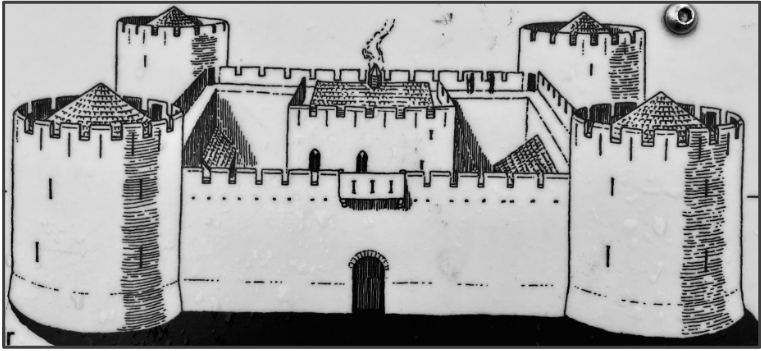
Given the width of the curtain walls (9’), the buttress towers (12’) and the existence of a surrounding moat, the Quin castle construction was a massive undertaking. Another record from the time tells us it was completed in 10 months. He must have had a permanent construction company at his disposal!
This is also the question raised by Robert Newenham Deane in 1882:
“The question, is who built the fortress? It cannot have been built subsequent to 1278 or 1433. The Norman invasion (Henry II.) was in 1171. Can it be possible that so formidable a building, surrounded by a moat, earth works, etc., could have been built and also razed within a century, without a note of its existence being extant ? Discarding this idea as most improbable, we must look backwards to the time of Brian Boru, 1002, and come to the conclusion that the fortress of which we now find the remains in connexion with Quin Abbey was erected prior to the Norman Invasion, thus indicating a period of civilization anterior to 1171, in which military requirements were well known, and stone castles of an important character built.”
Source: Proceedings of the Royal Irish Academy Polite Literature and Antiquities, Vol. 2
Is this a valid observation? We now know that the existing Bunratty Castle was built by the McNamaras, who also are credited with the construction of a network of Tower Houses. The 19th century antiquarians found it difficult to believe that the Gaelic families were capable of such undertakings. Was there cultural blind-spots prevalent on the part of these well respected gentlemen. Did the Royal Irish Academy help to foster what we now know as ‘group-think’ on the part of its learned members?
1304 MacGrath mentions a successful invasion by King Toirdhealbhach of Limerick and Tipperary (MS. copy of the “Cathreim” in the Royal Irish Academy). The context, however, seems to imply that it took place in De Clare’s lifetime. He continues: “Next year the garrison of the towered strong walled castle of Quin, the capital and nursery of the English forces . . . slew O Leideadh.” Other records show the destruction by the MacNamaras of Quin Castle to be in the year 1305.