
1350 Quin Friary was founded by the MacNamaras. Using the solid south curtain-wall of the old castle, they built a church from east to west. North of the church they erected a residence for the clergy and a small sacristy.
1395 The Gaelic lords and chiefs of Thomond formally accede to the rule of the English throne at a ceremony at Magh Adhair.
1402 Sioda Cam MacNamara built the cloisters
1430 The bell-tower and Lady Chapel were erected by Mahon MacNamara. Three years later he sponsored the Franciscan Friars and allowed them to establish their friary in Quin.
1433 Pope Eugene IV granted a licence to the MacNamara’s to place friars of strict observance in this monastery.
1433 The great arch, 24 ft. 6 in. wide, opening into the transept, was made. It is in two orders; the outer chamfered, and tying into the transept wall face at the springing; the inner half octagonal in section carried by a moulded pointed corbel.
1450 The best preserved of the MacNamara tombs is the one north-east of the choir was built. The Latin inscription along the edge of the covering slab beneath the carved stone canopy may be translated as follows: “Here lies Hugh, who was the son of Laurence, who was the son of Matthew MacNamara, and Couleen MacNamara his wife, who caused me to be made”.
1500 Odo(?) MacNamara burial here in tomb
1541 The abbey was officially suppressed by King Henry VIII.
1547 Became O’Brien property. The O’Briens, however, allowed the friars to continue living there. the abbey was granted to Conor O Brien, Lord Ibricken, but he protected the friars, as did his son Tadhg after his death in 1548
1548 The building had fallen into disrepair and was described as “one great church, now ruinous, covered with slate, and a steeple greatly decayed”.
1580 Earliest recorded burial – that of a MacNamara
1583 The monastery with all its possessions was granted to Sir Turlogh O’Brien, of Ennistymon.
1582 or 1583 A garrison of English soldiers was billeted there and that Donnchadh beag O’Brien led an attack on the Abbey and burned the garrison and the Abbey in one great holocaust — an act for which he paid dearly a year or so later.
1584 Sir John Perrot had Donough Beg O’Brien half-hanged from a cart, his bones broken with the back of an axe, and hung, still alive, on the steeple of Quin Abbey. The English forces maintained a barracks in the abbey until a namesake of Donough’s burned it over their heads.
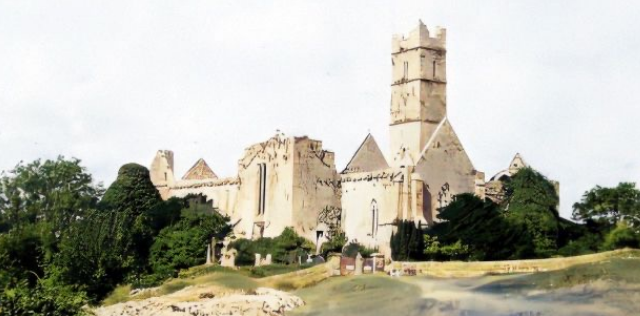
1604 Attempts were made to repair the friary (Comber 2003) The MacNamaras, with some help from other families in the district, repaired the church. The walls had suffered very little damage due to their firmness. The choir and Lady Chapel had been roofed over and the ground-floor apartments made habitable.
1615 John Rider, Protestant bishop of Killaloe, complained in a report to the Royal Commission of that year that many friars and priests were circulating between the various abbeys and monasteries in his diocese and that public gatherings were taking place at such places as Quin Abbey in County Clare.
1616 The roof of the friary had collapsed (Ó Dálaigh 1998, 15)???
1617 The Irish Franciscan Provincial, Fr Donough Mooney, noted the repairs and commented on the two or three friars then in possession as being “old, helpless men with scarcely a memory of the pre-suppression friary”. They told him that the altar plate of gold and silver had been given to one of the MacNamaras of Knappogue for safekeeping. Unfortunately, MacNamara died before he could divulge the whereabouts of the abbey’s altar plate. Father Mooney says that on his visit (the date of which is not given) he found the chancel and transept roofed and two or three friars living there.
1600’s ‘Apartments for Strangers’. Building constructed at west side of friary to house visitors.
1634, June, Br. Michael O Clery was here, methodically making copies of the priceless manuscripts and books in the Library, lest the originals fall into the hands of the English and be destroyed.
1637 the friars were expelled again.
1638, on the 15th of August, the friars were back and held their Provincial Chapter in the Friary, electing as their Minister Provincial Fr. Joseph Everard.
1641 Under the protection of the Confederate army, a college was opened in the abbey, which soon had large numbers of students and was the most prosperous seat of learning in the country. One of these scholars was the historian Anthony Bruodin, together with eighteen members of his family. Of these nineteen O Brodins, one was a youth destined later to become a friar and occupy a prominent place among the famous Franciscans of land-the author of “Propugnaculum Catholicae eritatis,” The school was founded by Eugene O’Cahan (Sgoilteacht).
1644 Antonius Broudinus, a Clare-born Franciscan noted that the school or studium had over 800 students (although this is likely to be an exaggeration-McInerney 2014,204). He was one of eighteen members of his family in attendance at that time.
1647, June, the friars are still in possession of Quin Friary, for the Apostolic Nuncio, Rinuccini, on his way to Galway, visited the Friary. He was received with pontifical honours, “to the joy of almost all the nobility of Thomond.”
1651 The Cromwellians broke into the friary and desecrated it. They shot and beheaded Fr. Rory MacNamara and hanged Fr. Donald Mac Clancy and Br. Dermot MacInerney.
Major William, and Henry Stainer, seized the abbey while the monks were celebrating Mass, and the former attempted to drag the officiating priest from the altar, but the old friar with uplifted arm found time to curse his assailant, and foretell the extinction of his race.
Stainer burnt down the building, and according to one account hanged the celebrant (T. J. Westropp’s “History of Quin Abbey”). The Cromwellians seized the head of the college, Eugene O’Cahan, who they first scourged and then hung. Another of the community, Roger Macnamara, is referred to as follows : ” This friar was a learned professor of the College of Quin Abbey, which his ancestors had built, and was ever a model of a simple and pious man. God determined to reward his piety, and so permitted him to be seized by soldiers, and by them taken to the town of Ennis, where, having refused to abandon his religion, he was first shot and then his head was severed from the body.”
1667 the Franciscans are mentioned again as having returned anew to the Friary.
1670 Fr. Moriarty O’Griffin was named as the guardian.
1681 The abbey was reported empty. Dinelys sketch shows the transept roofed and the huge metal crosses still on the gables. He notes it was lately “harbouring some friars of the Order of St Francis.”
1691 the friars had returned again when the cavalry of the defeated Irish army camped around the walls.
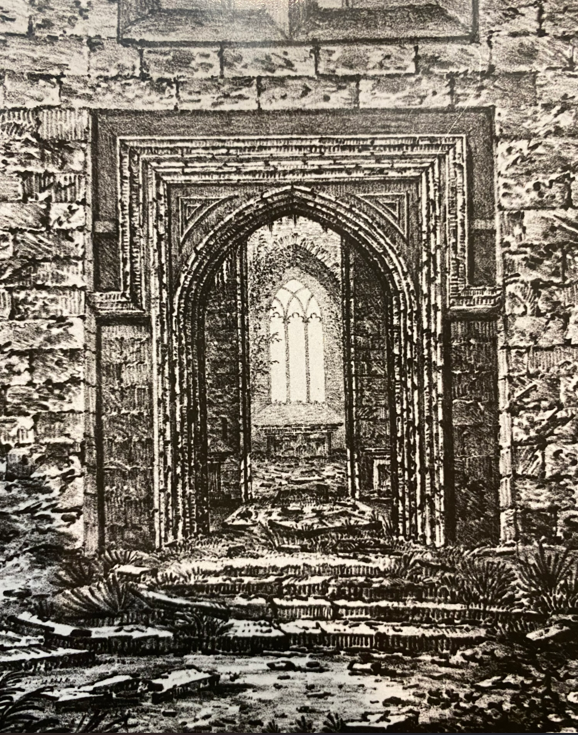
1714 Inserted under the canopy is another slab which states that Captain Teigue MacNamara repaired the tomb.
1740 Bishop Pococke (Richard, Protestant deacon and antiquarian) described it thus: “Quin is one of the finest and most entire monasteries that I have seen in Ireland”
1760 The friars were expelled again but remained in the townland of Drim, a few miles away. One friar, however, continued to live in the abbey ruins. Other friars succeeded him.
1808 The monastery was reported to be in much the same condition as Pococke had found it in 1740 but greatly disfigured by the custom of burying within its walls (Dutton: Statistical Survey of Clare)
1817 Mr. Trotter, who visited it, says, “We were astonished at beholding it. Quin-abbey is one of the most perfect ruins in Ireland, and of wonderful beauty. Its tower, cloisters, and aisles deserve great attention. There we saw an incredible quantity of bones and skulls, long blanched by Time’s resistless hand-they were piled in great quantities in the abbey.”
1820 The last friar of Quin, Fr John Hogan died, his tombstone lies at the north-east corner of the cloister walk.
1880 The Board of Public Works took over the abbey as a national monument.
The Lady Chapel is the last resting place of John “Fireball” MacNamara. He was the last of the MacNamara chieftains, a direct descendant of the men who built this abbey. They too were buried here.
Below: Henry Pelham’s 1787 lithograph drawing showing the derelict friary and adjacent buildings.