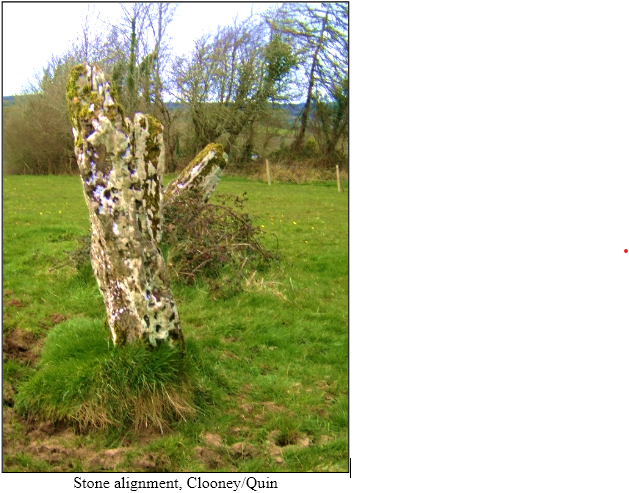
In this short essay I am stepping outside our usual parish bounds to bring attention to the enormously rich cultural and archaeological landscape east of the village, from Ballykilty to the Broadford Pass.
The Bronze Age in Ireland began about 2200 BC and continued through a series of phases to about 600 BC when iron became the dominant metal for future development. It could be argued that the Bronze Age might as also be described as the Copper Age, (the Chalcolithic period, so named), that preceded the Early Bronze Age. Copper was one of the two main constituents of the alloy bronze (the other being tin – mostly imported from Southwest Britain). Ireland was fortunate in having two areas of rich copper concentrations – at Mount Gabriel in Cork and Ross Island in Kerry, that were exploited during the middle portion (1500-1200 BC) of the Bronze Age.
Workable copper mines were scarce during the Bronze Age, with the closest working mines outside Ireland being in Austria. Only a relatively small amount of the total estimated copper mined in Cork and Kerry has been accounted for at home. There are many samples of Irish copper found, for example, in Britain, suggesting an active trade exchange (O’Brien, 1995).
Metallurgical advances provided one part of the catalyst for change, there were others, A growth in the population in the late Neolithic and an increase in bog cover, due in part to land degradation and an increasingly wet climate. This led to a movement away from the traditional higher living grounds favoured by the Neolithic people to the lower lying forested areas, around the beginning of the Early Bronze Age.
In Clare, the north of the county was highly populated during the Neolithic period but soil erosion from overuse of the land and possible population pressures led to a slow but significant movement off the Burren. While the principal focus for the migrants appears to have been in the Lough Gur area of Limerick. Others moved to the soil-rich woodland/estuarine areas around the lower Shannon basin in south-east Clare. The wooded areas here, overlooked by low hills, with a small lakeland district and some wetlands was ripe for land clearance and subsequent farming.
A land use system that permitted mixed agricultural activities throughout the year was possible in southeast Clare, once the trees were cleared utilising newly manufactured bronze axes and palstaves. This system might have included the growing of crops on hillside terraces and the grazing of cattle on grassland slopes and river meadows. Foraging for wild plants and wood and hunting game in the surrounding forests were undertaken (red deer are still present locally) while keeping cattle within safe distances of settlements in winter (wolves were still plentiful). Remains of wooden platforms, such as that at Island Magrath, suggest either fishing activities or at least access to boats, as rivers became important lines of communication and trade (O’Sullivan and Condit, 1995).
There is evidence from the pollen record of significant woodland clearance for agricultural in the region. Identification of 912 monuments in the Sites and Monuments Record (SMR) for southeast Clare provides further evidence for a high level of activity during the Bronze Age (Grogan and Condit, 1994). This was the region surveyed by the Discovery Programme on the north side of the Shannon River between 1992 and 1995.
As well as monuments, Bronze Age artefacts are recorded across southeast Clare. These include remains of pottery, riverside structures, dugout canoes, axes and axe moulds, beads, weapons, saddle querns and metal hoards (Grogan, 1995).
In an age of transition, as well as changes in territories and technologies there are also indications of change in social and power structures. There seems to have been a political shift whereby the autonomy of smaller local communities was subsumed into larger communal hierarchical structures, presenting wider responsibilities and identities.
Three significant ceremonial enclosures from the Early/Middle Bronze Age are noted at Coogaun, Knapoge (Knappogue) and Ballykilty suggesting the beginning of a shared community focus and a growing wealth base. (Grogan and Condit, 1994). The wealth may have come from control of important materials, or levies for safe passage to and from the Shannon River (Grogan, 1996).
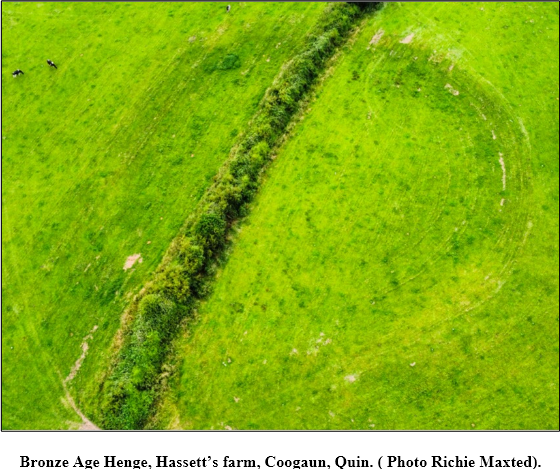
In the Late Bronze Age, southeast Clare appears to have had a well-defined and populated territory. Twelve clusters of farmsteads have been identified, of middle and lower social ranking, with a crannog or a hilltop enclosure, for community protection. At the centre of this territory stood the high-status hillfort of Mooghaun, a structure that could only have been achieved by huge collective effort and the presence of an elite class. Chiefdomship had firmly arrived in the lower Shannon basin (Grogan, 1996).
Below is a map of Mooghaun and the landscape emanating from the hill. It contains a large amount of typical Bronze Age artefacts that could only have come about from long-term occupation of the area.
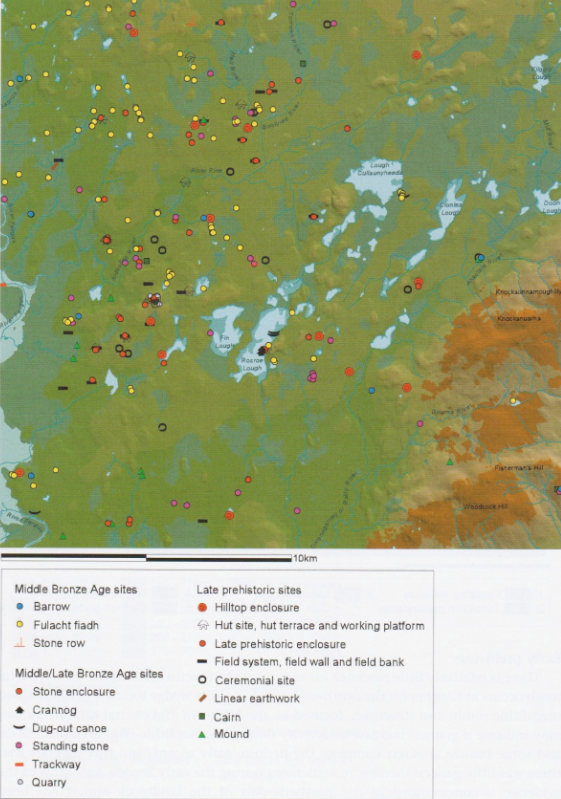
Source: Eoin Grogan, The North Munster Project, The Discovery Programme, Monograph No. 6, Page 92, Wordwell Ltd., 2005.
Knocknalappa, a man-made island home or crannog was constructed on a high point extending into Rosroe Lough, to the east of Mooghaun. It had two phases of building – the first was the erection of a wooden platform and support stakes around 1900-1700BC utilising a pre-existing midden mound (Raftery, 1942), while the second phase consisted of the addition of stones and timbers around 1000-850BC.
No sign of a hearth was found, making it uncertain if this was an occupation site, though this was probably the case. Findings at the site included a bronze sword, a bone knife, polished axes, a bronze sunflower pin, some interesting pottery shards and beads and bracelets. A significant range of animal bones was found.
Near the crannog were some typical Bronze Age monuments, including an example of the ubiquitous Bronze Age fulachta fiadh, a wedge tomb, and a bivallate enclosure. In the social hierarchy of southeast Clare, Knocknalappa is considered a middle-ranking site, perhaps the residence of a secondary chief. It was a reasonably complex site that appeared to enjoy wealth judging by the riches of its remains and had in its vicinity some typical Bronze Age structures to complement living. It was firmly set within the clan territory and had a view of the community hill fort of Mooghaun.
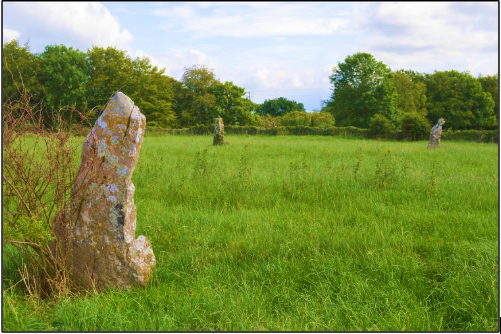
Left: Standing Stones/Cursus at Knappogue, Quin.
Mooghaun itself was the centre of political power in southeast Clare in the Late Bronze Age (950BC). Built on a prominent hill it consists of three stone ramparts, containing an estimated 500,000 tons of stone, encircling 23 acres. An astonishing feat in any age. It is as it was intended – awe inspiring.
While the three stone ramparts suggest a defensive role, the huge, enclosed area was impractical for meaningful resistance against an enemy. The fort was likely built to promote the status and wealth of the clan and its chief and to serve as a focus for the local B.A. community. Within the fort there appears to have been fewer living quarters than might be expected, suggesting that it was the home of some of the clan elite, perhaps the chief and his immediate kin. Most likely it was also used for important clan gatherings and ceremonies.
Three phases of activity have been recognised in terms of Mooghaun hillfort – an earlier Neolithic phase, the Bronze Age building/occupation phase and a post construction phase. It was during these excavations that the outer rampart, long covered in overgrowth, was re-established.
The entrances to the three ramparts and some of the enclosed circles were found to be of different orientations, hinting at maximising the effect of the fort on a ceremonial or political level. Surprisingly there were few artefacts found in the excavations inside the fort. Some chert, flint flakes, arrowheads and a bronze rivet and waste made up much of the extent of the findings (Bennet and Grogan, 1992).
However, Mooghaun had revealed its wealth in an earlier century when in 1854 while digging the new narrow-gauge Limerick/Ennis railway the workmen came upon a cavity to the west of the fort at Ballykilty that contained one of the richest Bronze Age gold hoards found in Western Europe.
The hoard consisted of many gold armlets, bracelets, gorgets, torques, cloak pins and other ornamental items, possibly numbering close to 200 in the initial find. 146 items were in the hands of the Royal Irish Academy but after casts were taken all but 29 of the original objects were melted down or otherwise went missing (Armstrong, 1917).
There were other hoards of Bronze Age materials found in southeast Clare. These include the Enagh West hoard, near Kilkishen, of mainly bronze tools including axes, socketed knife and chisels. The findings at Knocknalappa have already been discussed. Beneath a slab at Gorteenreagh, near Feakle, were gold ornaments of what was once a private stash including an interesting gorget, bracelets and cloak pins. The discovery of graves and an industrial metal site at Ballyconneely near Newmarket indicated a large local population and extensive use of bronze.
Four seasons of digging in the late nineties (1992-1995) as part of the North Munster Discovery Project, have added enormously to the available information on the territory.
Below is a list of the major artefacts identified in the Mooghaun area:
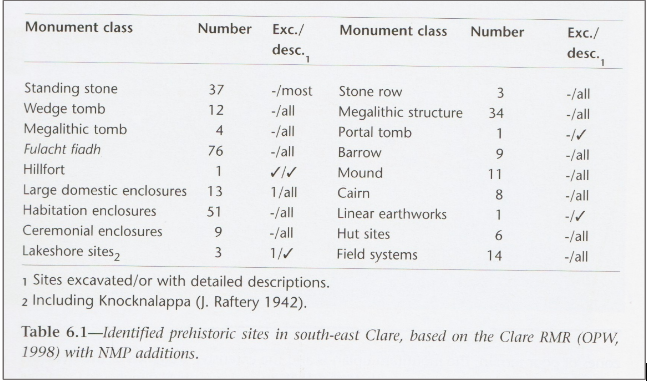
Source: Eoin Grogan, The North Munster Project, The Discovery Programme, Monograph No. 6, Page 93, Wordwell Ltd., 2005.
Clearly southeast Clare and the immediate area around Quin was a vibrant, successful and wealthy territory for much of the Bronze Age period and contains a rich archaeological inheritance for future exploration and interpretation. We should do more to promote it.
MH
April 2026
Sources:
Armstrong 1917, The Great Clare Find of 1854, JRSAI, vol. 47.
Bennett and Grogan, 1992, Excavation at Mooghaun South, County Clare, Discovery Project Preliminary Report.
Grogan, The North Munster Project, The Discovery Programme, Monograph No. 6, Wordwell Ltd., 2005.
Grogan and Condit, 1994, The Later Prehistoric Landscape of South-east Clare, The Other Clare vol. 18.
Leonard, Katherine, Ritual in Late Bronze Age Ireland – Material Culture, Practices, Landscape Setting and Social Context, 2014
O’Brien, 1995, Ross Island and the Origins of Irish British Metallurgy in Ireland in the Bronze Age, The Stationery Office, Dublin
Raftery, 1942, Knocknalappa Crannog, Co. Clare, North Munster Antiquarian Journal No. 3.