by Siobhán O’ Sullivan

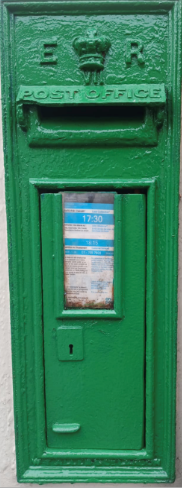
Left: The Post Box on Main Street Quin Village

An interesting part of Ireland’s street heritage are its post boxes. Modern post boxes were introduced into Britain in the 1850’s, and Ireland ‘inherited’ the same style, being part of the British Empire. We did not have a separate postal identity.

Sending letters in the 1840’s was expensive and difficult as the charge depended on the distance the letter had to travel and the route used. Letter writing was mainly confined to business, government, landlords and merchants.

A cathartic moment occurred with postal reform in Britain when in 1840 the ‘Penny Post’ was introduced across the United Kingdom. It was so-called as it was a standard price of ‘one penny’ for a letter up to a certain weight, it didn’t matter what distance it was covering. Letter writing became affordable for almost everyone. Families separated by work or emigration could now stay in touch. Often in a village, not everyone received an education and therefore they often chose one person to write or read the letters and in Quin, this was Fanny Corbett’s husband, Pat.

The system of delivering letters in rural areas was typically by ‘walking postmen’ who walked long routes of up to twenty miles daily or several times a week, delivering from rural post offices to homes, in hail, rain or snow. They also collected ‘outgoing’ letters and brought them back. The rural postman was a welcome sight as they brought the news of the village, be it a birth a death, or a welcome emigrant’s letter. They often sat and had the cup of tea as they imparted their joyous or sad news in equal measure.

Mail coaches and railway made delivery faster. When Ireland became independent in 1922, thousands of cast-iron British post boxes across the country were still in use. They had been installed when Ireland became part of the United Kingdom and were painted the familiar British pillar-box red. They carried the royal cipher of the monarch in power at the time, with a Crown on top.

The ‘ER’ on old green post boxes stands for Elizabeth Regina’ which is Latin for Queen Elizabeth. But one may also see ‘VR’ – Victoria Regina (Queen Victoria) The ‘R’ stands for ‘Queen’.

ER VII Edward Rex V11 (King Edward V11)

GR – George Rex (King George)

After securing independence, the Irish Government decided to repaint the red British post boxes green rather than removing and replacing, it was like a statement acknowledging the break from the Empire. Therefore, the royal insignia has remained – a gentle reminder of the subjugation.
William Marshal was the son-in-law of Richard de Clare, who we know of as Strongbow. Through marriage to the daughter of Aoife, daughter of Diarmuid MacMurrough, Marshal inherited vast tracts of land in Leinster. His wife was Isobel de Clare.


What did he ever do for us?

Marshal left his mark on the eastern side of the country through castle ruins at Ferns (home of the MacMurrough’s), Carlow, Kilkenny, Laois, amongst some others abroad. Most of his castles were built as four towered Keeps, in the same way as Quin Castle, built much later by Thomas de Clare. To re-imagine what his ancestor built in Quin, let’s look at what’s still extant elsewhere in Ireland.


Left: The marriage of Strongbow to Aoife. The painting depicts the 1170 marriage of the Norman knight Richard de Clare, 2nd Earl of Pembroke (“Strongbow”) to the Irish princess Aoife Ní Diarmait in Christ Church Cathedral, Waterford. It is portrayed as a pivotal moment in the Norman conquest of Ireland and the death of Gaelic Ireland.
In the foreground are the bodies of dead Irish warriors. To the left is a broken-stringed Celtic harp. Richard stands on a broken high cross.


Ferns Castle, Wexford

This castle was built on the site of the original MacMurrough clan seat of power to secure control of the region for William Marshal. The local Gaelic clans eventually burned them out in 1346, a faith very similar to that of Quin Castle. The Kavanaghs were then in control until 1540.

Carlow Castle, Carlow

Carlow Castle belongs to a small group of early stone castles known as four-towered keeps. These castles exhibit a rectangular or square design with cylindrical drum towers at each corner and cross-shaped arrow loop windows.

Excavations conducted in the 1990s revealed that the original structure was two storeys high, with some outer walls extending above the roof level. The castle walls measured 2.7 meters in thickness (as per Quin Castle) and rose from a battered plinth. The floors and roof were constructed from timber, with stone staircases embedded within the walls, providing access to the upper levels and roof. The entrance to the castle was located at first-floor level, accessible via a doorway in the north wall.

So what might Quin Castle have looked like?

We have other examples of Anglo Norman castles with round bastions, or towers supporting adjoining walls. Trim Castle, built by Hugh and Walter de Lacy, or Roscommon castle built by Robert de Ufford are of different footprint shape but otherwise similar. We know only that King John ordered the building of a castle in Limerick.

View from outside and inside a typical Norman Keep Castle


A previous attempt at recreating an image of Quin Castle was made by local architect, the late Frank O’Meara. As can be seen from this drawing, it is not dissimilar to what appears above in this post.


Left: Drawing by Frank O’Meara, courtesy of Ann McNamara Lawlor.

Is there a role here for AI?

Artificial intelligence may be useful and of course is improving all the time. Below is an attempt at availing of this tool to produce an image of Quin Castle surrounded by An Anglo Norman village. The moat and River Rine may not have been as wide as shown here:

We would welcome any input that readers would like to make to this exploration. The end result will help the visitors to our village gain a much better appreciation of what they are experiencing when they come here. Additionally, it will add Quin to the list of projects that will be undertaken next year as part of a broader European celebration.