
Know your Townland – Deerpark/Páirc na bhFianna
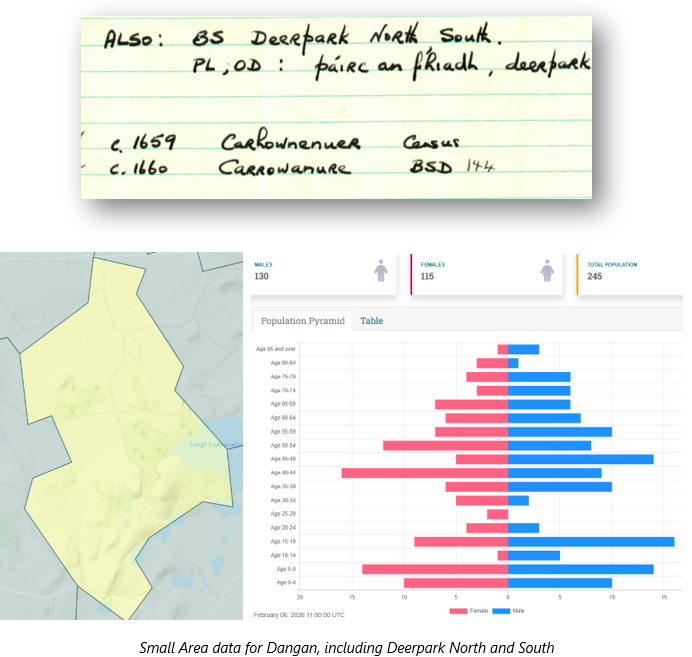
Both Deerpark North and South were part of what was known historically as Ceathrú an Iúir. (Ceathrú – quarterland, iúr – yew-tree). It was first recorded as Deerpark North/South in 1839. From 1580, when the first written records become available, until then, it appears under different English spellings of Carhunanure or Carrowanure. Deerpark is a generic name introduced by the landed gentry to describe areas where they contained their own stock of fallow deer as a permanent supply of venison. The placename is numerous in Clare and beyond and is easily confused during research with Deerpark in Doora.
Deerpark North/Páirc na bhFianna Thuaidh
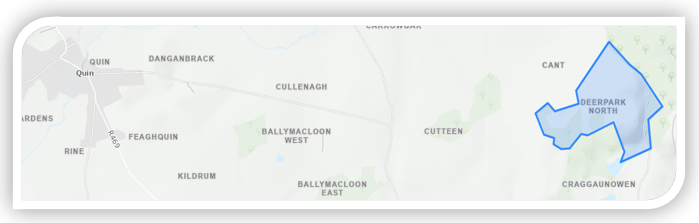
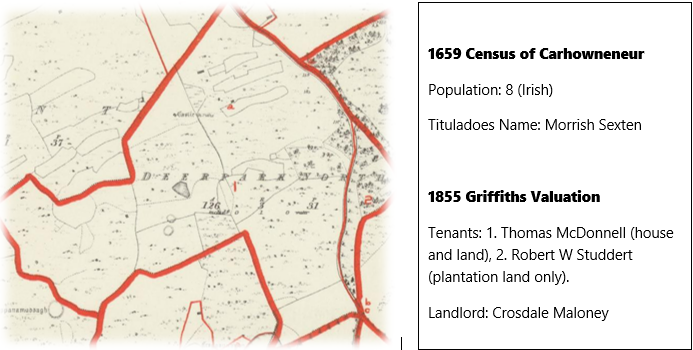
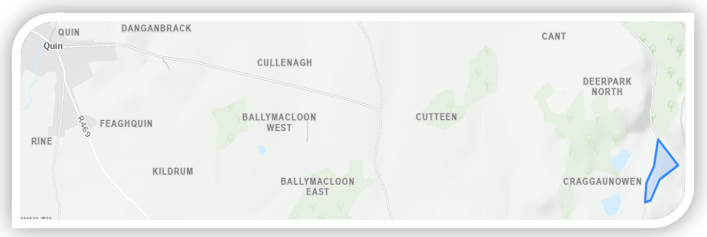
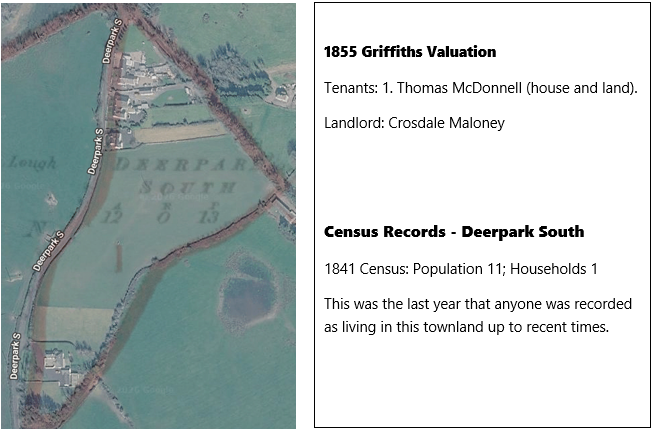
Squeezed between Craggaunowen and Cullaun, Deerpark North, devoid of population, is almost entirely forested. The smaller Deerpark South, at only 13 acres, is now the more populated of the two with five or six families now residing there.
Census Records – Deerpark North
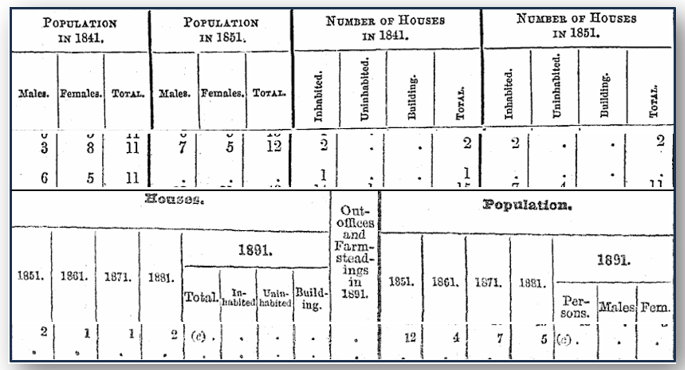
1841 Census: Population 11; Households 2
1851 Census: Population 12; Households 2
1861 Census: Population 4; Households 1
1871 Census: Population 7; Households 1
1881 Census: Population 5; Households 2
This was the last year that anyone was recorded as living in this townland. The enumerator reported that it was uninhabited in following surveys. See below:
1918 Redmond Fund:
Patrick Devanny and Morgan Fahy are listed with an address at Deerpark, Quin. Since neither census in 1911 and 1926 return any residents for either Deerpark townland, these may be land holders only.
National Monuments
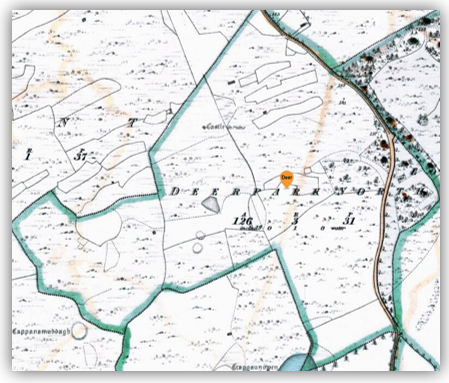
Castle CL043-017002: Situated in a gently undulating field in pasture. Named ‘Castle (in ruins)’ on the 1st edition OS 6-inch map and ‘Castle (site of)’ on the 1922 edition with hachures indicating the mound on which it stood. Known as Cullaun Castle, Cullaun townland and Lough Cullaunyheeda lying immediately to the E. Few historical details are available but it was apparently built by either Seán or Eoghan McNamara (Ua Cróinín and Breen 1997). Murrough O’Brien, in his will of 1551 leaves the castle of Cullaun to his son Donough O’Brien of Lemeneagh Castle (ibid.). By 1618 the castle was in ruins and had passed to his third cousin Donough O’Brien, 4th Earl of Thomond. An inquisition of that date records Donough conveying to ‘Maurice Mulconrey and his heir, the ruined castle and lands of Cullane…’ (ibid.). On inspection in 1992 extensive land reclamation was taking place and a large part of the mound had been destroyed. Large quantities of stone from the mound had been piled up, including quoins, window jambs and a sill stone with a pivot hole (SMR file). In 2004 a large chunk of mortared masonry (possibly portion of a collapsed ceiling vault) was noted on site and the mound was described as 15 in diameter and 3m high (Ua Cróinín and Breen 1997). On the same occasion a chisel-dressed stone was noted in a nearby wall. An inspection in 2019 found that all the above loose stone had been removed and a largely grassed-over mound remained.
Courtesy of Mary Tully, NMS
CL043-015 & CL043-016: Enclosures. CL043-113 megalithic tomb/wedge tomb.
A note on the function of deer parks
In the later medieval, the aristocracy preferred parks that were next to or close to their residences. By reserving large areas of land for their own use, elites made conspicuous statements of their high privileges to others. Designed to keep intruders out and animals in, park boundaries usually comprised inner ditches and outer banks surmounted by a palisade or wall. They usually contained a mixture of woodland and grazing pasture, and often included features such as fishponds, rabbit warrens and hunting lodges. Although a Norman introduction to Britain in the 13th century, the evidence of its later introduction here by the British is still to be found close to their former demesnes.
Deerpark South/Páirc na bhFianna Theas
Sample Petty Session Court Cases for residents of Deerpark
Martin Collins June 16th 1899, sale of pigs on public road.
Some Baptisms in Deerpark in 1800’s
December 1834 Bridget Murphy, born to Pat Murphy & Mary (Clune).
Witnesses Michael O’Brien, Ann Corbett.
May 16th 1868 Michael Meehan, born to Pat Meehan & Kate (Quin).
Witnesses Michael Strafford, Mary Strafford.
November 8th 1869 Martin Meehan, born to Pat Meehan & Kate (Quin).
Witness Mary Lillis.
Closing Comment
As it stands, the placename recorded in logainm.ie, the designated authority (and website) on these matters, is Deerpark/Páirc na bhFianna. Should not the original Gaelic name, Ceathrú an Iúir, be retained rather than the direct translation of the generic Deerpark. This practice has been undertaken elsewhere including the nearby Newmarket-on-Fergus.