
William the Conqueror – from the Battle of Hastings 1066… to Quin 1279
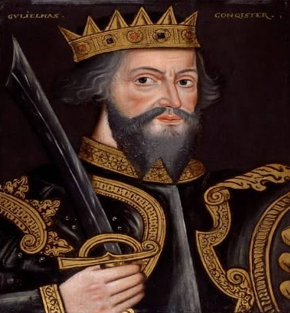
In 1066, William, Duke of Normandy, crossed the English Channel and changed the course of European History. Almost a century later, the Norman story would reach Ireland – and eventually Quin.
His Story
In 1035, as a child of 8, the title ‘Duke of Normandy’ was bestowed upon him due to his father’s death. The authority of a young Duke was not readily accepted by the powerful nobles, however as time passed, he extended more control over Normandy.
He married Matilda of Flanders and two of their ten children, William 11 and Henry 1, would later become kings of England.
So why did he invade England in 1066? In January of that year, the English King Edward the Confessor died without an heir. Harold Godwiser became King – but William claimed that Edward had promised him the throne and claimed that Harold knew this – Harold disputed same! In anger William gathered a huge invasive force in Normandy – thousands of soldiers and horses were assembled and brought across the Channel in ships.
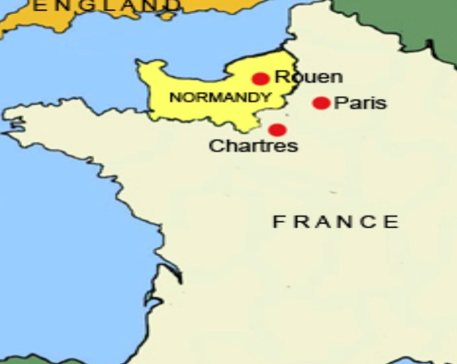
William the Conqueror’s story begins in Normandy France 1027
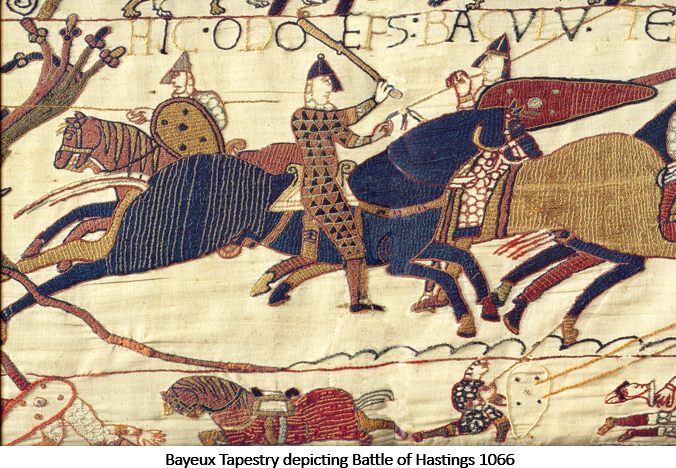
October 14th 1066, William’s army met Harold’s at the Battle of Hastings. William had archers, armoured cavalry and infantry, whereas the English fought behind a wall of shields. The battle lasted but a day – Harold was killed and the English Army collapsed. The Bayeux Tapestry is the most important visual source of this campaign.
William was crowned King of England on Christmas Day 1066. He set about redistributing enormous tracts of land to his Norman followers. They built castles throughout England and his Norman aristocrats replaced many of the English elite.
He commissioned the ‘Domesday Book’ which was an extraordinary survey of land and property across much of England. He needed to find out who owned land, and how much wealth every person had, so he could tax them accordingly. His armies confronted many rebels and caused extensive suffering.
William never set foot in Ireland, but he created the Norman political and military world from which the later Norman expansion into Ireland emerged. The Norman arrival into Ireland 1169, began 80 years after William’s death with the arrival of Richard de Clare (Strongbow). His Norman followers expanded into Thomond, which ultimately led to Thomas de Clare laying the foundations of a large castle and medieval village at Quin in 1279.
By the 13th century, the ambitions of the Norman de Clare family had transformed the landscape and left a remarkable medieval legacy that can still be read in the landscape today. But the Norman advance into Clare was not unstoppable. In 1318, at the Battle of Dysert O’Dea, the forces of the O’ Deas and their allies defeated the Anglo-Norman army led by Richard de Clare. It was a decisive moment and brought an end to Norman ambitions in the region.
It is a story that began in 1066, when William the Conqueror set in motion the Norman expansion that would eventually reach Ireland – and ultimately, Quin.