Village Heritage Walk
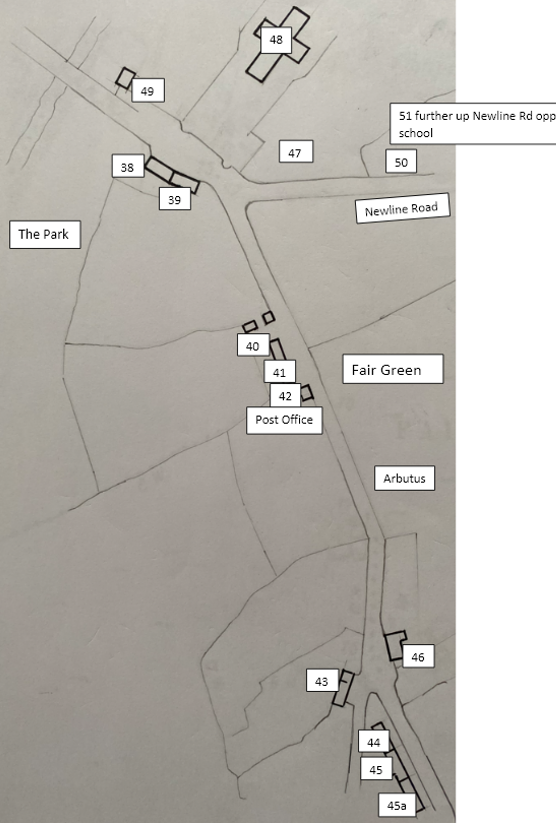
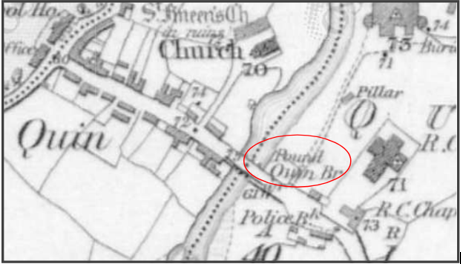
This guide to the Village Heritage Walk is intended to provide a brief description of significant village features. More comprehensive details can be found elsewhere, but we hope the collective outline will give a good appreciation of the valuable heritage that is in danger of being over-looked. It covers only those elements of our ‘built heritage’ to be found on or accessed from the Main Street. Where a numbered building, shown on our village map, is described, we include the number for ease of location. For ease of location, we have divided the village into north and south of the river. We hope you enjoy the collection of photos and information included. We are open to correction or improvement and welcome feedback from the community.
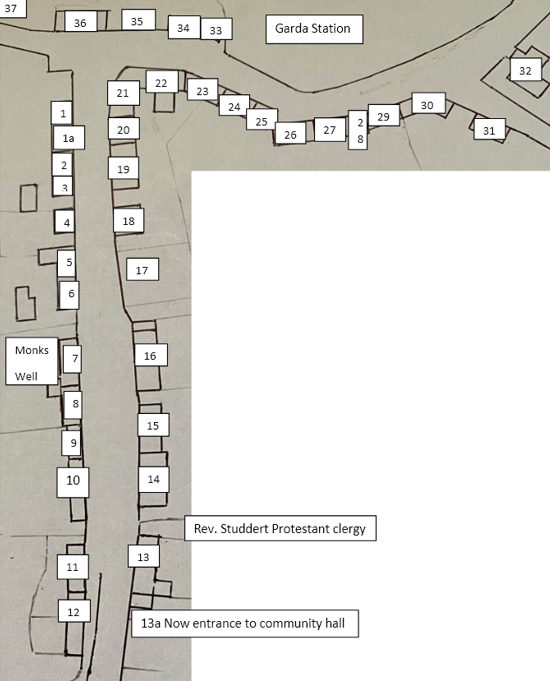
The numbering system used here is our own. These can be cross checked from the map to the list. Information is drawn from Griffiths Valuation, 1901 & 1911 census, local knowledge and written records for the 1940’s.
We will start off at the Quin Cross end on the village (north end) and cover the lower end of the village further on in this post, beginning with Quinville House and townland.
Please check against the information set out below.
| 1855 | 1901 | 1911 | 1940’s | |
| 1 | Elizabeth Clune | John Clune | John Clune |
Jim Johnny Clune-carpenter 1a dispensary (both now Mike ‘Parnell’ Clunes house) |
| 2 | Anna Maria Hewitt | O’Dea? | O’Dea? | No information on this |
| 3 | Margaret Normoyle | O’Halloran Post Office | Paddy O’Halloran | Paddy O’Halloran, now Pauline O’Hallorans. |
| 4 | John Hayes | Band Room, now Chambers house | ||
| 5 |
XXX |
Willie ‘Johnny’ & Catherine Clune, now Quinlivans house. | ||
| 6 | XXX | Maggie Clune (Justice Hurley rented after she died). Since demolished and part of Quinlivan garden. | ||
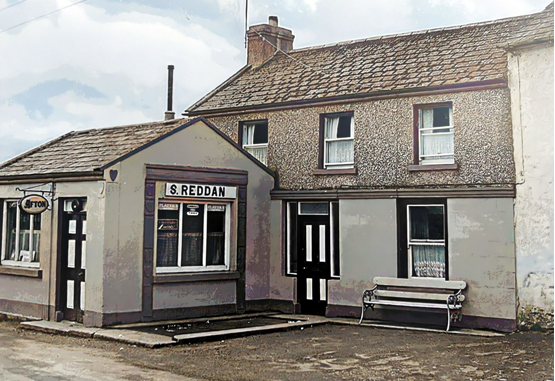
| 7 | Bridget Lawlor | Maria Reddan’s pub* | Powers pub, now Monks Well | |
| 8 | John Meade | now Mike & Ann Corbett’s home | ||
| 9 | Ellen McMahon | Was Corbett’s shop |
| 10 | Michael Corbett | Patrick/Fanny Corbett, | ||
| 11 | Bryan Daffy | Carrigs | Carrigs | Laoise Carrig music teacher inherited from Nora and Tom Carrig, now vacant Chinese Restaurant |
| 12 | Patrick Corbett | Patrick Corbett |
Dan Baker family 1930/40’s. Later purchased by Marlborough family |
|
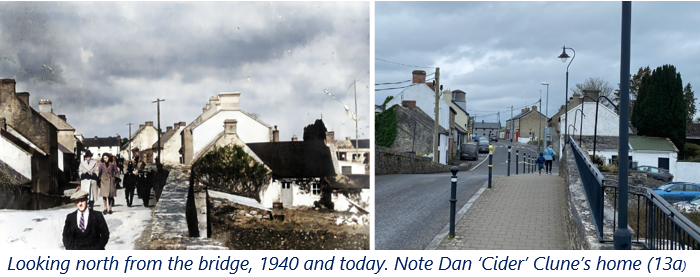
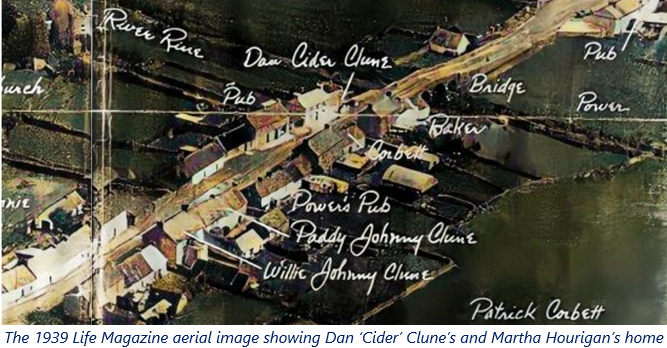
| 13a | Thomas Creagh | Dan Cider Clune (pork butcher), now FAS shed | ||
| 13 | Eliza McGuinness | Murty Carrig’s, worked in Quinville as land agents clerk | ||
| 14 | Michael Carmody | Catherine Carmody | Catherine Carmody? | Lynch’s Bridge House Pub, originally protestant church stables |
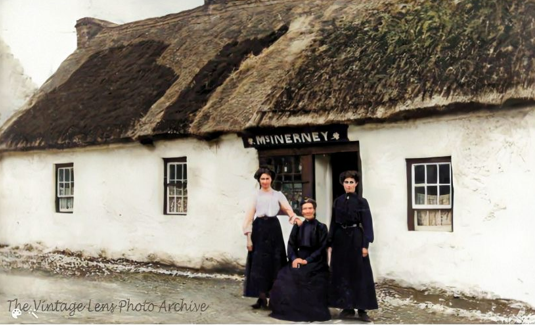
| 15 | John Meade | McInerney’s pub | McInerney’s pub | McInerney’s pub, site now part of Marlborough garden |
| 16 | James Crowe | Thomas Crowe | Thomas Crowe | Tommy Crowes shoemaker, later Leydan’s |
| 17 | Timothy Dolaghty | XXX | XXX | Hay Barn only on site? |
| 18 | James Hurley | Walsh Postman? | Walsh Postman? | Mrs Heffernan’s sweet shop. Denis Hallinan – butcher? |
XXX building not extant at this time
| 19 | Vac/JM | Sammon | Sammon | Johnno Sammon postman/William Sammon |
| 20 | Vac/JM | Michael Droney | Michael Droney | Paddy & Mary Droney |
| 21 | Cornelius Hourigan | Frank Clune | ||
| 22 | James Moylan | Michael Moylan? | Matt Clunes Pub | |
| 23 | Vac/JM | Cannot determine | ||
| 24 | Michael Cody | Cannot determine | ||
| 25 | Francis Lynam | Cannot determine | ||
| 26 | Denis Lynch | Mrs Crotty | ||
| 27 | Margaret Connor | Paddy Clune/Hugh McFadden/Mrs McFadden? | ||
| 28 | Patrick Moylan | Evelyn O’Briens? |
1917 recorded residents of Quin village: John Halpin, Michael Nevin, Katie Markham, Thomas O’Loughlen
| 29 | Martin Magrath | Gerry & Mary Kate Carmody shop | ||
| 30 | Martin Magrath | McGrath | McGrath | Post Office (McGrath’s) later Gaffneys then Henchys* |
| 31 | Denis Nash | Moynihan? | XXX | |
| 32 | RIC Barracks | Doherty | Peters | Dan ‘Cider’, then Stephen ‘Johnny’ Clune |
| 33 | Francis Leonard | James Sexton | Alice Sexton | Nurse Clune midwife shop |
| 34 | Grand Jury Court | Court House | Cannot determine | |
| 35 | Patrick Markaham | Michael Clune | Michael Clune | Jim & Nonie ‘Bow’ Clune pub & butcher |
| 36 | John Reynolds | Patrick Clune | Patrick Clune-carpenter | Jim & Josie ‘Cider’ Clune small shop |
| 37 | Cornelius Halloran | XXX | XXX | XXX |
Quinville townland and House
This was originally one townland called Poll an Ghearráin (Hole of the Geldings). The townland retained its original name until the Manor House was built. ‘Quinvill’ was for the first time recorded on Henry Pelhams map of 1787 and the townland was subsequently named after the big house. This house was in the possession of the Singleton family for many generations. Henry Pelham, a surveyor/engineer was the second husband of Sarah Singleton Copley of Quinville Abbey and would have spent much time at the house.
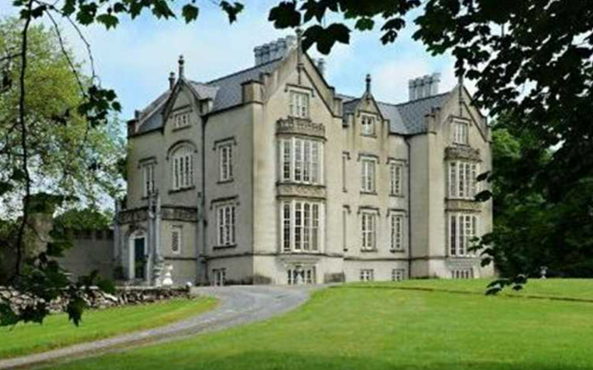
Hugh Singleton was the county magistrate while his son, John, was a Justice of the Peace (JP) and High Sheriff of County Clare. John was also a large landlord with estates not only in Quin, but also in West Clare. He had commissioned the renovation of Quinville House in 1828 and the house was notable for the Elizabethan style.
The Pain brothers redesigned the mansion, on a commission from John Singleton, so that the windows of all the major rooms face south, opening out onto a vista stretching down to the village and Quin Abbey. The Pain brothers were two innovative architects who had designed nearby Dromoland Castle for Lord Inchiquin. It is described, by those in the know, as having a ‘neo-Gothic-cum-Elizabethan appearance’.
The Singleton family would continue to reside in this house until the early 1900s. The Ivers family are resident there in the 1901 census. It was eventually sold the house to the McCauslands from Derry. Major Marcus McCausland sold the property to an American, Mr John Burke of California. Quinville then passed to another American, Dr Chapin. His wife, Mrs Chapin, was the eldest daughter of the late 16th Baron Inchiquin of Dromoland Castle.
The property came into the possession of the Ennis based solicitor Desmond Houlihan and his wife Helen, who completely refurbished it in 1999. After 20 years, this couple put it on the market in 2012 following which it sold to a Dublin based family.
More information can be found on our website: quinheritage.ie then use the search option.
RIC Constabulary Barracks (32)
The new RIC barracks was opened on 27th November 1848 and remained active until July 1916.
It replaced the original barracks situated where the Abbey Tavern pub restaurant is now. John Singleton of Quinville Abbey, a member of the county Grand Jury and Justice of the Peace, seems to have been much concerned about ‘White-boy’ outrages, as noted in his diaries. The growing assertion of agrarian rights at this time eventually resulted in many landlords transferring their land to former tenants with a consequent decline of many estate holdings. Quinville Abbey and the land holdings of the Singleton family would succumb to this also.
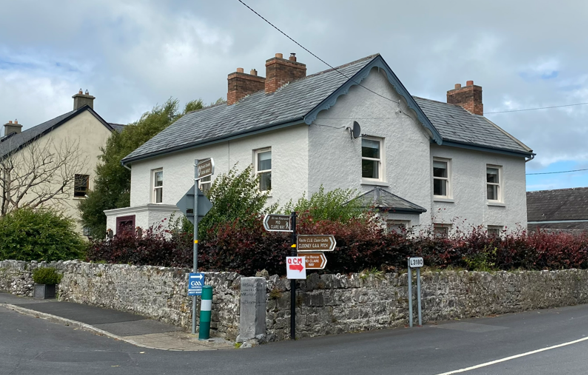
This building was purchased by Daniel Clune in 1917. It was re-sold and was the home of Stephen ‘Johnny’ Clune from 1932. His son Conor Clune grew up in this house and went on to author a book ‘The Clunes, from the Dalcassians to Modern Times’.
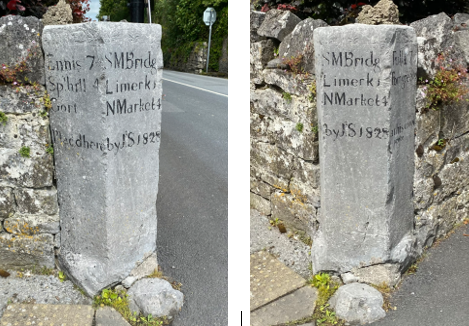
The village ‘Milestone’
Freestanding cut-limestone milestone, dated 1828, on a square plan. Inscribed: “Ennis 7½ Sp’hill 4 Gort [?]”, “SM Bridg [destroyed] Limerick [destroyed] N Market 4”, “Tulla 7 Tomgreany [?]” and “Placd [sic] here by J.S 1828 at his own expence [sic]”. The “J.S” is presumed to be John Singleton (1793-1877) of nearby Quinville Abbey and the stone, its upper margin showing foliage in low relief, may have been left over from the reconstruction of Quinville House.
In this 1954 photo of the north end of Quin, taken from outside the Garda barracks, we can see the typical single storey thatch cottage prevalent along that side of the street up to that time. The water tower did not appear on the horizon until c1965.
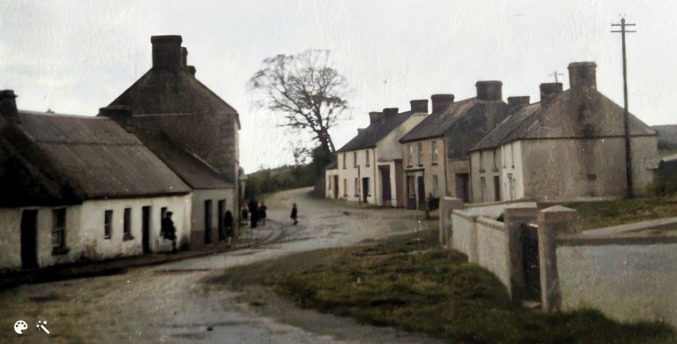
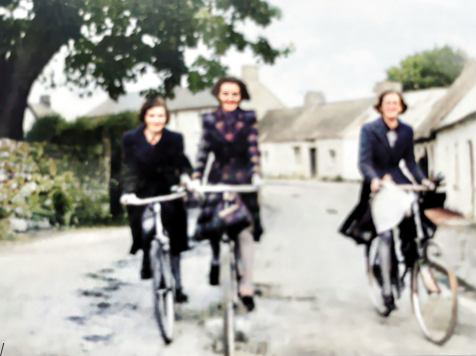
Left: Kitty Chambers, Nancy Cooney & Peg Markaham having passed Mary Kate Carmody’s (approaching Quin Cross) in the 1940’s.
Garda Barracks
This Garda Station was built sometime in the late 1940s and was active for about 60 years. Harry Shally was probably the last Garda to operate it as a community facility. It was used or opened intermittently when he retired in the late 1990s and eventually shut its doors completely in the early 2000’s. We hope to see this situation change sometime in the near furure.
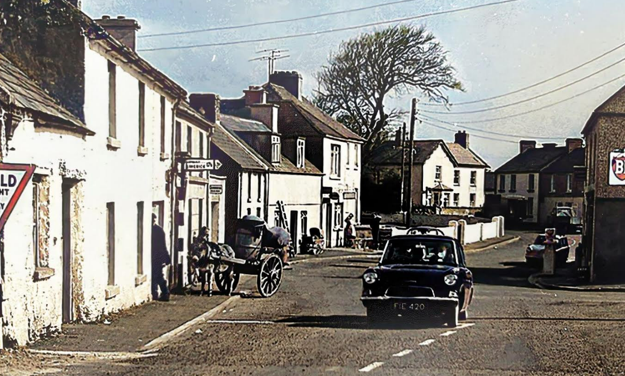
Left: Looking back from Quin Cross c1965
The Court House (34)
John Singleton, member of the Grand Jury for the county and Justice of the Peace, owned the land on which the RIC barracks and the Court House were located. He later transferred some of this land to Mike Bow Clune as payment for a debt.
Nonies (35)
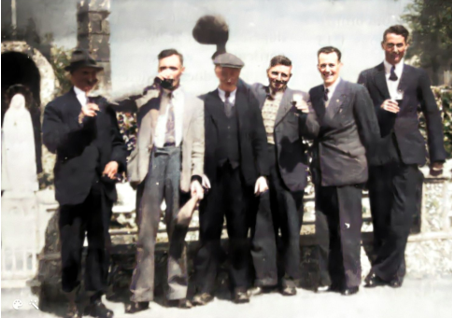
Jim & Nonie Bow Clunes pub & butcher. These were brother and sister. The photo on the left below captures the owners and locals outside the premises in 1949. This is now The Village Inn pub.
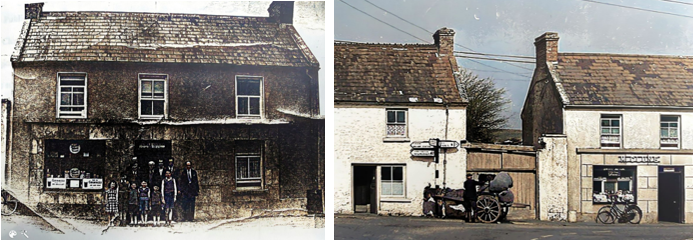
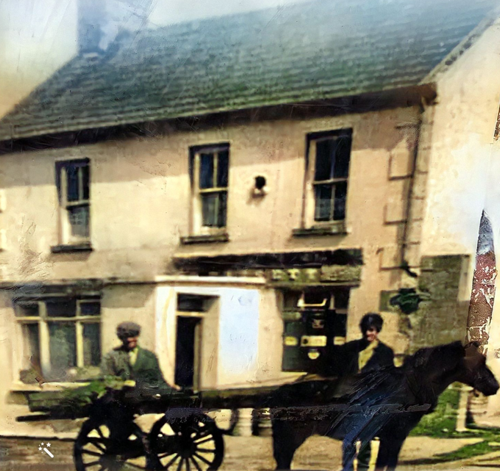
The original ER VII (Edward Rex) Post Office box is still intact and in use on Quin Main Street. It was painted green after the formation of the Free State. It was not unusual at the time but this is one of the few examples remaining in the country.
see Quin heritage.ie for more information on this and the history of the local postal services.