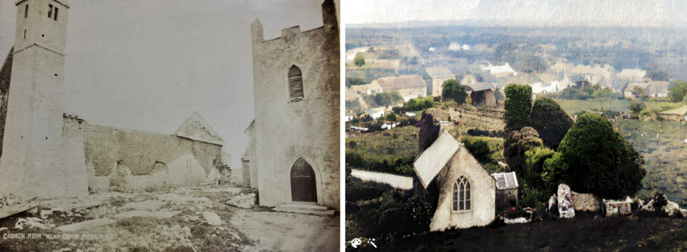
St. Finghín’s Church(CL042-02703)on the bank opposite to the Friary on the River Rine is several centuries older than its sister building. It is in a reasonable state of preservation, though the north wall has long since been lost. Both the interior of the church and the area around the church are now filled with graves (CL042-02704).Its main features are the remains of a moulded window in the south wall and a thirteen-foot-wide opening in the east gable.  A square tower sixty feet in height was built in the 17th century at the corner of the west gable, with a low door opening into the church. Careful scrutiny will show the presence of two heads beneath the tower string.

Ariel view of Quin Abbey and St Fineens

The Annals of the Four Masters state that St. Finghín was the patron of Quin parish. In 1005 Finghín of Roscrea, who may have been the same individual, died. O’Hanlon’s in his Lives of the Irish Saints, places his feast day as the fifth of February.

The foundation of Finghín’s Church is not known. Some documents and a few architectural features would suggest the early thirteenth century. The Four Masters recorded that the church was rebuilt by Thomas de Clare after it had been burned over his soldiers by the O’Brien’s in 1278. In the absence of hard facts, local folklore stated that ‘The old parish church of Quin stands at the other side of the stream (Rine). It is called Teampall Finnín from Finnín Mac Conmara, and was built in one night by the angels’.[1]

An architectural article from 1908 recorded that ‘The old church is a plain rectangle about 79 ft. by 27 ft., not divided into nave and chancel: a small square tower stands at the south-west corner. Though the walls are mainly of early thirteenth century date, several later features have been added, such as the battering buttresses at the east end, and the tower. In the last century it fell into ruin.’To the south of Finghín’s stood a small Church of Ireland chapel in use until the late 19th century. Due to lack of use, the building was removed in the 1960’s.

Though somewhat overshadowed by Quin Friary, Saint Finghíns is a venerable church, still treasured by the local community.[1][i]

 [i]Cochubhar Ua Briain, The Architectural and Topographical Record, Part 2, Vol. 1. (1908), pp 169-192

The boot-makers (16)

Here lives a man who don’t refuse

To make or mend both boots and shoes

His leathers good, his work is quick

His profits small, so can’t give tick

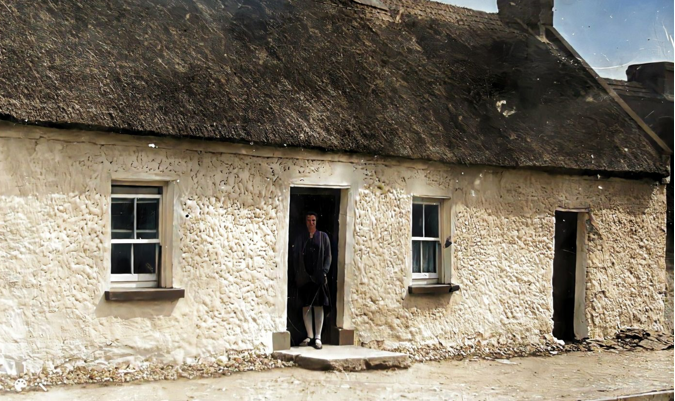
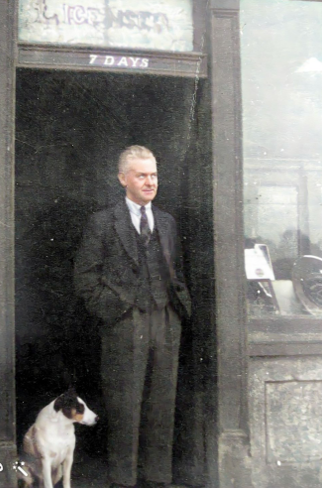
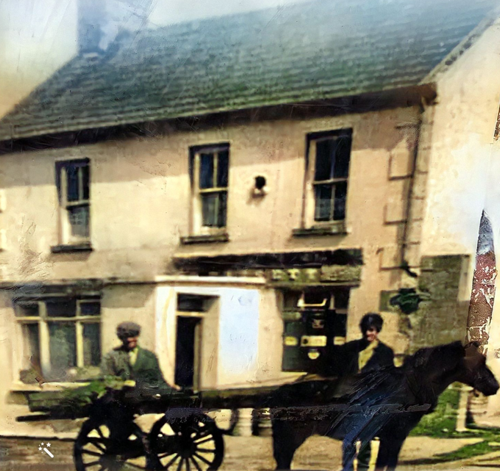
The sign nailed above the door to Crowes, The Boot-maker, at the entrance to the current OPW coach park, or opposite The Monks Well.

Left: Mai Crowe at doorway of Tommy Crowes 1940’s

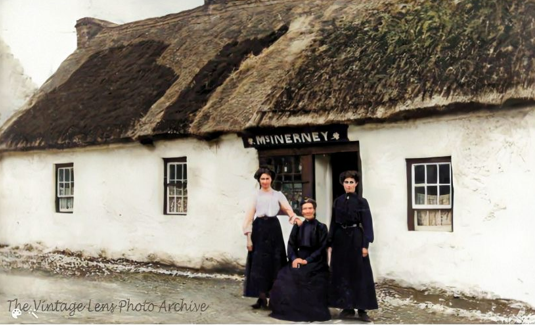
Photo on right is courtesy of The Vintage Lens

McInerney & Lynch families (14 &15)

Sisters Ann and Ellen with their mother Margaret McInerney, nee McCarthy, outside their pub c1918. Margaret was married to Thomas and they reared six daughters in this house. This was located to the left of the current Marlborough home, which was also a pub, known as The Bridge House, owned by the Lynch family. These two related families lived side by side. A descendent of Ann ‘Patsy’ Lynch, later authored a book which covers much of their life here, called ‘Mapping the Past’, by Charles Drazin.

The Protestant Church of Quin, built in 1797,  was the place of worship for the parishioners of Doora-Quin. The glebe house for this parish was in Doora, the ruin of which is still intact. The attendance, 40 in 1845,  dropped significantly over the years and the church was eventually knocked down in the 1960s. It served just three families in 1939. The photo above shows the church alongside St Fineens Chapel.

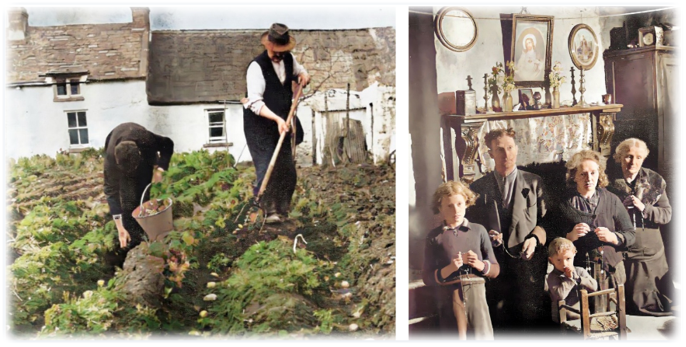
Amby Power planting the spuds, the Baker family at evening prayer (mother-in-law Mrs Corbett extreme right). Both families resident in Quin Gardens in the 1930’s. The derelict Baker house still stands alongside the village bridge.

Photo’s at left courtesy of Life Magazine.

Corbett’s shop (9)

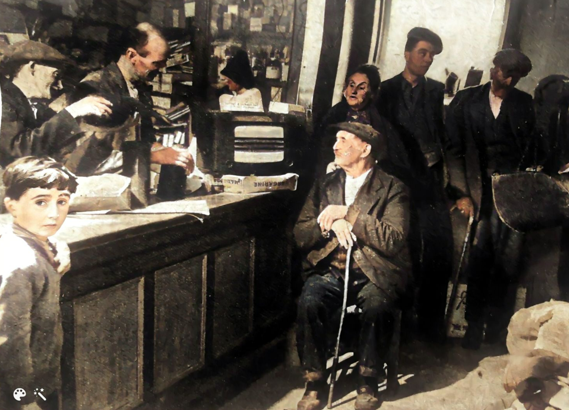
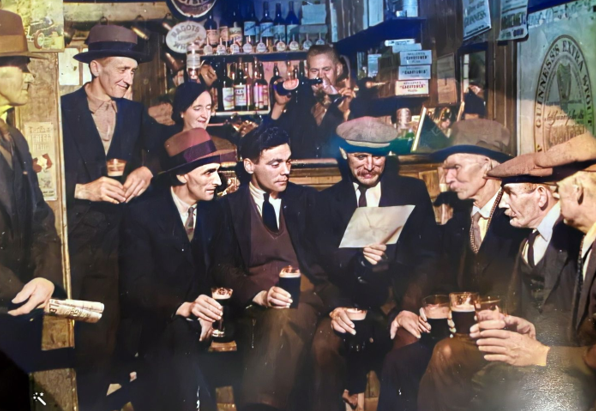
From Life magazine 1939: A gossip at end of day in Corbett’s shop. Included in the photo: The Young boy on the left is (Fr.) Con O’Sullivan who became P.P. in Milltownmalbay – his father was a Guard in Quin.  Shop assistant on the left was Michael Reynolds, a brother to Nancy Reddan of the Post Office.  Patrick Corbett is next . The man sitting in the chair is Dan Cider Clune who donated the land to build the hall. To his rear is Mrs Pine O’Brien. The tall man with the cap is Paddy the Yank Clune (as he came home from the U.S.), he lived across from Kildrum graveyard.  Next is Michael Corbett, Kildrum – Patrick Corbett’s cousin who owned the land where the Graveyard is now.  The last gentleman is John Guerin of Ballymarkham.


Photo at left is courtesy of The Vintage Lens

The Tailors House (49)

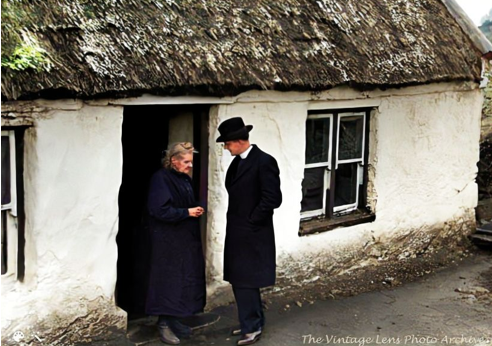
Martha Hourigan in conversation with Fr Bolton in 1940 outside of her cottage which was on the site adjacent to the present village garden, An Tearmann. Her husband, James, had been the local travelling tailor, calling to homes to carry out alterations as required. They reared three sons and three daughters here. This single story thatched cabin was, unusually, built with gable facing the street.

Quin Village Lower (south end)

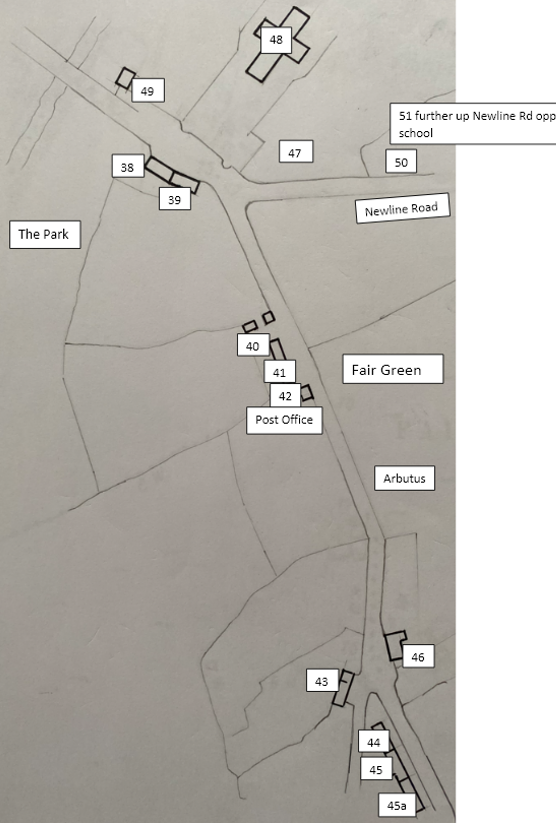
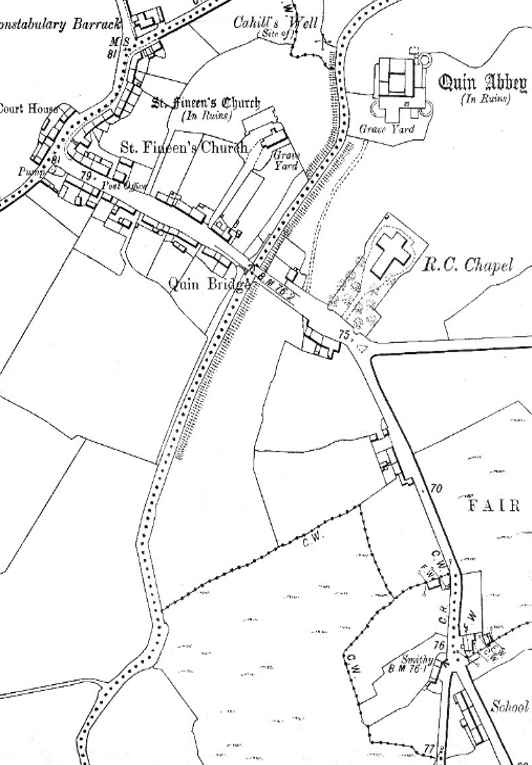
The numbering system used here is our own. These can be cross checked from the map to the list. Information is drawn from Griffiths Valuation, 1901 & 1911 census, local knowledge and researched articles for the 1940’s.

1855 1901 1911 1940’s
38 Not available McInernerys McInernerys McInernerys pub and petrol pump
39 Not available RIC barracks, now restaurant
40 Not available

Mikey Sullivans,

41 Not available Garda Cummins, then Doherty, then Garda Hennessy
42 Not available Conways pub, then Reddans, now PO
43 Blacksmith Forge Blacksmith Forge Blacksmith Burkes Forge Paddy Moroney
44 Not available Mals stable
45 Not available School teacher Mrs Weldon/Ms Degidon
45a School School School School
46 Denis Hassett Denis Hassett Denis Hassett Denis/Jim Hassett-pub & butchers


47 XXX RC Curates House RC Curates House RC Curates House (Fr Loughnane, Canon Vaughan)
48 RC Chapel RC Chapel RC Chapel RC Chapel
49 Cornelius Hourigan? James Hourigan James Hourigan Martha Hourigan, fountain and community park


50 XXX XXX XXX John Joe & Mary Thady Clunes shop


51 XXX XXX XXX George Gallagher, then Jack/Ellie McMahon house across from school

St Marys Chapel

 “A new chapel is now in course of erection in Quin; it is a handsome and spacious cruciform structure, in the Gothic style, with a portico of hewn stone; the estimated expense, £2000, is being defrayed by subscription “, from Samuel Lewis Topographical Report of Quin 1831

This new chapel was built under the direction of the two Corbett brothers. Fr Daniel Corbett finished it when his older brother died. A small chapel is shown on the first OS 6 inch map from 1839 located close to the pump at the corner on Newline Road.

Old RIC Barracks/McInerneys/Abbey Tavern (38 & 39)

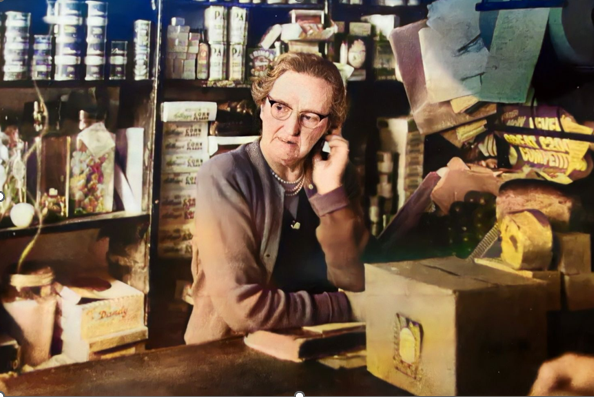
Top left: Nora McInerney behind the counter of her grocery and public house in 1940. Top right: Paddy McInerney outside of his premises 


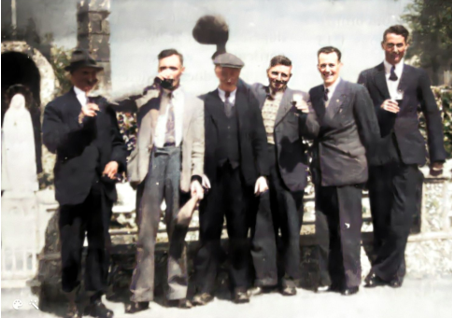
Right: Paddy Moroney, John Guerin, Tom O’Brien, Tom Fahy, Charlie Scanlon, Jim Meaney, Jim Clune, Pat Conroy, Paddy & Nora McInerney.

Courtesy of Life Magazine 1931

Left: Tom Cullinan, Tom Fahy, Jim Clune, Jim Woulfe, Tommy King, Mike O’Neill. Taken across the road from McInerney’s pub in 1950.

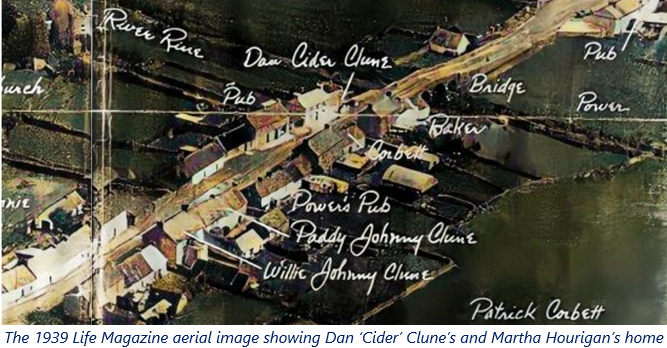
Life magazine and the Post magazine featured photos and some detail relating to life in Quin in 1939. One of their photographers stopped off in the village and we now benefit from the records left behind. The aerial image alongside photos taken in McInerney’s pub; Corbett’s shop and parishioners leaving mass are all courtesy of these two magazines. A copy of the original Life magazine is in the possession of Quin Heritage Group.


An Tearmann Quin Community Garden & the ‘Pound’

Tithes were the tax paid to Established Church (Church of Ireland), calculated as one-tenth of the rateable value of one’s agricultural produce. Readers of our ‘Know Your Townland’ series of posts will be familiar with seeing this listing by townland. A parallel list called the ‘Tithe Defaulters’ list was drawn up following the outbreak of the Tithe Wars.

Tithe War On March 3rd 1831, the Tithe War began, mostly in Leinster and East Munster.
The tithe, one-tenth of agricultural produce, later payable in cash, was owed to the minority Protestant Church of Ireland. In a country overwhelmingly Roman Catholic, with a substantial Presbyterian population as well, it was not only an unjustified theft of property but also a sectarian insult. A tenant, barely subsisting, was expected to fund the clergy of a church they did not attend.

Rev James Hall, in his ‘Tour of East Clare’, 1812 noted:

 “In every parish there is a pound-park, to which they take the cows, pigs, calves, and the like, of those who are in arrears for tithes. In eight days after the cattle have been in pound, if the owner do not come and relieve them, by paying the tithe and other expenses, the cow, or whatever it may be, is sold to the highest bidder; and the balance, if any, after paying what had been due, and all expenses, is given to the person to whom the animal, or thing, belonged. There is generally also a pound-park in the parish for the landholders; and middle-men, or receivers, do the same when there happens to be any arrear of rent.”

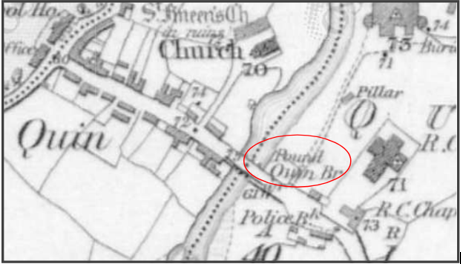
The ‘Pound’ for Quin was located on the site of the present community garden ‘An Tearmann’. It was captured in the first 6” OS map, which was published in 1842 but surveyed about 1839. This would have been at the height of the Tithe Wars and explains the existence of the ‘Pound’, at the time of the OS survey of Quin.

Fair Green

 The November fair, on the site of the existing Arbutus Grove homes, was once the main commercial and social occasion in the village. The Fair Green, where animals were assembled for buying and selling was on the far side of the village in the townland of Feaghquin, as one heads towards Kilkishen. The fair was once managed by the Singleton landlords, who collected the customary tolls at the time. With their departure, the Fair Green came into the ownership of Vincent Hassett.

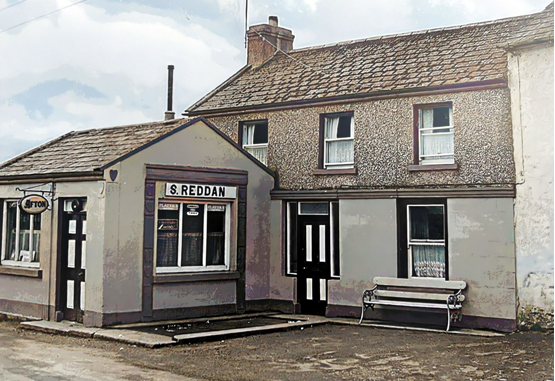
Reddan’s Public House (42)

Reddan’s Pub, now Quin Post Office

Blacksmiths Forge (43)

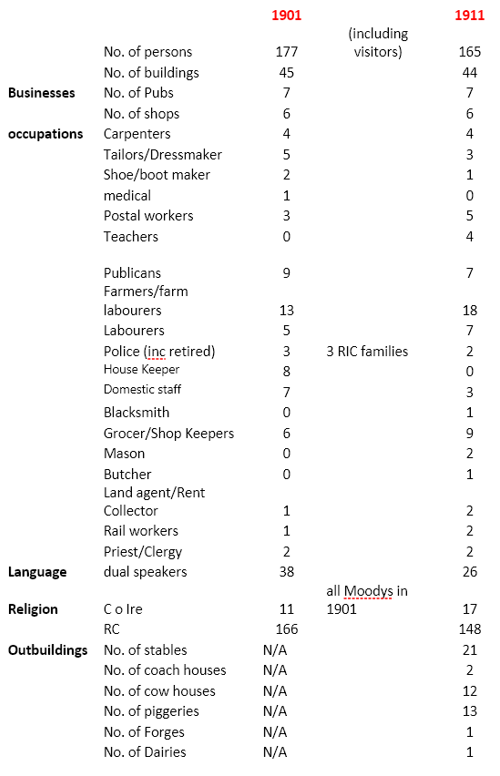
Burkes forge, later owned by Paddy Moroney, was on the site opposite Malachy Hassetts pub. The extract above from the 1901/11 census outlines the dependence of the village on the horse for transport, agriculture and leisure. The number of stables and coach houses underlines this, so there would have been a strong reliance on the services of a good blacksmith.


Hassetts Pub (46)

This pub and grocery shop was home to Denis and Mary Hassett in 1901. They reared three sons and a daughter here. It was passed to their son Jim and then to Patrick, better known as Malachy, in whose family name it is still in ownership today.

see: https://quinheritage.ie/malachy-hassett-quin/

Quin School Feaghquin (45a)

The first recorded ‘National school’ in Quin was opened in the year 1856. The school, known locally as a “Reading House,” was situated where Malachy Hassett has his stables in Feaghquin. The home of the late Mrs. Muriel O’Neill was at that time the residence of the teacher. The last teacher to live there was Mrs. Lena Weldon – Helena Degidon of Rylane and her husband John Weldon, aka the writer Brinsley MacNamara. The first recorded enrolment in the “Male School” in the year 1863 was Michael Clune – Carhugar – farmer, aged 15. In 1871, there is a record of the first infant, William Considine-aged six, whose father is registered as a teacher. Situated in Feaghquin, the ‘Old School’ was built in 1896. The boys and girls schools were amalgamated on April 1st 1928. Up to that year they were separate schools.The last significant upgrade was in 1960 at Newline. It was occupied in 1964. The old school was used by the local Macra na Feirme as a garage and training workshop for skills such as welding and mechanics for many years afterwards.It waas converted to a private home in the 1990’s and continues to be in private ownership to this day.

Brinsley MacNamara (45)

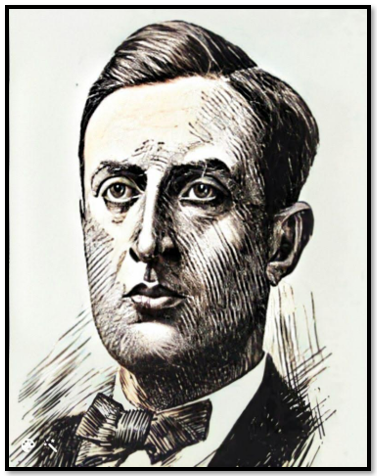
 This was the pen-name of John Weldon a writer, playwright and registrar of the National Gallery of Ireland. He was the author of several novels, the best known was his first, The Valley of the Squinting Windows (1918). The book caused a furore in his native Westmeath on its publication, to the extent that Brinsley had to retreat from his home place of Delvin. He continued to write for many years after his controversial first work. Among his plays are ‘The Glorious Uncertainty’ (1923) and ‘Look at the Heffernans’ (1926). On the 23rd of June 1920 MacNamara married local Quin girl, Helena Degidon of Rylan, in Clooney Church. Helena was a school teacher. The couple lived in Feaghquin next door to the school.


Born John Weldon, McNamara grew up in the small town of Delvin, Co. Westmeath, where his father was the schoolmaster. His work of fiction, ‘The Valley of the Squinting Windows,’ was written in 1916 and lambasted the gossip and crushing conformism which he felt exemplified rural Ireland at that time.
Garradrimna, the small town featured in the book, was a hotbed of gossip and scandal.
Its description in the book, even down to its population and layout, seemed to resemble Delvin closely.
As for the characters, the men were cruel drunks while the women were invariably judgmental and unpleasant. The schoolmaster was one of the few local people with redeeming features.

In 1918, the book finally made its way to Delvin where it was read publicly by groups of horrified townspeople. Many locals reportedly recognised themselves in the text and a group of men accosted James Weldon, the author’s father, roughing him up. He only escaped due to police intervention. They also sought out Brinsley McNamara, who was in the town but had been forewarned. He fled through the countryside, later stating that he believed he would have been killed had he been caught that night. The protestors had to make do with burning a copy of the book in a tar barrel in the town.


The criticism extended beyond Delvin.
The author was castigated for the negative portrayal of Ireland and the frank discussion of sexuality in the book. As one newspaper thundered: ‘It is a downright shocking book. The marrow of a cynicism, uncalled for, captious, sullen, vicious, currish and the meanly sordid is writ large upon its every page.
The author does not seem to have caught the small beauty of Irish village life. Rather, beetle-like, he has chosen to immerse himself in the fetid sordid meanness and reeking moral filth.’

Back in Delvin, a boycott of the family began when the shops in the town refused any of the Weldons service. The school in which Brinsley McNamara’s father taught was also boycotted with pickets placed outside the building. Half of the students were withdrawn in a boycott that lasted seven years and only ended when the Weldon family was forced to move away.

Brinsley McNamara himself went on to become a well-known actor in Dublin and the registrar of the National Gallery of Ireland. His publishers had withdrawn his book from circulation, however, and the controversy had a profound effect on his family and the town of Delvin. It is likely that neither he, nor the village of Delvin, never forgot the reaction to ‘The Valley of the Squinting Windows.’ It is likely, also, that other Irish authors of the era thought twice before writing a negative portrayal of their homeland after such a reaction.