We are very grateful to Ristéard Ua Cróinín and Martin Breen for permission to use this extract from their 1986 article in the Other Clare on ‘Ballymarkahan Castle: A Mac Namara Residence of the Medieval Period.’

The 1986 article where the Mac Namara pedigree was attributed to Twigge was in fact constructed by Martin Breen, based on the Twigge manuscripts. The history of Ballymarkahan and information on G. U. Macnamara is in The Other Clare, vol 42. There is new data on Quin in the recent The Other Clare, vol. 48, which features Danganbrack.

Much is yet to be written about the huge wealth of castles near Quin village and the surrounding areas.

O’Dwyer, chief of Kilnamanach in County Tipperary, Maccon Mór had  three  sons,  and  from  the  eldest of these sons Cumheadha, the MacNamara Fionn branch descends. Their territory was the barony of Bunratty or  West  Clan Cuiléin.  The  MacNamara Fionn was responsible for the building of Bunratty castle, Knappogue Castle and the friary of Quin, as well as other castles and tower houses in county Clare. By his second marriage to Anne, the daughter of O’Kelly, chief  of  Ui  Maine  (an area which straddled parts of the present counties Galway and Roscommon), Maccon Mór also had three sons, Sean ‘an Gabhaltais’, descend the branch which became known as MacNamara Riabhach, whose territory was the barony of Tulla, or East Clan Cuilein.8

The MacNamara Riabhach were also responsible for the building of several castles or tower houses in east Clare, the castle of Ballymarkahan is one of these constructions. The castle, although badly ruined, still remains many well executed features of late medieval castles.  Over sixty castles or tower were constructed in east Clare by the various branches of the MacNamara clan in the fifteenth and sixteenth centuries. Many of these structures

have broadly   similar designs. Ballymarkahan castle is a typical example of one of these fortified late medieval buildings, in its construction, its history, and its destruction. The history of this tower house and the description of its remaining features are discussed below.

Description:

Ballymarkahan Castle (Baile Ui Mharcachain – Home of O’Markahan)

CL042-03702-, 042-/08/2. 14359/17280 O.D. O’-lOO’. Tower House and Bawn.

Ballymarkahan tower house stands almost 16m. high to its full height. Only the north, west and portion of the south wall remain as the comer containing the circular staircase no longer stands. The building was constructed of dressed limestone rubble set in erratic courses on a base batter resting on a crude plinth of flat stones. The dressings around windows and doors are particularly well carved. The tower house was built in one section unlike many County Clare examples, which were constructed in two sections. The building is vaulted over the ground floor and second floor with corbels set in the lateral walls to carry intermittent wooden floors and also to support vault centring forms.

Pedigree of the MacNamara Riabhach, showing descent to the MacNamaras of Ballymarkahan

Floorplan of Ballymarkahan Castle

Ballymarkahan Castle from south (2017), showing main and smaller chambers

The ground floor contains a small porter’s lodge to the right of the entrance door and embrasures for loops in the south, west and north walls. The remains of a garderobe-corridor, supporting arch can be seen inside the entrance lobby, while the remains of the upper floor vault can be seen near the west wall.

The narrow stairwell section, most of which has collapsed, shows stone vaults over the ground, first, third and fourth storey narrow rooms, while the solar or top floor was all one room. There are two garderobes at first and third floor levels, the upper one containing a secret chamber to the left that has no window, but has an external slop-stone. The top room contains ogee headed loops and a finely dressed arched and splayed embrasure over the north and west windows, which appear to have been glazed, double light windows with central mullions.

To the northwest of the castle can be seen the footings of a bawn wall stretching over 60m. from the west wall of the towerhouse. These footings are regular and appear to be about lm. wide. There is also a natural spring well to the west of the tower house, and the remains of a limekiln lie about 20m to the east. At the northwest comer of the bawn wall footings is a low burnt mound which is likely a fulacht fiadh, and there is evidence that others exist nearby, on the bank of the marsh.

At the rear of the farmyard, about 50m. southeast of the tower house, is the remains of what appears to be a seventeenth century house with a large stone fireplace, (with a modem concrete lintel), and a brick bread-oven with overhead flue to its left hand side.

Surveyed 12-02

Ua Croinin and Breen.

History:

According to the various castle lists available, several individuals are credited with the construction of the castle of Ballymarkahan, although all are agreed that it was built by the MacNamara clan. According to T.J. Westropp, the castle was built in the period 1430-1450 by Donall, son of Shane, (Sean), ‘an Gabhaltais’ MacNamara, who died in 1373. This concurs with Standish Hayes O’Grady, who was quoting from lists of County Clare castle builders in manuscript form in the British Library, O’Grady added that one of the lists   gives   the above Shane MacNamara himself as the builder. According to Dr G.U. MacNamara, the soubriquet ‘an Gabhaltais’ (‘of the Conquests’), only appears in the later manuscripts, and was given to Sean because of his alliance with Brian Catha an Aonaigh


Seán na Gealaí

Halloween is the direct descendent of Samhain. It was the night when the gap between this world and the spirit world narrowed.  Known as Oiche Shamhna or ‘spirit night’, the souls of the dead were expected to return to the family home. The Church introduced the Feast of All Saints (Nov1) and the Feast of All Souls (Nov 2nd) to counter Samhain. Evil spirits were also thought to be abroad and people avoided travelling alone on this night.

   “Deireann na daoine go mbíonn sidheogaí amuigh oidhche Shamhna”, Schools’ Collection (NFCS 249).

Origins of Samhain

Contender 1- Tulsk, County Roscommon

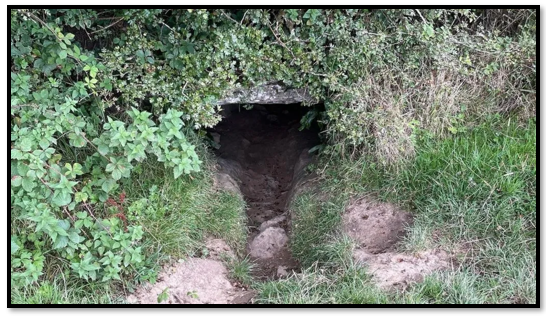
Oweynagat Cave, Uaimh na gCat, meaning the ‘Cave of the Cats’ in Rath Croaghan. The Book of Leinster names it as dorus iffrin na Hérend – Ireland’s Gateway to Hell. Demons and all kinds of creatures emerge from here on Oiche Shamhna.

 Echtra Nerai (the Adventures of Nera) is first mentioned in the 10th century Cath Maige Mucrama story,  happening at Samhain.

Oweynagat Cave is also said to be the home of the Morrigan. She is portrayed as a goddess of battle and war, with the power to transform into crows or ravens. Her dreaded cry was frequently heard over battlefields.

Echtra Nerai, the Adventures of Nera

An Irish text taken from the Ulster Cycle, dating to the tenth century entitled ‘Nera and the Dead Man’, tells of the warrior Nera who accepts a dare during a dark and stormy Samhain night to tie a withy around the ankle of a hanging dead man. As he does so, the corpse suddenly comes to life and asks Nera to carry him on his back. Nera complies. After some adventures Nera gets the dead man back to his tree. All of this takes place at Samhain at Rath Croaghan/Cruachan, hence its association with Halloween.

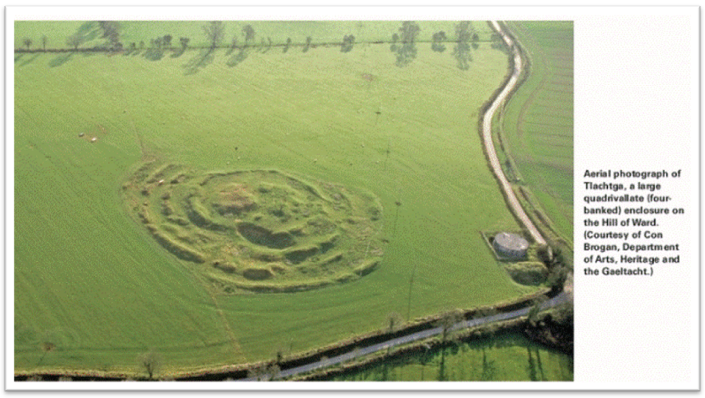
Contender 2 – Tlachtga, Meath

The original Tlachtga was a druidess of considerable power and importance, the daughter of Mug Ruith who lived on Valentia Island in Kerry. He is said to have lived through the reign of nineteen kings, with his lifespan stretching back to the time of Christ on earth. Tlachtga and her father could travel the world on the Rath, a fabulous spinning wheel of fire that easily transported them. Mug Ruith sought out knowledge and learning like few before him and it was in this manner that he and Tlachtga travelled to study under Simon Magus (Simon the Sorcerer), who is mentioned in the Bible.

Simon Magus and Mug Ruith sent Tlachtga out into the world to gather as much knowledge as she could find. Upon her return they realized that her knowledge far surpassed their own!
They were outraged and such was their jealousy that they set the three sons of Simon Magus upon Tlachtga, who defiled her. She returned to Ireland where she gave birth to three sons, Dorb (Doirb), Cuma (Cumma) and Muach.

It was on the hill of Ward in county Meath that Tlachtga brought her three sons into the world, and it was there that she died, unable to sustain her life in the face of the utter grief and despair she felt at the indignity she had endured.

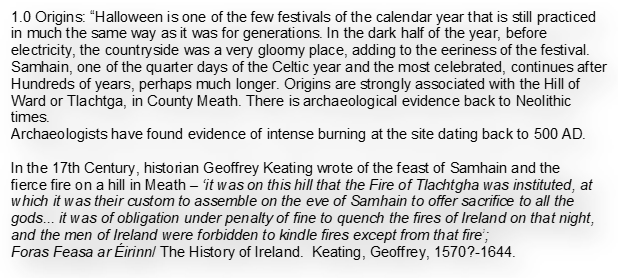
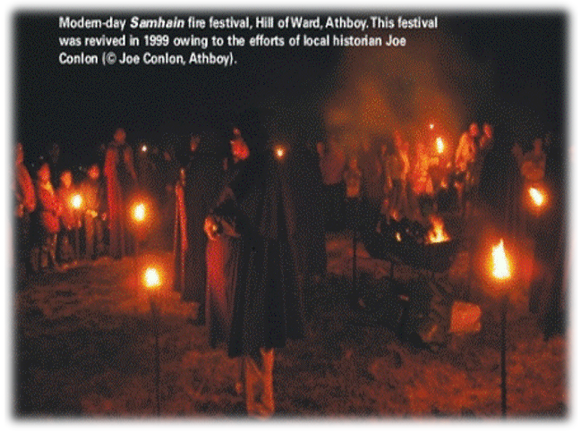
In recent years a renewal of the annual gathering on the hill of Ward now attracts hundreds of people at Halloween. A walk from Athboy up towards the Hill itself culminates with a celebration, with elaborate ceremonies and an acknowledgement of the cultural gift to Ireland and the world that Tlachtga represents.

In the ancient kingdom of Mide, Tlachtga was considered an important assembly place alongside Tara, Teiltun and Uisneach. These four ‘corners’ are recorded as having been the location of fortresses constructed by high king Tuathal Techmar at the foundation of Mide in the early decades of the first millennium AD.

‘Much of the (archaeological) evidence points towards a long history of ritual activity. Large quantities of animal bones – a sign of large scale feasting have been found throughout all phases of the site. The lack of evidence of any residential or day to day activity strengthens the idea that it most likely it was set aside purely for ritual or celebratory activity.

There have been finds in all three phases of the site, including scattered Bronze Age human remains and the skeleton of an infant between seven and ten months old… The child burial, next to a ritual deposit of cow bones, dates to AD 450 – around the time of the arrival of Christianity.

“The child was clearly buried with care and having not found any evidence of burials on the site, we’d have to guess that This child belonged to someone significant”.

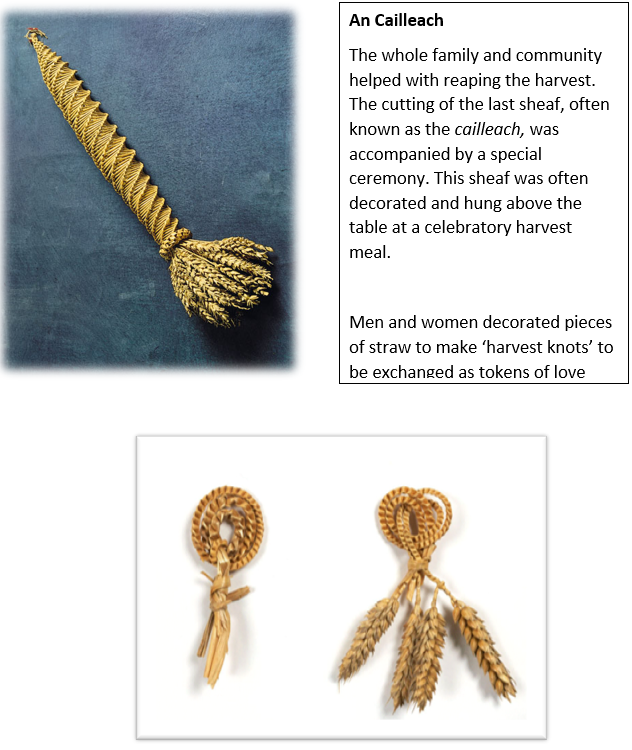
Harvest knots and Guises


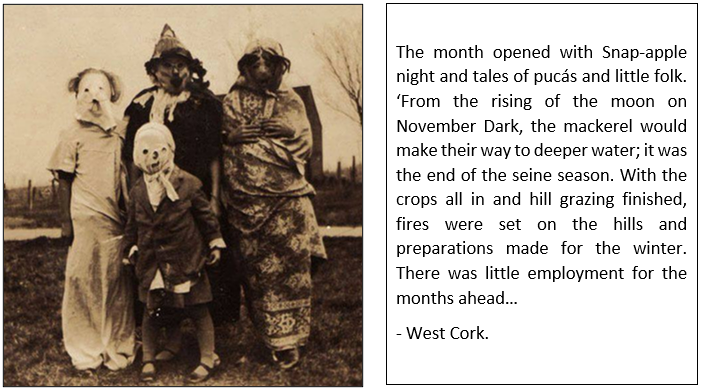
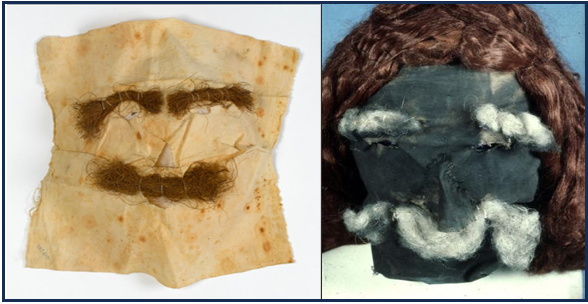
Homemade masks made by village boys calling to local houses on Oiche Shamhna

Outdoors

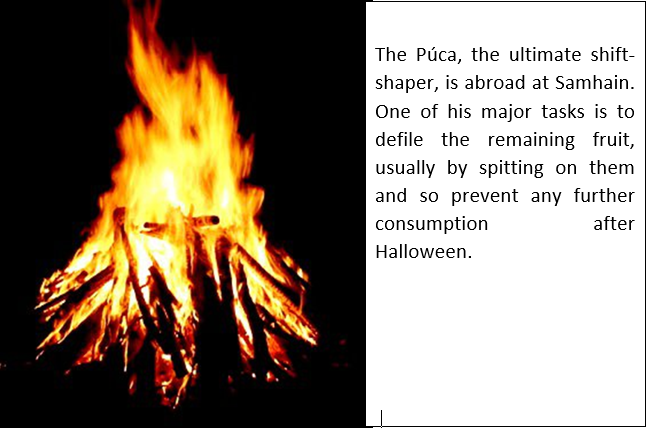
Unlike May when the fairies are active, November Eve brings malevolent spirits. It is the night for community bonfires, especially in housing estates in the cities and towns. Collecting the last handful of fruit and nuts.

Indoors

Families would attempt to have a celebratory supper on Oiche Shamhna. Family supper might be colcannon or pandy. They would first secure the house by sprinkling Holy Water and possibly placing a religious object in the thatch near the front door.

Typical Samhain Food included pancakes, stampy (a potato and apple cake, crusted with barley, enhanced with sea spinach and rock samphire & cooked with oil) apple cakes, nuts, blackberry pies.

An bairín breac/the barmbrack or the ‘speckled loaf’, containing oodles of dried autumn fruits is still a favourite treat, with lashings of butter.

Tokens inside the traditional loaf included the ring as a symbol of love and marriage,  a thimble (spinsterhood); a button (bachelorhood); a stick (to be beaten by the spouse); a rag (poverty); a coin (wealth) and a crucifix (the taking of religious orders).

Future Reading