Taken from Clare Champion, Nov.2nd, 1940 and published in the first edition of the Quin – Clooney – Maghera Parish magazine 1987

A NEW PAROCHIAL HALL FOR QUIN

Blessing and Opening Ceremony

Tribute by Canon Vaughan.

St. Fineen’s new Parochial Hall in Quin was blessed and opened on Sunday last in the presence of a distinguished gathering of people from the parishes of Quin and Clooney.  Built on the bank of the River Rine and in close proximity to the Catholic Church and the famous abbey of Quin, the new hall is a magnificent structure and is a lasting monument to the zeal and enthusiasm of the people of the united parishes and to the energy of their respected Parish Priest. Very Rev. Canon Vaughan.

As has already been stated in those col­umns, the erection of the Hall was only decided upon in the early part of the present year. A representative committee, under the chairmanship of Very Rev. Canon Vaughan, was formed at a meeting held on the first Sunday in March, and the following week saw the commencement of  the foundation of a

new building, which is second to none in Munster and a building which reflects the greatest credit upon all associated in any way with its erection. It is a credit to the parish and to the parishion­ers who erected it. Its actual cost is about £1,500, but the possible cost, including levelling, filling, labour, etc., is anything up to £3,500.

Very Rev. Canon Vaughan, at the opening cere­mony on Sunday, said there is not a penny of public money within its walls. This is further proof of the generosity, zeal and enthusiasm of the people of the parish, who provided about £2,000 worth of free labour.

 OPENING CEREMONY

The ceremony of blessing and opening the Hall took place after last Mass on Sunday. The day was exceptionally fine and

QUIN HALL COMMITTEE 1940. Standing: James Clune, N.T.; D. Cooney, J. Moylan, Igt. Murphy, M. Hogan, W. Moylan, Rev. Fr. Loughnane, C.C.;. Carmody, D. Hassett, M. Power, J. Woulfe. Sitting: A. Power, W. Cullinan, D. Corbett, Vice-Chairman; Rev. Canon Vaughan, P.P., Chairman; P. O’Halloran, P. J. McInerney, Hon. Secretary and J. Scanlon. Inset: J. Kiely

the large crowd assembled in front of the Hall, as Canon Vaughan addressed them, formed a very impressive sight. The approaches to the Hall were beautifully decorated with flags and bunting. Members of the Committee present included Canon Vaughan and Rev. P. Loughnane, C.C., were Messrs, Dan Corbett, Vice-Chairman; P. J. Mclnerney, hon. sec.; James Scanlan, John Kiely, P. F. O’Halloran, Daniel Hassett, James Clune, N.T.; Ambrose Power, Patrick Armstrong, Patrick Carmody, James Moylan, Michael Power, Michael Hogan, Michael Kelly, Thomas Fahy, Tim Clune, Stephen O’Dea, Wm. McNamara, Patrick Corbett. Thomas O’Loughlin, John
Reynolds, Brendan Kilmartin.
Very Rev. Canon Vaughan assisted by Father Loughnane, having blessed the Hall, addressed those assembled outside.
You have been asked here to-day, he said, to witness and assist at the opening of the new Parochial Hall. The Hall is named after St. Fineen – the Patron Saint of Quin – one of those lrish Saints of the past, of whose birthplace and parentage we know nothing, beyond the fact that the ruins of the old Church alongside this modern building, carry his name down the centuries thereby linking the old with the new and serving as a silent reminder of the ascetic and sacrificing spirit of a time when lrishmen became the glory and wonder of the world, following almost alone the footsteps of the Master.

NO MEAN ACHIEVEMENT

The story of the Hall can be briefly told. A meeting of the Parishioners was held on the first Sunday in March. A Committee was appointed, and, on the following week, work commenced on the foundation of the new building. The work proceeded so regularly and quickly that by the end of March, the building was completed for all practical purposes. lt took only seven months – no mean achievement “in the piping times of peace” – and something more when we remember there is a world war, with all the inevitable curtailments of supplies and the difficulty of procuring materials, even of an inferior kind. We came through, however.
It is fortunate for lreland that such materials as cement and slate are now manufactured in this country. It is a pity that more attention is not given to afforestation, to the providing and proper seasoning of native timber to replace the foreign kind, at Ieast the woods for ordinary work, such as roofing, doors, etc. The lack of such, at the moment, may induce our Covernment to face up to this problem with a view to future contingencies.
To go on with the story. Plans were drawn at Mr. Richard Dowling’s office in Ennis. His able assistant, Mr. O’Leary, a young Architect, recently arrived in Ennis, took over the entire responsibility, supervised the lay-out, construction, and spared neither time nor patience in seeing to the erection, in fact, I might say he was almost

too particular in his desire to have every thing as near to perfection as it could be. On my own behalf, and on the Committee’s. I wish to offer him our best thanks for his services to us, and I might add, that if he gives, the same attention and intelligence in planning to other or greater works of this kind, his position as an Architect is guaranteed from this onwards.

ACCOMPLISHED BY LOCAL LABOR

The actual building was accomplished by local labour for the most part. Here at the outset. I must compliment and congratulate the Parishioners on their wonderful co-operation all through. From the very first day, right down to the end, it was only a question of asking a horse, or a car, or a man, or men, for that matter, and they came as requested.
The amount of free labour I could not properly assess. At no time during the seven months was there a day, that, on an average, 3 or 4 or even 5 men were not working on the site, and they are all the more deserving of praise when it is realised that it was the busiest time of the year – from Spring sowing to the end of the Harvest. I should also add that this free offer of labour was not confined to the district around, but we had outsiders from the parishes of Doora and Newmarket-on-Fergus.
To one and all – parishioners, and externs – I am deeply grateful, and the parish itself is grateful for their fine public spirit and for the generosity and enthusiasm which inspired all this voluntary effort.

NECESSITY OF PAROCHIAL HALLS

I will not tire you by putting you the
question or discussing it aloud with myself: “What use is a Parochial Hall?” The fact that you came together as one body and built it, the fact that a Committee had the courage and perseverance to see it through, the fact that it has aroused a certain amount of public interest must surely be an index that such halls are a necessity in the lives of the people. I do not mean to assert that they will solve all or many of the problems that arise in our rural living. They are not meant to do so. If they do nothing else but bring people together, whether for a social entertainment or for recreational or educational or other purposes, they will help to break down prejudices and petty barriers, and I think it about time that a general demolition of that kind should take place in our rural districts.

CO-OPERATION AND SACRIFICES

I now declare the Hall open. It was built by the energy, co-operation and sacrifices of the people of the district of Quin. It actually cost about £1,500. Possible cost – including filling, levelling, edifice labour, anything up to £3,500.  There is not a penny of public money in its walls and there is no provision made for such in the statutes

of our native Government. One would think when so much money is being scattered about in doles etc., that any project having as its object the betterment of the people, “the brightening of the countryside”, as it is called, and incidentally, the relief of unem­ployment – should enlist the practical sup­port of our legislators.
Not only this, but, very soon, I know the Valuation Officer will pay us a visit and then hand over his dossier to the Rate Collector, who will, in due course, send out his notice that so-and-so is due. If it comes to securing a general licence for a dance, the applicant pays £3 – just the same fee as is charged to the man who runs a dance hall, for profit. Is it any wonder, at times, that private initiative is lacking when anomalies, such as I have mentioned, operate. Be that as it may the Hall is a fact. It is there for your benefit, for reasonable recreation for the improvement of your social life, for any other benefits that may accrue to you from it, and they can be many if properly exploited.
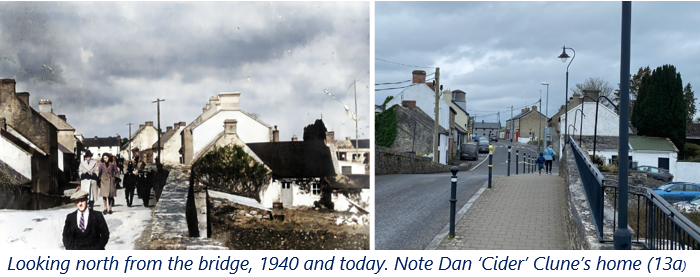
I thank the committee in particular for their loyalty and co-operation. I must say it was a pleasure at all times to work with them. I thank also Mr. Dan Clune for the way in which he facilitated us in procuring the site. He acted very decently, and when it came to a question of splitting half a crown, I think he was the decentest man 1 ever made a bargain with (applause). In return for his kindness, 1 propose he be made an honorory life member of the Hall, that he can take part in all its functions, and if he so desires, to indulge in the light fantastic (laughter and applause).
“May the Hall “, concluded Canon Vaughan, “bring brightness and pleasure into your lives and help to foster in you a love of your homes and countryside, and restore some of their simplicity and modera­tion that was such a feature of our Irish life at all times and that permeated the walls of yonder old Abbey, that forms such a splen­did and appropriate background to St.Fineen’s Parish hall < applause).

APPEAL FOR RESPECT

Mr. Dan Corbett, in proposing a vote of thanks to Canon Vaughan, said that Canon Vaughan was not long in the parish when he set about repairing and beautifying the Churches. When that work was finished, he set about building that Hall, the finest of its kind in existence. He would also like to thank the committee, and the parishioners in general for their great co-operation and assistance. They were truly worthy of the deeds of their ancestors. He would make a special appeal to all to respect the Hall, to take a deep interest in its welfare, and by so doing, they would be paving their way to make good and perfect citizens. Mr. Corbett congratulated the people of the parish on having Canon Vaughan sent amongst them, and he expressed the hope that the Canon would be spared many long years to guide the destinies of the ancient and historic parish.

Taken from Clare Champion, Nov.2nd, 1940 and published in the first edition of the Quin – Clooney – Maghera Parish magazine 1987

QUIN DANCE

The dance in the new Parochial Hall in Quin on Sunday night, in celebration of the opening of the Hall earlier in the day, will rank as the most successful and enjoyable
function ever held in the village. From 8 o’clock in the evening, motor cars carrying their loads, began arriving and in less than an hour the Hall was practically full. All
present were loud in their praise of the

general arrangements, including the seating accommodation, catering, the splendid floor and the choice music rendered by the Ennis Caiety Dance Band. The supper arrangements were supervised by Mrs. Weldon, N.T. and a staff of able and willing young ladies who had spent two days getting everything into shape for the big event. The attendance, numbering about 850, came from many parts of the county, a large percentage being from the town and district of Ennis, Tulla, Kilkishen, Crusheen, Newmarket-on-Fergus and other outlying districts were also represented.

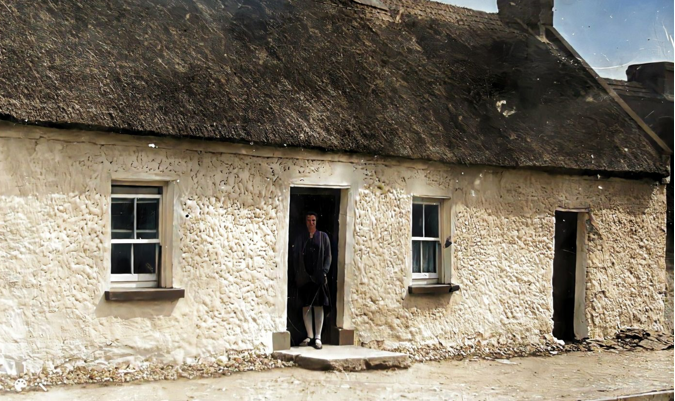
The boot-makers (16)

Here lives a man who don’t refuse

To make or mend both boots and shoes

His leathers good, his work is quick

His profits small, so can’t give tick

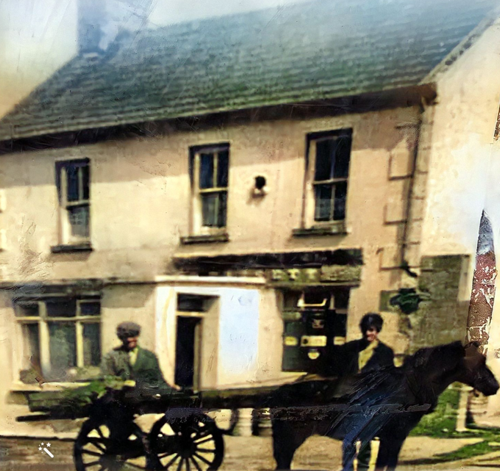
The sign nailed above the door to Crowes, The Boot-maker, at the entrance to the current OPW coach park, or opposite The Monks Well.

Left: Mai Crowe at doorway of Tommy Crowes 1940’s

Photo on right is courtesy of The Vintage Lens

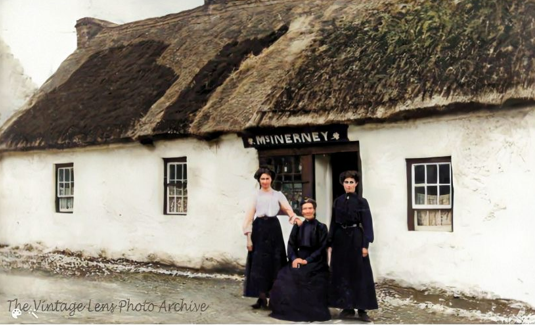
McInerney & Lynch families (14 &15)

Sisters Ann and Ellen with their mother Margaret McInerney, nee McCarthy, outside their pub c1918. Margaret was married to Thomas and they reared six daughters in this house. This was located to the left of the current Marlborough home, which was also a pub, known as The Bridge House, owned by the Lynch family. These two related families lived side by side. A descendent of Ann ‘Patsy’ Lynch, later authored a book which covers much of their life here, called ‘Mapping the Past’, by Charles Drazin.

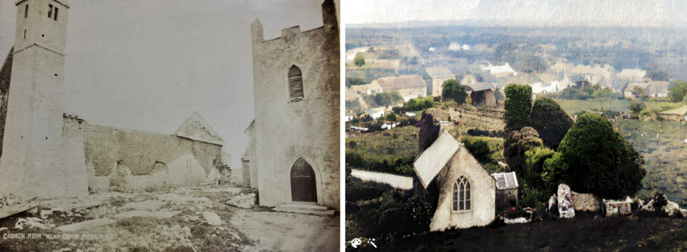
The Protestant Church of Quin, built in 1797,  was the place of worship for the parishioners of Doora-Quin. The glebe house for this parish was in Doora, the ruin of which is still intact. The attendance, 40 in 1845,  dropped significantly over the years and the church was eventually knocked down in the 1960s. It served just three families in 1939. The photo above shows the church alongside St Fineens Chapel.

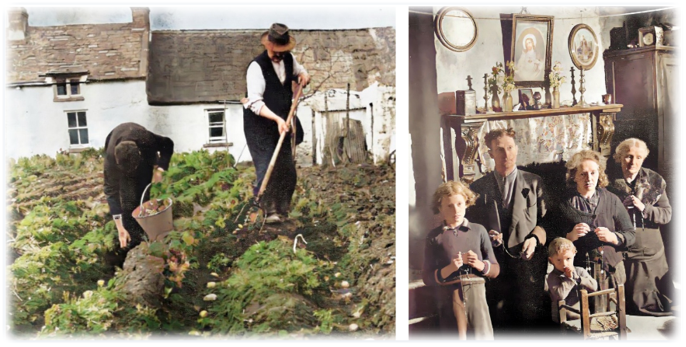
Amby Power planting the spuds, the Baker family at evening prayer (mother-in-law Mrs Corbett extreme right). Both families resident in Quin Gardens in the 1930’s. The derelict Baker house still stands alongside the village bridge.

Photo’s at left courtesy of Life Magazine.

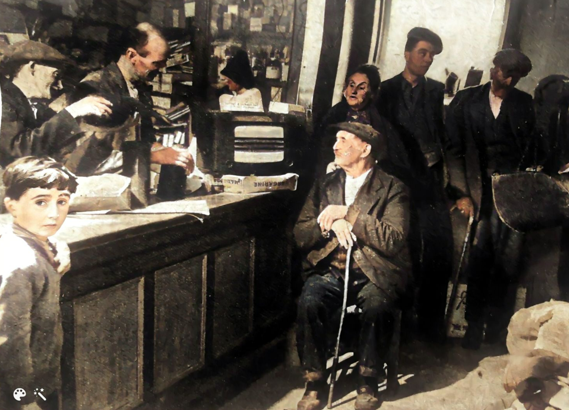
Corbett’s shop (9)

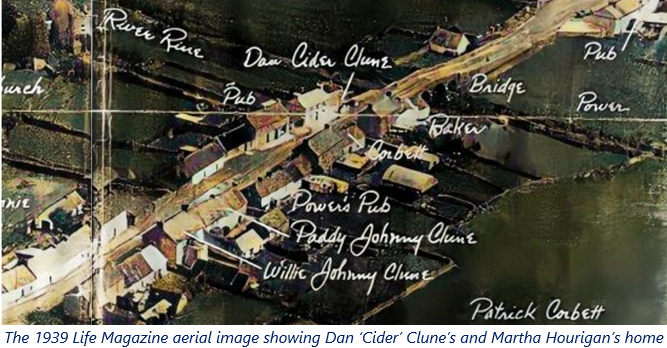
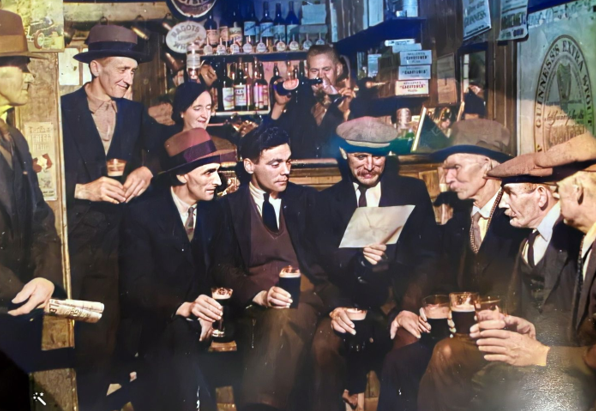
From Life magazine 1939: A gossip at end of day in Corbett’s shop. Included in the photo: The Young boy on the left is (Fr.) Con O’Sullivan who became P.P. in Milltownmalbay – his father was a Guard in Quin.  Shop assistant on the left was Michael Reynolds, a brother to Nancy Reddan of the Post Office.  Patrick Corbett is next . The man sitting in the chair is Dan Cider Clune who donated the land to build the hall. To his rear is Mrs Pine O’Brien. The tall man with the cap is Paddy the Yank Clune (as he came home from the U.S.), he lived across from Kildrum graveyard.  Next is Michael Corbett, Kildrum – Patrick Corbett’s cousin who owned the land where the Graveyard is now.  The last gentleman is John Guerin of Ballymarkham.


Photo at left is courtesy of The Vintage Lens

The Tailors House (49)

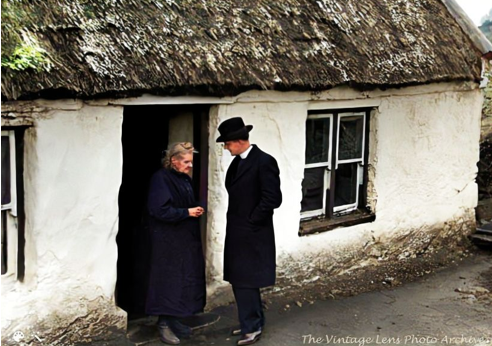
Martha Hourigan in conversation with Fr Bolton in 1940 outside of her cottage which was on the site adjacent to the present village garden, An Tearmann. Her husband, James, had been the local travelling tailor, calling to homes to carry out alterations as required. They reared three sons and three daughters here. This single story thatched cabin was, unusually, built with gable facing the street.

Quin Village Lower (south end)

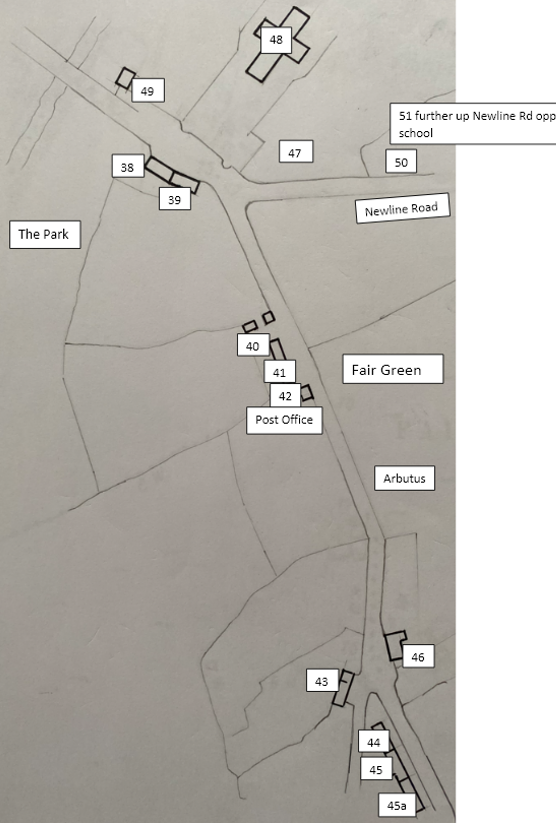
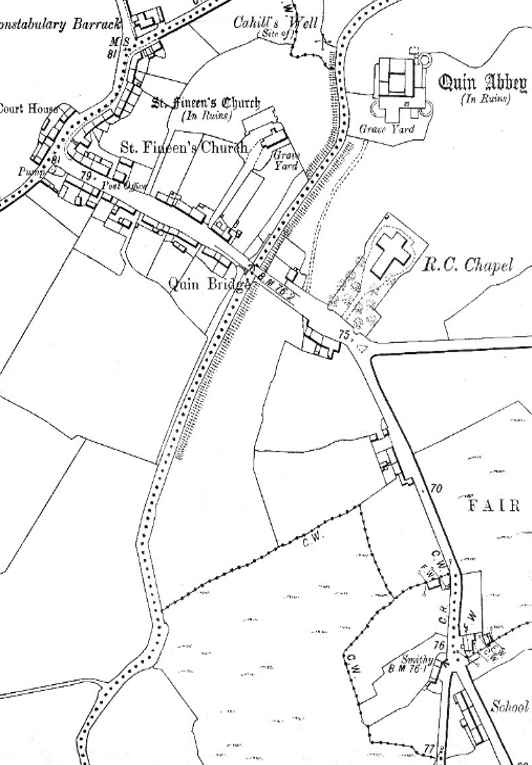
The numbering system used here is our own. These can be cross checked from the map to the list. Information is drawn from Griffiths Valuation, 1901 & 1911 census, local knowledge and researched articles for the 1940’s.

1855 1901 1911 1940’s
38 Not available McInernerys McInernerys McInernerys pub and petrol pump
39 Not available RIC barracks, now restaurant
40 Not available

Mikey Sullivans,

41 Not available Garda Cummins, then Doherty, then Garda Hennessy
42 Not available Conways pub, then Reddans, now PO
43 Blacksmith Forge Blacksmith Forge Blacksmith Burkes Forge Paddy Moroney
44 Not available Mals stable
45 Not available School teacher Mrs Weldon/Ms Degidon
45a School School School School
46 Denis Hassett Denis Hassett Denis Hassett Denis/Jim Hassett-pub & butchers


47 XXX RC Curates House RC Curates House RC Curates House (Fr Loughnane, Canon Vaughan)
48 RC Chapel RC Chapel RC Chapel RC Chapel
49 Cornelius Hourigan? James Hourigan James Hourigan Martha Hourigan, fountain and community park


50 XXX XXX XXX John Joe & Mary Thady Clunes shop


51 XXX XXX XXX George Gallagher, then Jack/Ellie McMahon house across from school

St Marys Chapel

 “A new chapel is now in course of erection in Quin; it is a handsome and spacious cruciform structure, in the Gothic style, with a portico of hewn stone; the estimated expense, £2000, is being defrayed by subscription “, from Samuel Lewis Topographical Report of Quin 1831

This new chapel was built under the direction of the two Corbett brothers. Fr Daniel Corbett finished it when his older brother died. A small chapel is shown on the first OS 6 inch map from 1839 located close to the pump at the corner on Newline Road.

Old RIC Barracks/McInerneys/Abbey Tavern (38 & 39)

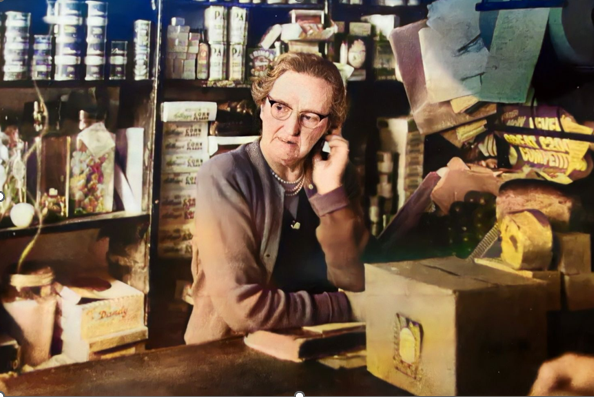
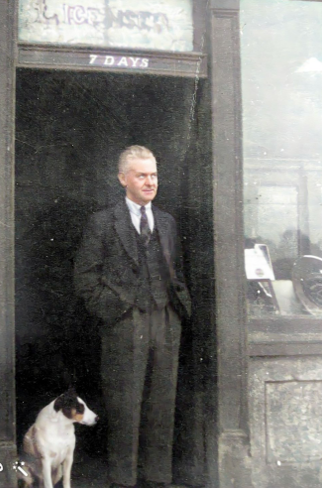
Top left: Nora McInerney behind the counter of her grocery and public house in 1940. Top right: Paddy McInerney outside of his premises 


Right: Paddy Moroney, John Guerin, Tom O’Brien, Tom Fahy, Charlie Scanlon, Jim Meaney, Jim Clune, Pat Conroy, Paddy & Nora McInerney.

Courtesy of Life Magazine 1931

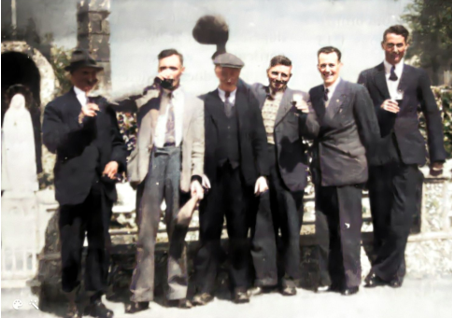
Left: Tom Cullinan, Tom Fahy, Jim Clune, Jim Woulfe, Tommy King, Mike O’Neill. Taken across the road from McInerney’s pub in 1950.

Life magazine and the Post magazine featured photos and some detail relating to life in Quin in 1939. One of their photographers stopped off in the village and we now benefit from the records left behind. The aerial image alongside photos taken in McInerney’s pub; Corbett’s shop and parishioners leaving mass are all courtesy of these two magazines. A copy of the original Life magazine is in the possession of Quin Heritage Group.


An Tearmann Quin Community Garden & the ‘Pound’

Tithes were the tax paid to Established Church (Church of Ireland), calculated as one-tenth of the rateable value of one’s agricultural produce. Readers of our ‘Know Your Townland’ series of posts will be familiar with seeing this listing by townland. A parallel list called the ‘Tithe Defaulters’ list was drawn up following the outbreak of the Tithe Wars.

Tithe War On March 3rd 1831, the Tithe War began, mostly in Leinster and East Munster.
The tithe, one-tenth of agricultural produce, later payable in cash, was owed to the minority Protestant Church of Ireland. In a country overwhelmingly Roman Catholic, with a substantial Presbyterian population as well, it was not only an unjustified theft of property but also a sectarian insult. A tenant, barely subsisting, was expected to fund the clergy of a church they did not attend.

Rev James Hall, in his ‘Tour of East Clare’, 1812 noted:

 “In every parish there is a pound-park, to which they take the cows, pigs, calves, and the like, of those who are in arrears for tithes. In eight days after the cattle have been in pound, if the owner do not come and relieve them, by paying the tithe and other expenses, the cow, or whatever it may be, is sold to the highest bidder; and the balance, if any, after paying what had been due, and all expenses, is given to the person to whom the animal, or thing, belonged. There is generally also a pound-park in the parish for the landholders; and middle-men, or receivers, do the same when there happens to be any arrear of rent.”

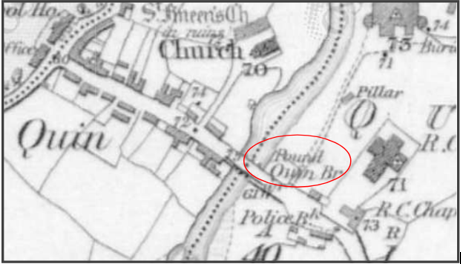
The ‘Pound’ for Quin was located on the site of the present community garden ‘An Tearmann’. It was captured in the first 6” OS map, which was published in 1842 but surveyed about 1839. This would have been at the height of the Tithe Wars and explains the existence of the ‘Pound’, at the time of the OS survey of Quin.

Fair Green

 The November fair, on the site of the existing Arbutus Grove homes, was once the main commercial and social occasion in the village. The Fair Green, where animals were assembled for buying and selling was on the far side of the village in the townland of Feaghquin, as one heads towards Kilkishen. The fair was once managed by the Singleton landlords, who collected the customary tolls at the time. With their departure, the Fair Green came into the ownership of Vincent Hassett.

Reddan’s Public House (42)

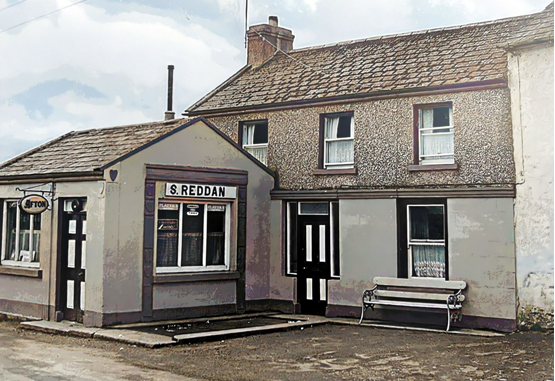
Reddan’s Pub, now Quin Post Office

Blacksmiths Forge (43)

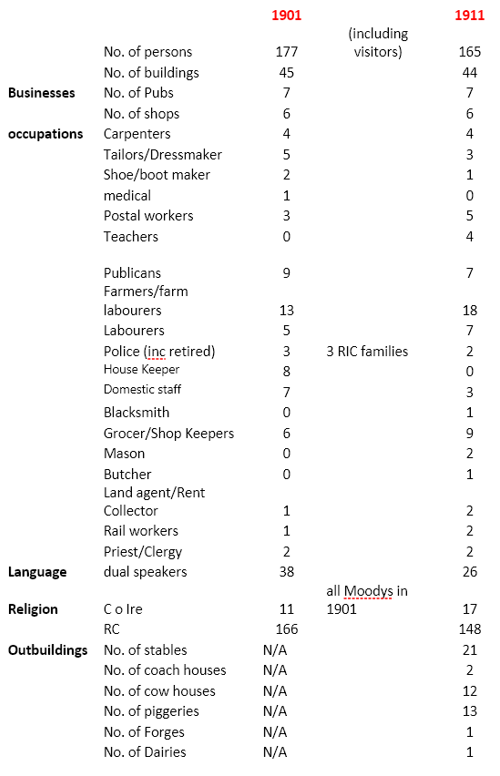
Burkes forge, later owned by Paddy Moroney, was on the site opposite Malachy Hassetts pub. The extract above from the 1901/11 census outlines the dependence of the village on the horse for transport, agriculture and leisure. The number of stables and coach houses underlines this, so there would have been a strong reliance on the services of a good blacksmith.


Hassetts Pub (46)

This pub and grocery shop was home to Denis and Mary Hassett in 1901. They reared three sons and a daughter here. It was passed to their son Jim and then to Patrick, better known as Malachy, in whose family name it is still in ownership today.

see: https://quinheritage.ie/malachy-hassett-quin/

Quin School Feaghquin (45a)

The first recorded ‘National school’ in Quin was opened in the year 1856. The school, known locally as a “Reading House,” was situated where Malachy Hassett has his stables in Feaghquin. The home of the late Mrs. Muriel O’Neill was at that time the residence of the teacher. The last teacher to live there was Mrs. Lena Weldon – Helena Degidon of Rylane and her husband John Weldon, aka the writer Brinsley MacNamara. The first recorded enrolment in the “Male School” in the year 1863 was Michael Clune – Carhugar – farmer, aged 15. In 1871, there is a record of the first infant, William Considine-aged six, whose father is registered as a teacher. Situated in Feaghquin, the ‘Old School’ was built in 1896. The boys and girls schools were amalgamated on April 1st 1928. Up to that year they were separate schools.The last significant upgrade was in 1960 at Newline. It was occupied in 1964. The old school was used by the local Macra na Feirme as a garage and training workshop for skills such as welding and mechanics for many years afterwards.It waas converted to a private home in the 1990’s and continues to be in private ownership to this day.

Brinsley MacNamara (45)

 This was the pen-name of John Weldon a writer, playwright and registrar of the National Gallery of Ireland. He was the author of several novels, the best known was his first, The Valley of the Squinting Windows (1918). The book caused a furore in his native Westmeath on its publication, to the extent that Brinsley had to retreat from his home place of Delvin. He continued to write for many years after his controversial first work. Among his plays are ‘The Glorious Uncertainty’ (1923) and ‘Look at the Heffernans’ (1926). On the 23rd of June 1920 MacNamara married local Quin girl, Helena Degidon of Rylan, in Clooney Church. Helena was a school teacher. The couple lived in Feaghquin next door to the school.


Born John Weldon, McNamara grew up in the small town of Delvin, Co. Westmeath, where his father was the schoolmaster. His work of fiction, ‘The Valley of the Squinting Windows,’ was written in 1916 and lambasted the gossip and crushing conformism which he felt exemplified rural Ireland at that time.
Garradrimna, the small town featured in the book, was a hotbed of gossip and scandal.
Its description in the book, even down to its population and layout, seemed to resemble Delvin closely.
As for the characters, the men were cruel drunks while the women were invariably judgmental and unpleasant. The schoolmaster was one of the few local people with redeeming features.

In 1918, the book finally made its way to Delvin where it was read publicly by groups of horrified townspeople. Many locals reportedly recognised themselves in the text and a group of men accosted James Weldon, the author’s father, roughing him up. He only escaped due to police intervention. They also sought out Brinsley McNamara, who was in the town but had been forewarned. He fled through the countryside, later stating that he believed he would have been killed had he been caught that night. The protestors had to make do with burning a copy of the book in a tar barrel in the town.


The criticism extended beyond Delvin.
The author was castigated for the negative portrayal of Ireland and the frank discussion of sexuality in the book. As one newspaper thundered: ‘It is a downright shocking book. The marrow of a cynicism, uncalled for, captious, sullen, vicious, currish and the meanly sordid is writ large upon its every page.
The author does not seem to have caught the small beauty of Irish village life. Rather, beetle-like, he has chosen to immerse himself in the fetid sordid meanness and reeking moral filth.’

Back in Delvin, a boycott of the family began when the shops in the town refused any of the Weldons service. The school in which Brinsley McNamara’s father taught was also boycotted with pickets placed outside the building. Half of the students were withdrawn in a boycott that lasted seven years and only ended when the Weldon family was forced to move away.

Brinsley McNamara himself went on to become a well-known actor in Dublin and the registrar of the National Gallery of Ireland. His publishers had withdrawn his book from circulation, however, and the controversy had a profound effect on his family and the town of Delvin. It is likely that neither he, nor the village of Delvin, never forgot the reaction to ‘The Valley of the Squinting Windows.’ It is likely, also, that other Irish authors of the era thought twice before writing a negative portrayal of their homeland after such a reaction.