Ballymacloon is divided into three townland names by spatial identification as Ballymacloon North, East and West.
As will be evident from this post, the Clune/McGlúin clan have long been a presence and continue to be so in this area today.
The Down Survey only records one townland as Ballamclune, which is probably closer to the present spelling of the family name with which it is identified. It is recorded as being part of the parish of Quinkey. Please see the the list compiled by the Placenames Branch/Logainm.ie outlining the evolution of the name at the end of this post.
Pre-Cromwellian ownership
1543: Ownership of these townlands passed from the MacGlúin (Clune) clan to the O’Briens as part of a widespread transfer to the newly appointed O’Brien Lordship of Thomond. In 1635 his agent, James McEnerhine (McInerney) acted as arbitrator in a case against Loughlin McCloon for unlawful mortgage of these lands. Further details are provided under Historical References at the end of this post.
1641 owner(s): Dr Thomas Arthur is the sole (Catholic) owner for all of Ballamclune.
1670 owner(s): John White is the sole (Protestant) owner for all of Ballamclune.
1671 These lands were claimed (unsuccessfully) by Mcnamara Finn of Dangan Uí Bhigín as part of the inquisitions.
Ballymacloon East
Ballymacloon East consists of 134 acres/0.6 square kilometres. It still retains a small portion of what is designated as ‘Native Woodland’.
1841: Households 4, Population 24
1851: Households 2, Population 16
1855 Griffiths Valuation: Frost, Slattery, Fox, Moloney
1891 Census: Population 7, no names available
1901 Census family names: Grady(4), Hogan(1), O’Brien(1 RIC), Early(1 RIC). Population:7
1911 Census family names: Grady(4), O’C, J, H. Population:7

Ballymacloon West
Ballymacloon West consists of 123 acres/0.5 square kilometres.
1841: Households 2, Population 19
1851: Households 5, Population 30
1855 Griffiths Valuation: Clune, Brown
1891 Census: Population 21, no names available
1901 Census family names: Clune(14), Lyons(1), Halloran(1). Population:16
1911 Census family names: Clune(10), Halloran(1), Boland(1), Duffy(3). Population:15

Ballymacloon North
Ballymacloon North consists of just 9 acres/0.04 square kilometres. It lies north of Cutteen and is entirely used for agriculture only. It is not adjacent to the other two Ballymacloon townlands.
1841: Households 3, Population 21
1851: Households 0, Population 0
1855 Griffiths Valuation: Matthew Clune, Eliza Brown
1901 Census family names: None in residence
1911 Census family names: None


Features of interest
Ballymacloon East is home to a number of archaeological features of interest.

Toberaneeeve/Tobar an Naoimh-Well of the Saint (CL042-041002) and Cillín
This well is located in a grazing field and is marked by an island of small trees, mostly whitethorn. There is a mass rock and a cillín in the immediate area. A cillín is a graveyard on unconsecrated ground where unbaptised children were often buried. The well itself is no longer evident.
Béaloideas – The Tale of Ballymacloon Well
There is a very interesting story recorded in the 1930’s Schools Folklore Collection, as told by Michael Clune. It seems to relate to the well in Ballymacloon East and suggests an explanation for some of its unique features. The story concerns love and courtship between a couple from different classes of Quin society. It is outlined in detail elsewhere on the Quin Heritage website and need not be repeated here, but please do look it up.
https://www.duchas.ie/ga/cbes/5177635/5174738?HighlightText=Quin&Route=stories&SearchLanguage=ga

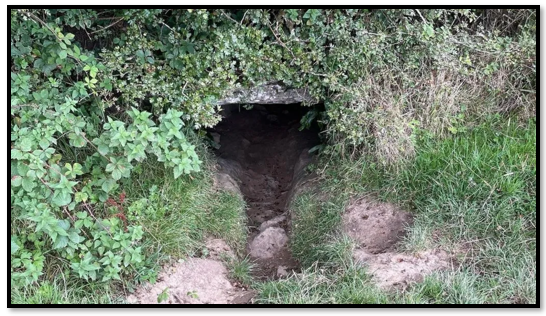
Ballymacloon Ringfort/Lis & Souterrain CL042-043002
On the border between Ballymacloon East and West, it is shown as a ringfort and cave on the OS 6” map.
From The Proceedings of The Royal Irish Academy – Thomas Westropp 1913 – Types of Ringforts Remaining in East Clare;
Macan was of Lismacain, near Sodhmacain, or “Macan’s Weir”. Now, the narrative implies that Macan lived close to the mound on Magh Adhair, on some stream. The name “Lismacain” is lost, but, in 1287, there was a “Ballymaking” on the northern edge of the English lands, apparently at or near Ballymacloon, and to the east of Quin. It is quite possible (indeed probable) that the important Liss, with the flooded souterrain, in Ballymacloon, the earthen fort best meeting the above conditions, may be the spot intended; unless (which we have nothing to show) the actual (as apart from the supposed) Norman territory, lay across the river, when the Liss may have been Creevagh. The only Liss name within the river-loop is Ballylassa, in quite the other direction.
For a more detailed description of this ringfort and souterrain, see the separate post on quinheritage.ie ‘Ballymacloon Ringfort & Souterrain’.
Ballymacloon Dolmen (Megalithic Structure CL042-038)
This can be found in Ballymacloon East, shown on the OS map as a Cromlech and described by Westropp as a “simple cist” in The Cists, Dolmens and Pillars of the eastern half of the County of Clare P.85:
One (of the two parish dolmens) stands near a small lake in a field with outcrops of rock in Ballymacloon. It is entirely overthrown, but was of rude and massive slabs of gritstone. One measures 7 feet, east and west, by 5 feet 3 inches. It is shown on the map of 1840 as a massive block, resting on three lesser stones. Near it is a dolmen-like slab resting on a large boulder, but probably natural, and certainly bearing no marks of human workmanship.
Historical References:
HISTORY AND TOPOGRAPHY THE COUNTY OF CLARE, , EARLIEST TIMES TO THE BEGINNING OF THE i3tH CENTURY, WITH MAP AND ILLUSTRATIONS, JAMES FROST, M.R.I. A.
We give here translations of some Irish Deeds relating to lands situate in Quin. “Partition of Land, 1543: The effect of this writing is as follows: A partition is made by Donogh O’Brien, and by Conor son of Donogh MacGluin, between Mahone son of Morogh MacGluin and his brother Donogh to wit, to Donogh the quartermeer of the half quarter nearest to the fort of the half quarter of Cullenagh in Ballymacloon, and the half quartermeer of Derreen in Carrowgar, the half quartermeer of Lisduff in Creevagh, and the half quartermeer Clonmore in Creevagh, comprising five half quartermeers. All the lands possessed by the said MacGluins over and and above those heretofore mentioned are to be divided share and share alike between them. Written at Cuincé (Quin), the 11th of July, 1542. The witnesses present are God in the first place, Donogh O’Brien, Teige MacConmeadh MacNamara, Donogh son of John (M‘Namara), of Kilkishen; Teige Ultagh, of Ballymacashel; Conor MacGluin, Richard Roe MacMaoilin, Conor Balv (the stammerer), O’Rodan the steward of O’Brien.
- Mahone MacGluin.[29]
Purchase of Land, A.D. 1545.
“This is the amount of the mortgage which Murrogh, son of Donogh M‘Gluin, paid for the half quarter of the Liss of Carnmallow for Donogh, the son of Conor O’Brien, [30] and also for Murrogh himself, viz. twenty milch cows with her calves, twenty in-calf cows, a dozen of heifers, and two strippers. This mortgage was given to John son of Loghlen MacNamara of Ballymarkahan, for the half quarter of Lisheennabunnia, and for the half quartermeer of Ballyanerball. It is by the consent of Teige son of Loghlen his brother, that Mahone mortgaged the half quarter of the Liss and Knock in the first-mentioned lands. All other lands which the aforesaid race of MacGluin should acquire to be enjoyed, share and share alike, between themselves and their foster brother said Donogh O’Brien and their heirs. At the expiration of five years afterwards Murrogh MacGluin gave sixty marks to said Mahone and Teige son of Loghlen, for the fee-simple of that land for ever, according to the form and covenant before mentioned. Anno Domini, 1545. In witness whereof we, Mahone, son of Loghlen of Ballymarkahan, and Teige son of Loghlen of the same place, do set our hands to this deed in presence of witnesses here present.— Mahone MacLoghlan, Teige MacLoghlen. Murrogh O’Brien is the O’Brien at this time.[31] (Murchad O’Brian, na O’Brian an tan so). These are the witnesses present, viz., Teige MacNamara and John MacNamara of Danganbrack; Donald M‘Rory of Caherscooby; Flaherty O’Liddy of Shandangan; Teige O’Brien of Quin; Thomas Duff, son of Miler of Kilnahow; Teige, son of Donogh, son of John, of Cloonlissan; and many others not mentioned here

-A 1640 register of the Thomond Papers at Petworth House by Luke McInerney p44.
Despite the dominance of English as a written language, day-to-day communication with tenants and legal agreements continued in Irish. Only the literary families and their cultivated circle who had a longstanding tradition of literacy in Irish continued to produce writings and agreements in that language. Legal writings in Irish still had a measure of value as proof of past treaties. As late as 1635, an agreement concerning Ballymacloone near Quin cited an earlier Irish indenture that can be identified as one of two deeds in Irish (dated 1542 and 1545), that survived and was published by Hardiman in 1826.86 These deeds related to the inheritance of the McCloones of Quin and show the continuing curation of Irish language deeds by the Thomond O’Briens. It also shows that the utility of Irish language deeds, though swiftly declining by the time of the Ballymacloone deed, continued in some attenuated form on the Thomond estates even after they had fallen out of direct use.
War dead from Ballymacloon
James Hayes: Born in Ennis, lived in Quin, died of wounds 7th July 1917 age 27, Irish Guards 1stBattalion 5332 (just before the Battle of Passchendaele), Guards Division, G/M in Belgium. Son of Patrick and Margaret Hayes, Ballymacloon Quin.
Historical references to place name

Births recorded in the 3 townlands of Ballymaclune (B/macloon) in 1800’s
| Child’s name | Father’s F/name | Mother’s name | Date of Birth | ||
| Michael | Boyce | John | Carmody | Margaret | 20.07.1861 |
| Martin | Clune | Connor | Magennis | Ellen | 15.11.1857 |
| Timothy | Clune | James | Nash | Judith | 18.06.1861 |
| Daniel | Clune | James | Nash | Johanna | 18.04.1865 |
| Mary | Clune | Martin | Woolfe | Jane | 26.03.1864 |
| Matt | Clune | Martin | Woulfe | Jane | 04.03.1860 |
| Michael | Clune | Martin | Woulfe | Jane | 03.09.1861 |
| John | Clune | Martin | Woulfe | Jane | 10.02.1866 |
| Cornelius | Clune | Martin | Woulfe | Jane | 25.08.1867 |
| Daniel | Clune | Martin | Woulfe | Jane | 14.04.1869 |
| Thomas | Clune | Martin | Woulfe | Jane | 24.02.1871 |
| James | Clune | Martin | Woulfe | Jane | 08.01.1873 |
| Martin William | Clune | Martin | Woulfe | Jane | 27.04.1875 |
| Bridget | Clune | Martin | Woulfe | Jane | 09.10.1877 |
| John | Clune | Michael | McDonnell | Margaret | 14.01.1879 |
| Ellen | Corbett | Pat | Clune | Bridgid | 19.01.1880 |
| Kate | Fox | Daniel | Warrant | Kate | 29.05.1861 |
| Peter | Fox | Daniel | Warren | Catherine | 03.07.1858 |
| Johanna | Fox | Daniel | Warren | Catherine | 12.03.1864 |
| Mary | Meany | William | Hassett | Susan | 18.11.1860 |
| Ellen | Meany | William | Hassett | Susan | 09.05.1863 |
| Bridget | Meany | William | Hassett | Susan | 31.03.1865 |
| John | Meany | William | Hassett | Susan | 19.02.1871 |
| Patt | Meany | William | Hassette | Susan | 23.01.1859 |
| Michael | Meany | William | Hassette | Johanna | 15.09.1867 |
| Martin | Ryan | John | Carty | Mary | 04.11.1860 |
| Cornelius | Ryan | John | Carty | Mary | 15.08.1865 |
| Bridget | Ryan | John | Carty | Mary | 08.01.1870 |
| Catherine | Ryan | John | Carty | Mary | 14.04.1872 |
| Susan | Ryan | John | Carty | Mary | 29.08.1874 |
| Anne | Ryan | Patt | Ryan | Mary | 01.01.1861 |
| Miss | Bigane | (?) | McNamara | Mary | ??.08.1834 |
| John | Brasil | Thomas | Clune | Anne | 22.06.1824 |
| James | Brassil | Thomas | Clune | Anne | 17.11.1816 |
| Catherine | Brassill | Thomas | Clune | Nancy | 03.05.1827 |
| Mary | Brassill | Thomas | Clune | Nancy | 29.04.1830 |
| John | Brazil | Thomas | Clune | Anne | 08.03.1821 |
| Winny(?) | Broady | Martin | Meer | Kate | 04.11.1843 |
| Margaret | Callaghan | Tom | Moylan | Bridget | 13.02.1852 |
| Mary | Carney | James | Clune | Margaret | 28.12.1821 |
| Ellen | Carney | James | Clune | Margaret | 08.03.1824 |
| Corney | Cluin | Conor | McCuinness | Ellen | 27.10.1838 |
| Catherine | Clune | Conner | McInnis | Ellen | 13.10.1836 |
| John | Clune | Connor | McGinness | Ellen | 10.06.1843 |
| Michael | Clune | Connor | McGinnis | Ellen | 10.09.1845 |
| Patt | Clune | Connor | McGuiness | Ellen | 18.05.1841 |
| John | Clune | Connor | McGuiness | Ellen | ??.06.1843 |
| Matt | Clune | Connor | McGuiness | Ellen | 01.08.1850 |
| Bridget | Clune | Cornelius | McGennis | Anne | 02.02.1853 |
| Mary | Clune | James | Nash | Judy | 29.08.1853 |
| John | Clune | John | Moroney | Peggy | 18.06.1843 |
| Patrick | Clune | John | Morony | Margaret | 03.01.1833 |
| Cornelius | Clune | John | Morony | Margaret | ??.05.1834 |
| Ann | Clune | John | Morony | Margaret | ??.06.1836 |
| Mary | Clune | John | Morony | Margaret | 11.05.1838 |
| Margaret | Clune | John | Morony | Margaret | 01.11.1840 |
| Mat | Clune | John | Morony | Pegy | 04.07.1846 |
| Thady | Clune | John | Morony | Margaret | 08.04.1849 |
| Martin | Clune | Mathew | Brown | B. | 12.11.1823 |
| Thomas | Clune | Mathew | Brown | Briget | ??.05.1827 |
| Lucy | Clune | Mathew | Brown | Briget | 06.05.1832 |
| John | Clune | Mathew | Brown | Bridget | 26.12.1834 |
| John | Clune | Matt | McMahon | Bridget | 30.06.1837 |
| Honora | Clune | Pat | Meaney | Ann | ??.11.1838 |
| Margaret | Clune | Thady | Lynch | Mary | 27.11.1828 |
| Mary | Clune | Thomas | Lynch | Mary | 08.02.1836 |
| Matt(?) | Clune(?) | Matt | Reidy | Bridget | 27.02.1841 |
| Patrick | Collins | Patrick | Hynchy | Ellen | 14.02.1830 |
| Anne | Commane | Joseph | Quinlivan | Mary | 25.02.1817 |
| William | Duire(?) | Daniel | Hurley | Rosanna | 29.10.1819 |
| Michael | Fahy | James | O’Brien | Judy | 21.08.1844 |
| Mary | Fall | James | Warrant | Mary | 15.02.1844 |
| Stephen | Faul | James | Warrant | Mary | ??.07.1839 |
| William | Fox | Daniel | Warrant | Catherine | 23.04.1843 |
| Mary | Fox | Daniel | Warrant | Cath/Anne | 28.02.1847 |
| Daniel | Fox | Daniel | Warrant | Catherine | 21.05.1850 |
| Patt | Fox | Daniel | Warrant | Catherine | 01.05.1853 |
| Eliza | Haneen | Matt | Hynes | Mary | 06.12.1839 |
| Michael | Hogan | John | MacDonnell | Anne | 14.11.1816 |
| Thomas | Hogan | John | McDonnell | Anne | 24.07.1823 |
| Patrick | Hogan | John | McDonnell | Nancy | 09.06.1826 |
| Matt | Hynes | James | Henessy | Bridget | 12.05.1839 |
| Eliza | Hynes | James | Hennessy | Bridget | 0?.01.1833 |
| Patt | Hynes | James | Hennesy | Bridget | 19.04.1837 |
| Betty | Hynes | Michael | Tuohy | Mary | 04.12.1842 |
| Darby | Hynes | Pat | Grady | Briget | 03.08.1831 |
| Bridget | Hynes | Pat | O’Dea | Catherine | 20.11.1833 |
| Eliza | Hynes | Thady | Liddane | Cath | 10.12.1843 |
| Mary | Hynes | Thady | Liddane | Catherine | 22.06.1845 |
| Honor | Kinelly | Connor | McMahon | Bridget | 24.05.1833 |
| Mary | Lynch | John | Clune | Ann | ??.12.1838 |
| McDonnel | Thomas | Murphy | 10.11.1841 | ||
| Pat | McNamara | Michael | McDonnell | Mary | 24.01.1834 |
| Patrick | Meany | Patrick | 01.03.1824 | ||
| Mary | Morrisy | Michael | Sadler | Margaret | 27.01.1846 |
| Wenifred | Russell(?) | Thomas | (?) | (?) | ??.02.1816 |
| Cate | Savage | Robert | Taylor | Honora | 17.09.1818 |
| Mary | Savage | Robert | Taylor | Hana | 21.06.1821 |
| Catherine | Slatery | Patrick | Taylor | Joane | 05.12.1830 |
| Pat | Taylor | Samuel | Lynch | Nancy | 26.12.1835 |
| Anne | Taylor(?) | James | (?) | Nancy | 10.08.1841 |
| Edmond | Warrant | Pat | Hussy | Bridget | ??.07.1839 |
Mick Maguire July 2024