In this post we examine a sparsely populated townland that was dominated by Ballyroughan House and the Quinlivan family. At one stage over a hundred people lived here (see census information below). Other surnames to be found include Ryan and O’Dea. A full list of births from 1816 to 1880 is provided at the bottom of the post should you seek to track distant relatives.
The two Ballyroughan townlands, North and South, are to be found at the eastern edge of the parish where we turn left from the Quin to Kilkishen road for Cragganowen. The name is recorded in the Petty Survey map 1663 as Ballirughan and the Tithes Applotment Books 1823-37 as Ballyloughan, one townland. It is recorded in the 1659 census as Ballyroughane and being in the ownership of Murrogh O’Bryen (gent). The origin of the name relates to the homestead of the Ó Rócháin family according to Logainm.ie.

Ballyroughan North or Baile Uí Rócháin Thuaidh is 0.4537 km²/0.18 square miles
National Monuments:
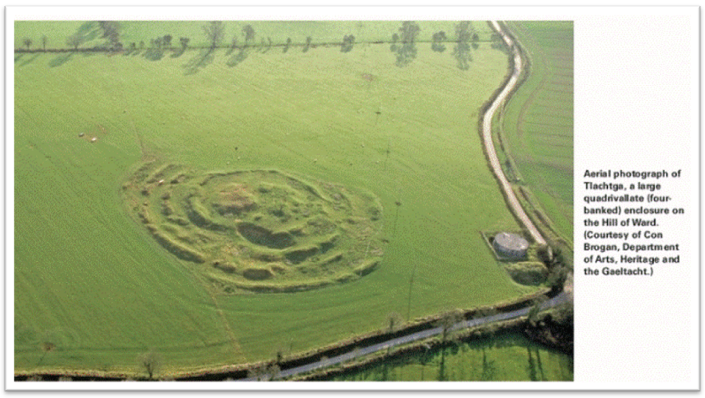
CL043-009— 043-/01/4 14589/17320 Enclosure
CL043-019— 043-/01/4 14589/17320 Enclosure
1855 Griffiths Valuation recorded landowners:
Thomas Hewitt, Crosdale Maloney
1861 Census:
2 household, 11 residents
1881 Census:
7 household, 32 residents
1901 Census of residents:
Pat and Kate O’Dea, son Michael, daughter Katie.
Total: 1 household, 4 persons
1851 Census:
1 household, 7 residents
1871 Census:
7 household, 35 residents
1891 Census:
1 household, 7 residents
1911 Census of residents:
Pat and Kate O’Dea, son Michael, daughter Katie. Total: 1 household, 4 persons
Ballyroughan South or Baile Uí Rócháin Theas is 0.6910 km²/0.27 square miles
National Monuments:
CL043-004— 043-/05/1 14567/17244 Enclosure
CL043-006— 043-/05/4 14578/17224 Enclosure
CL043-007— 043-/05/I 14575/17269 Enclosure
CL043-008— 043-/05/2 14595/17283 Enclosure

1851 Census:
17 households, 99 residents
1861 Census:
7 households, 38 residents
1871 Census:
6 households, 37 residents
1891 Census:
7 households, 33 residents
1911 Census of residents:
Ellen Murphy with son Michael and daughter Mary Ellen.
Patrick & Maria Daly with daughter Bridget.
Kate Quinlivan with daughter Maud, servants John Hinchy, John O’Halloran.
Total: 3 households, 10 persons
1855 Griffiths Valuation recorded landowners:
James Quinlivan, Michael Quinlivan, Arthur G Creagh, John Creagh.
1881 Census:
5 households, 30 residents
1901 Census of residents:
Ellen Murphy with 2 sons John, Michael, 3 daughters Maria, Anne, Mary Ellen.
Patrick & Mary Daly with daughter Bridget, son Thomas.
James & Kate Quinlivan with 3 daughters Maud, Cecilia, Christine, grandson Frank Quinlivan, grand daughter Kate Sexton, servant John Hinchy.
Hanoria Hogan.
Total: 4 households, 19 persons

Ballyroughan House
Ballyroughan House is associated with the O’Dwyer, Quinlivan and Armstrong families. It is a pleasant, two-storey, three bay, half- hip roofed house with a central rectangular lit front door and facing south-east over Rathluby Lough and valley. There is a small garden in front, and the yard and farm buildings adjoin the south-west. The gate piers and their incorporated style are unusual. Interesting stone ornaments adorn the garden. An identical extra bay was added to the south-west end in 1984.
The old stone cider trough from here was donated to Bunratty Folk Park. Tom Steele, whose goddaughter, Miss O’Dwyer (1820) and her close relative, Bishop Dwyer of Limerick, were connected with the house, stayed here whilst reconstructing nearby Craggaunowen Castle. A friend of Mr Quinlivan, he is reputed to have executed the ceiling in the north-east reception room during this period. In 1855 James and Michael Quinlivan were in possession of the house, and one hundred and seventy-two acre farm.
Paddy Hannan (Hanneen) who in 1843 was born in a thatched cabin on the farm, was one of the original miners in Australia and he discovered the Kalgoorlie Gold Mine in 1893.


Paddy Hannan, on the right of photo, alongside a fellow prospector Richard Greaves.
Above, the 1993 unveiling of the commemoration plaque acknowledging his achievement by family members and book author in Quin.
Closing Comments
The population collapse of this townland immediately after the famine is not surprising, but what is striking is the fact that it was able to sustain so people in the first place. It is located in one of the most scenic locations in the parish, but that didn’t put bread on the plate. Its hillside location overlooking a number of different lakes in surrounding townlands adds to its appeal. Within Ballyroughan North is a small lough called Lough Derragher. Given that no mention is given of thie name Uí Rócháin in available records, you would have to wonder if the name given the townland in the Applotment Books – Ballyloughan, might make a lot more sense for this townland of small lakes!
Historical References & Research
Quinlivans of Ballyroughan:
https://clarelibraries.ie/localstudies/clare-past-forum/viewtopic.php?t=3873
Paddy Hannon Kalgoorlie gold mine:
https://ebw.pms.mybluehost.me/paddy-hannan-ballyroughan-gold-prospector/
“The Deposition of James Vandelure, Dutch resident of Sixmilebridge, listed money owed to him by his debtors in the Kilmurry and lower Tulla region among Gaelic landholder and incomer alike, including Oliver Delahyde of Tyredagh, John MacNamara of Ralahine, Conor O’Brien of Ballymulcashell, John Reagh MacNamara of Kilmurry, Owen Molony of Ballyroughan, Daniel MacNamara of Mountallon, and Thomas and William Creagh of Sixmilebridge”
Births in Ballyroughan 1816 to 1880
| Forename | Surname | Father’s Forname | Mother’s Surname | Mother’s Forname | Date of birth |
| Brigid | (?) | Daniel | Cullinan | Mary | 10.06.1816 |
| Dennis | (?) | Daniel | Molony | Margaret | 23.06.1833 |
| Mary | Burke | John | Conlan | Briget | 29.06.1825 |
| Mary | Burke | Thomas | Donnelan | Mary | 04.09.1850 |
| John | Burke | Tom | Donnelan | Mary | 09.05.1847 |
| Mary | Clune | Connor | O’Brien | Margaret | 02.02.1819 |
| Mary | Clune | Tead | Lynch | Mary | 28.05.1842 |
| Michael | Connellan | Thomas | Corbett | Bridget | 04.09.1824 |
| Margaret | Croghan | Laurence | Kirrane | Mary | 10.09.1829 |
| Patrick | Donoghoe | James | Fox | Margaret | 17.02.1831 |
| Eliza | Flaherty | Dennis | Lyons | Mary | 23.07.1844 |
| Briget | Garrahy | James | Lynch | Catheirne | 2?.01.1828 |
| Cate | Griffin | Pat | Tobin | Mary | 05.02.1840 |
| Richard | Griffy | Pat | Glynn | Mary | 20.01.1833 |
| Tom | Griffy | Patt | Tobin | Mary | 10.12.1843 |
| James | Hassett | Timothy | McNamara | Norry | 13.04.1828 |
| Bridget | Hassette | Michael | Callahan | Anne | 31.12.1853 |
| Hana | Hynes | Patrick | Graddy | Bridget | 02.12.1821 |
| Mary | Hynes | Patrick | 21.04.1824 | ||
| Michael | Kelly | Pat | Ryan | Briget | 29.09.1839 |
| Thomas | Lyddy | Lyddy | 17.07.1817 | ||
| James | Lyddy | Patrick | Spellissy | Anne | 08.01.1816 |
| Patrick | Lyddy | Patrick | Spellissy | Anne | 24.03.1818 |
| Margaret | Lyddy | Patrick | Clancy | Margaret | 19.06.1816 |
| Anne | Lyddy | Patrick | Littleton | Anne | 24.06.1829 |
| John | McInerny | James | Conlon | Honora | 12.09.1853 |
| Mary | McMahon | James | Fox | Mary | 12.09.1842 |
| John | McMahon | James | Fox | Judy | 16.04.1844 |
| Briget | McMahon | James | Harrington | Mary | ??.07.1835 |
| Mary | McMahon | Michael | Moran | Mary | 09.03.1837 |
| John | Meany | Michael | McMahon | Margaret | 02.11.1839 |
| Thomas | O’Brien | Cornelius | Tracy | Bridget | 29.11.1821 |
| John | O’Brien | Pat | Earles | Margaret | ??.08.1835 |
| Pat | O’Brien | Pat | Earls(?) | Margaret | 24.02.1827 |
| Norry | O’Brien | Patrick | E(?)ls | Margaret | 16.05.1830 |
| Margaret | O’Brien | Patrick | Earles | Margaret | 04.03.1838 |
| Hanna | O’Neal | Pat | Qullinan | Hanna | ??.11.1837 |
| James | O’Neil | James | Kean | Mary | 07.07.1833 |
| Michael | O’Neil | Pat | Cullinan | Hannagh | 20.05.1827 |
| Patrick | O’Neil | Patrick | Cullinan | Briget | 17.01.1830 |
| John | O’Neill | James | Cullinan | Hannah | 15.07.1840 |
| Thomas | O’Neill | Patt | Cullinan | Hannah | 10.04.1844 |
| Pat | O’Shea | Michael | Houragan | Ellen | 18.02.1833 |
| Michael | Quinlivan | James | Dwyer | Mary | 25.08.1821 |
| James | Quinlivan | James | Dwyer | Mary | 28.04.1825 |
| Martha | Quinlivan | James | Dwyer | Mary | 04.05.1826 |
| Mary | Quinlivan | James | Dwyer | Maria | 18.03.1830 |
| Susanna | Quinlivan | James | O’Dwyer | M. | 11.05.1823 |
| Margaret | Quinlivan | James | Mary | 04.10.1819 | |
| Mary | Quinlivan | Michael | D(?) | Ellen | 06.05.1821 |
| Margaret | Quinlivan | Michael | Dendon | Helen | 07.02.1817 |
| Ellen | Quinlivan | Michael | Dondon(?) | Ellen | 06.12.1825 |
| Eliza | Quinlivan | Michael | Dundon | Ellen | 24.10.1823 |
| Patrick | Quinlivan | Michael, Farmer | Ellen | 03.03.1819 | |
| James | Riordan | James | Ryan | Cate | 28.02.1820 |
| Laurence | Riordan | James | Ryan | Catherine | 15.10.1821 |
| Mary | Riordan | Thady | Quinlivan | Bridget | 24.05.1841 |
| Mary | Ryan | Daniel | Cullinan | Mary | 20.03.1827 |
| Jenny | Ryan | Daniel | Cullinan | Mary | 01.10.1829 |
| Tom | Ryan | Michael | Hogan | Eliza | 13.04.1849 |
| Mary | Ryan | Pat | Lyddy | Mary | 23.07.1821 |
| Mary | Ryan | Pat | McNamara | Mary | 18.12.1828 |
| Ann | Ryan | Pat | McNamara | Mary | ??.07.1835 |
| Thomas | Ryan | Pat | Neill | Bridget | 09.12.1847 |
| Pat | Ryan | Pat | Brigid | 09.07.1817 | |
| Bridget | Ryan | Pat | Mary | ??.07.1839 | |
| James | Ryan | Patrick | McNamara | Mary | 09.12.1830 |
| Honor | Ryan | Patt | Mack | Mary | 04.10.1844 |
| Margaret | Ryan | Patt | O’Neill | Bridget | 05.08.1849 |
| Timothy | Ryan | Patt | Ryan | Bridget | 20.10.1818 |
| Michael | Ryan | Roger | O’Brien | Mary | 27.09.1816 |
| James | Ryan | Thomas | Hynes | Jane | 05.08.1817 |
| Nancy | Sadler | Daniel | Molony | Margaret | 08.05.1836 |
| James | Shea | Michael | Houragan | Mary | ??.04.1835 |
| Catherine | Shea | Michael | Hourigan(Hannigan?) | Ellen | 24.05.1841 |
| Daniel | Sheehan | Michael | Gleeson | Briget | 26.02.1827 |
| Pat | Tierny | John | Delahunty | Ellen | 18.01.1834 |
| Mary | Tierny | John | Delahunty | Ellen | 18.01.1834 |
| Mary | Tobin | Edmond | Enright | Mary | ??.06.1837 |
| Bridget | Tracey | Connor | Tracey | Mary | 28.12.1823 |
| Anne | Hassette | Michael Hassette | Callinan | Anne | 04.04.1855 |
| Mary | McMahon | James McMahon | Conlan | Mary | 03.03.1861 |
| Catherine | McMahon | James McMahon | Conlon | Mary | 22.05.1859 |
| Bridget | McMahon | James McMahon | Conlon | Mary | 21.02.1863 |
| Anne | McMahon | James McMahon | Connellan | Mary | 27.03.1857 |
| Bridget | O’Dea | Patt O’Dea | Hallinan | Catherine | 04.03.1866 |
| John | O’Dea | Pat O’Dea | Hallinan | Kate | 03.05.1874 |
| Anne | O’Dea | Patrick O’Dea | Hallinan | Kate | 08.01.1870 |
| Mary | O’Dea | Patrick O’Dea | Hallinan | Kate | 10.03.1872 |
| Patrick | O’Dea | Patrick O’Dea | Hallinan | Kate | 20.04.1876 |
| Mary | O’Dea | Patt O’Dea | Hallinan | Kate | 19.01.1868 |
| Honora | O’Dea | Patt O’Dea | Hallinan | Kate | 21.05.1878 |
| Catherine | O’Dea | Patt O’Dea | Hallinan | Kate | 19.10.1880 |
| Bridget | Burke | James Burke | Halloran | Mary | 30.07.1859 |
| Patt | Ryan | James Ryan | Hinchey | Bridget | 11.07.1869 |
| Martin | Ryan | James Ryan | Hinchey | Bridget | 09.11.1873 |
| James | Ryan | James Ryan | Hinchey | Bridget | 24.06.1876 |
| Mary Anne | Ryan | James Ryan | Hinchy | Bridget | 13.03.1875 |
| Mary Ellen | Quinlivan | Laurence Quinlivan | Hogan | Margaret | 07.01.1865 |
| Michael | Quinlivan | Laurence Quinlivan | Hogan | Margaret | 14.10.1866 |
| Bridget | Murphy | Patt Murphy | Keeffe | Ellen | 25.02.1877 |
| William | Hanneen | John Hanneen | Lynch | Bridget | 24.01.1858 |
| Catherine | Burke | Michael Burke | Mac | Catherine | 03.09.1865 |
| Martin | Quigley | Andrew Quigley | Mac | Eliza | 09.11.1861 |
| Patt | Quigley | Andrew Quigley | Mack | Eliza | 04.09.1866 |
| Mary | Murphy | Pat Murphy | O’Keeffe | Ellen | 15.08.1875 |
| Cecilia Bridgid | Quinlivan | James Quinlivan | Ryan | Cath | 09.02.1879 |
| Patrick | Quinnlivan | James Quinnlivan | Ryan | Cath | 24.10.1861 |
| Augustine | Quinlivan | James Quinlivan | Ryan | Catherine | 04.05.1863 |
| Morry | Quinlivan | James Quinlivan | Ryan | Catherine | 21.07.1865 |
| Teresa | Quinlivan | James Quinlivan | Ryan | Catherine | 21.07.1865 |
| Agnes | Quinlivan | James Quinlivan | Ryan | Kate | 20.06.1867 |
| Jane | Quinlivan | James Quinlivan | Ryan | Kate | 10.04.1869 |
| Kate | Quinlivan | James Quinlivan | Ryan | Kate | 25.08.1870 |
| Norah | Quinlivan | James Quinlivan | Ryan | Kate | 29.10.1872 |
| Monica | Quinlivan | James Quinlivan | Ryan | Kate | 21.03.1874 |
| James | Quinlivan | James Quinlivan | Ryan | Kate | 03.07.1875 |
| Margaret | Quinlivan | James Quinlivan | Ryan | Kate | 31.10.1876 |
| Matilda | Quinlivan | James Quinlivan | Ryan | Kate | 31.12.1877 |
| Michael | Quinlivan | James Quinlivan | Ryan | Kate | 17.10.1880 |
| James | Ryan | James Ryan | Ryan | Mary | 18.11.1871 |
| Bridget | Ryan | Patt Ryan | Ryan | Mary | 01.01.1860 |
| Denis | Flaherty | Thomas Flaherty | Shallue | Anne | 01.01.1869 |


Tom Lynch, ancestor to Paddy Hannan, showing ruins of the original family cottage in Gorteen where Paddy’s family lived before moving to Ballyroughan.