So, Brendan, son of Findlug, sailed then over the wave-voice of the strong-maned sea, and over the storm of the green-sided waves and over the mouth of the marvellous, awful, bitter ocean, where they saw the multitude of the furious, red-mouthed monsters, with abundance of great sea-whales. And they found beautiful, strange islands, and yet they tarried not therein.’
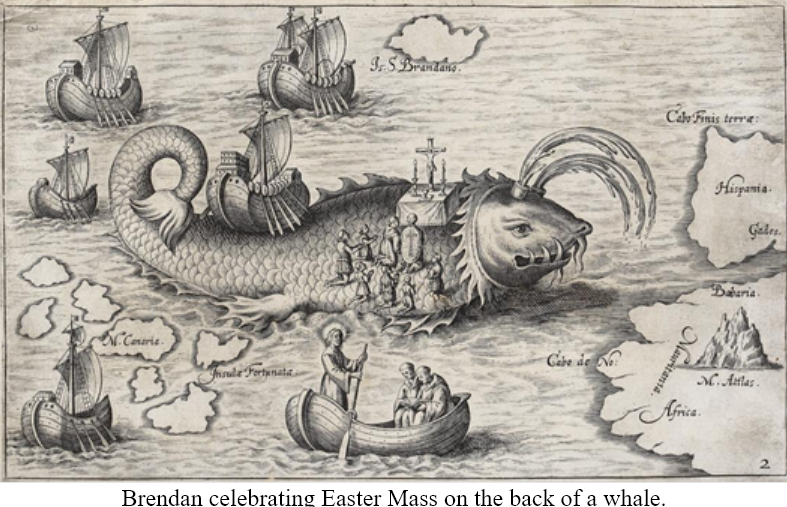
Naomh Breandán, an Loingseoir: Brendan the Navigator was born about 484AD in Fenit, North Kerry. He founded monasteries in Ardfert and Clonfert, Galway. Following a huge tradition of adventurous voyaging (Immram) he undertook a sea voyage in an open currach to the “Promised Land of the Saints”, in this instance America. His voyage was recorded in the ninth century account Navigatio Sancti Brendani, Abbatis, which was something of a European bestseller. It prompted other voyagers to sail west into the Atlantic. He died in 577AD

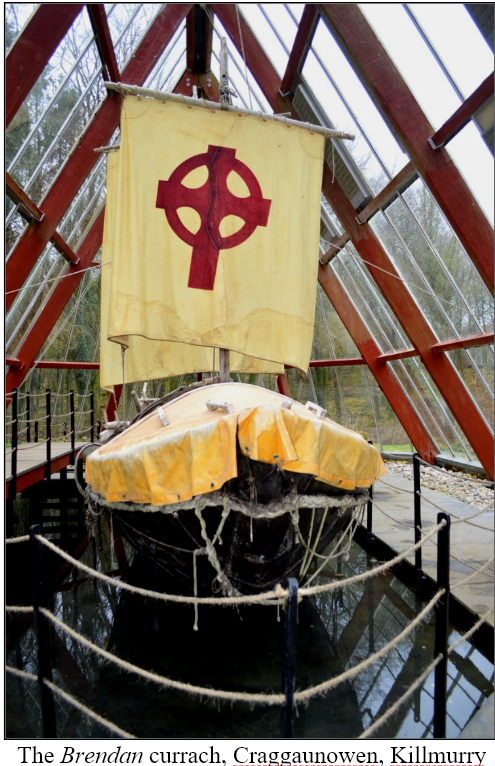
About 1400 years after Brendan’s voyage, Cork man Tim Severin constructed a leather sailing naomhóg using the same design and technologies as the saint. His boat ‘The Brendan’ was built of Irish ash and oak, hand-lashed with leather thongs, and wrapped in ox hides sealed with wool grease. In May 1976, I joined hundreds of others on a blustery day at the tiny harbour of Brandon Creek/Cuas an Bhodaigh in west Kerry. From here Brendan and his monks had sailed in the sixth century. There was a tangible sense that day that we were present at a juncture where new and old worlds met. This was the first attempt of the Brendan boat to set sail to the Americas. Because the seas and winds were too rough on the day, the sailing was postponed, eventually leading to a successful launch a week later.

Severin and his crew followed the route described in the Navigatio account finding and ticking off the various destinations reached by the monks as they sailed – the Hebrides, the Faroe Islands, Iceland, and Greenland. Overwintering in Iceland because of the early arrival of pack-ice to the west, the Brendan resumed its journey the following year and reached Peckford Island, Newfoundland in June 1977. Using oars and sail, it had successfully completed a journey of 4,500 miles. The voyage unequivocally demonstrated that sixth century Irish monks could have reached the New World. Here in East Clare, we are fortunate to have Tim Severin’s iconic Brendan boat as a permanent exhibit at nearby Craggaunowen, Kilmurry.
As well as Severin’s book on his voyage, the journey also inspired Shaun Davy to compose his wonderful musical suite ‘The Brendan Voyage’. Master piper Liam O’ Flynn used the uileann pipes as the voice of the leather boat, while the marine world of the Atlantic is performed by the symphony orchestra.

In 2016 I had the good fortune to meet Tim Severin, Shaun Davey and Liam O’Flynn at the Brendan boat in Craggaunowen. It is my regret that I did not bring my copy of ‘The Brendan Voyage’ that day and have them sign it for me. Both Liam and Tim have since died.

Give yourself a treat. Get a copy of Severin’s book, listen to the Brendan Voyage Suite (it’s on Spotify) and visit the leather boat in its glass shed at Craggaunowen. There you will connect with the 6th century saint, the 1970’s adventurer and get a glimpse of a Celtic world we are fast forgetting.

MH.

16/06/2026.

References:

Carl Selmer (Editor) Navigatio Sancti Brendani Abbatis, from Early Latin Manuscripts, Four Courts Press, Dublin, 1959.

Tim Severin, The Brendan Voyage, Mcgraw-Hill Book Co. , New York, 1978
William Marshal was the son-in-law of Richard de Clare, who we know of as Strongbow. Through marriage to the daughter of Aoife, daughter of Diarmuid MacMurrough, Marshal inherited vast tracts of land in Leinster. His wife was Isobel de Clare.


What did he ever do for us?

Marshal left his mark on the eastern side of the country through castle ruins at Ferns (home of the MacMurrough’s), Carlow, Kilkenny, Laois, amongst some others abroad. Most of his castles were built as four towered Keeps, in the same way as Quin Castle, built much later by Thomas de Clare. To re-imagine what his ancestor built in Quin, let’s look at what’s still extant elsewhere in Ireland.


Left: The marriage of Strongbow to Aoife. The painting depicts the 1170 marriage of the Norman knight Richard de Clare, 2nd Earl of Pembroke (“Strongbow”) to the Irish princess Aoife Ní Diarmait in Christ Church Cathedral, Waterford. It is portrayed as a pivotal moment in the Norman conquest of Ireland and the death of Gaelic Ireland.
In the foreground are the bodies of dead Irish warriors. To the left is a broken-stringed Celtic harp. Richard stands on a broken high cross.


Ferns Castle, Wexford

This castle was built on the site of the original MacMurrough clan seat of power to secure control of the region for William Marshal. The local Gaelic clans eventually burned them out in 1346, a faith very similar to that of Quin Castle. The Kavanaghs were then in control until 1540.

Carlow Castle, Carlow

Carlow Castle belongs to a small group of early stone castles known as four-towered keeps. These castles exhibit a rectangular or square design with cylindrical drum towers at each corner and cross-shaped arrow loop windows.

Excavations conducted in the 1990s revealed that the original structure was two storeys high, with some outer walls extending above the roof level. The castle walls measured 2.7 meters in thickness (as per Quin Castle) and rose from a battered plinth. The floors and roof were constructed from timber, with stone staircases embedded within the walls, providing access to the upper levels and roof. The entrance to the castle was located at first-floor level, accessible via a doorway in the north wall.

So what might Quin Castle have looked like?

We have other examples of Anglo Norman castles with round bastions, or towers supporting adjoining walls. Trim Castle, built by Hugh and Walter de Lacy, or Roscommon castle built by Robert de Ufford are of different footprint shape but otherwise similar. We know only that King John ordered the building of a castle in Limerick.

View from outside and inside a typical Norman Keep Castle


A previous attempt at recreating an image of Quin Castle was made by local architect, the late Frank O’Meara. As can be seen from this drawing, it is not dissimilar to what appears above in this post.


Left: Drawing by Frank O’Meara, courtesy of Ann McNamara Lawlor.

Is there a role here for AI?

Artificial intelligence may be useful and of course is improving all the time. Below is an attempt at availing of this tool to produce an image of Quin Castle surrounded by An Anglo Norman village. The moat and River Rine may not have been as wide as shown here:

We would welcome any input that readers would like to make to this exploration. The end result will help the visitors to our village gain a much better appreciation of what they are experiencing when they come here. Additionally, it will add Quin to the list of projects that will be undertaken next year as part of a broader European celebration.