Daniel Augustus Beaufort, Journey Through County Clare, August 1788

Clarecastle to Quin via Dromoland
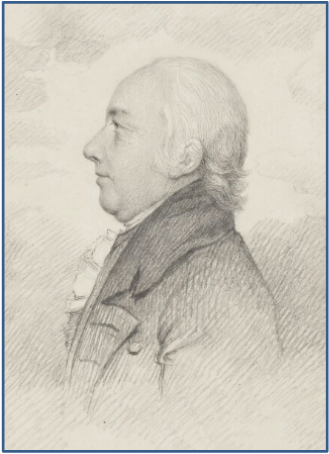
Daniel Augustus Beaufort LL.D. (1 October 1739 – 1821), was an Anglican priest and geographer, born in England to French Huguenot parents. He was rector of Navan, from 1765 to 1818, and a talented amateur architect also remembered for his 1792 map of Ireland.

Clare(Castle)

Immediately after church [Ennis] we set out and passed through Clare, a small town at the confluence of the Shannon and Fergus over which there is a good bridge and large vessels at its quay. Here is a castle now converted into a barrack for two companies who march to church to Ennis. Half way between these two towns are the ruins of Clare Abbey.

The country here is rich and good and full of gentlemen’s seats: Morriesk, Mr McNamara’s, which we saw at a distance, a Major Grant’s which we passed by are said to be very good and pretty places. But the largest in this country is Dromoland the seat of Sir Lucius O’Brien.

Just before we came to it we crossed on a high bridge a little river with deep muddy banks – the Wye in miniature. At the gate of Dromoland, we applied for leave to drive through the grounds which the porter told us every gentleman was welcome to do. So we went on by a pretty lake and then turned short by the offices, not to be seen, and were passed them a good way and making out of the avenue as fast as we could, when a man on horseback overtook us, whom we were striving to avoid and determined to refuse if he came with an invitation. But when we found it was Sir Lucius O’Brien himself, such a hospitable exertion was not to be refused – ergo – we turned to the antique mansion and spent a very pleasant day.

Dromoland

A large old house not regular and only part of a vast design, intended to connect with a castle, since pulled down, standing between terraces with gravel walks, grassy smooth slopes and distant objects seen through vistas in front. In the rear commanding a small lake, with fine woods overhanging a fine rising ground full of haycocks beyond it. The house covered with jasmine, a great aloe in a tub at the front and many very beautiful trees make this old fashioned place cheerful as well as magnificent.

In the house are several old family pictures of the O’Briens and some better ones of all the Clarendon family, from whom Sir Lucius is descended by the women. In a long tiled gallery full of maps and stags’ horns and other such things is a very curious massy table of some kind of mahogany, with four lions for legs and in the middle Hope on one side and Charity on the other for supporters, all rudely carved. This table was taken out of one of the ships of the armada wrecked on this coast 200 years ago and can be lengthened at both ends, in an uncommon manner, by drawing out two half leaves which are under it and the great upper leaf falling in between them which keeps all level and fast. Here we saw also an ancient sword which was in the hand of his ancestor Conor O’Brien when slain by General Ludlow.

Sir Lucius cultivates hemp and lucerne but R. W. had not time to stay for us to see this farm tomorrow.

Lady O’Brien is a very pleasant and very affable woman, has been very handsome, talks a good deal and was very attentive to me. Offered to write to Mr Pelham the painter and surveyor to meet me at Killarny. She showed us many miniatures of her father’s and uncle’s and of other paintings. She showed me Pelham’s original drawing of the County Clare. In short they were as civil as possible and pressed us to stay another day. They have eleven very fine children. Here are also two of his late brother’s Edward, James and Harriett: the boy a most beautiful intriguing face and seemingly very industrious to be informed, the girl handsome but, I think, not quite so pleasing in her manner as Nichola, Miss O’Brien’s name. But all these young people extremely well behaved and very attentive and civil to William.

The dinner was plain and plenty. We drank full enough, had coffee and a slight supper and at ½ past eleven retired to rest. This whole day has been intensely hot.

August 4th 1788

At 7 we took leave of the Baronet, for he was up, and passed through Ardsallas, a very small village where a great fair is held, to Quin where a few scattered houses form a little hamlet.
Quin

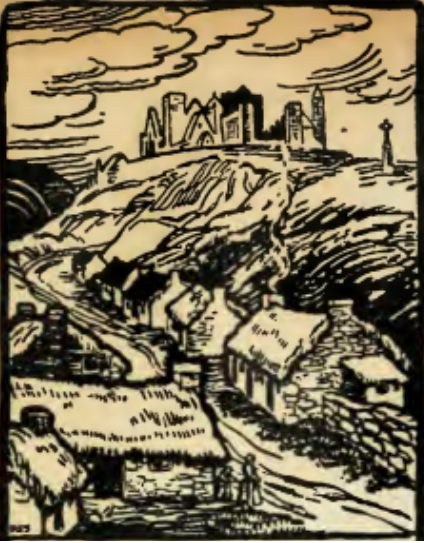
The abbey of Quin stands on a bank on the east side of a small river, which we passed yesterday, and makes a grand picturesque object. The west door is square on top and the ascent to it up several steps, 8 or 10, which are not quite destroyed, adds to the dignity of its appearance. The west aisle is 56 [feet] long by 23 wide. The steeple 15 [feet] square raised on four arches 7 feet 9 inches wide, and very lofty, at least 35 feet. In the choir over the stone arch of a tomb, are distinct remains of a large crucifix and other figures in stucco. On the south side there is a chapel called McNamara’s, well built of cut stone 39 feet long and 24½ wide, arch that breadth in the south wall of church. In this are 4 windows one at south end, one at west but not central and 2 at east side regular and a niche between them.

There were several detached buildings to this abbey but at the east end are two circular projections which look like the stumps of castles, the north one however seems to have been a dove cote, the south is more levelled.

The abbey belongs to Mr McNamara. The village to Sir Lucius and the opposite side of the river, where stands the ruined parish church, is Lord Pery’s.
What did the Anglo Normans ever do for us?

We are well aware of the impact of the Anglo-Norman invasion on our history, the undermining of Gaelic society and the replacement of our native structures. Poor old Diarmuid MacMurrough takes a lot of blame for all of this, despite the fact that Henry II in England had already sought and had been given approval by Pope Adrian to invade and civilise us. Henry was just waiting to finish his war in France before sorting us out!

Anyway, in they came, conquered, settled, married and eventually becoming more Irish than even ourselves, ‘níos gaelaí ná na Gaeil féin’! But besides building towns and castles, robbing our women (and probably taking our jobs!), what did the Anglo-Normans do for us – if anything?

Well, for one, they gave us a whole new suite of names, both forename and surname, to choose from.

The Norman influence on Irish surnames

Following the invasion of 1169, a large number of Anglo-French first and last names entered into Ireland. Many, such as Power, Browne, Fleming, Joyce, Burke, Barry, Costello, Nagle, Nugent, D’arcy, Roche and Walsh/Welsh/Wallace, are nowadays considered Irish and are commonly found in Clare. So, too, are those with the Fitz prefix such as Fitzmaurice, Fitzgerald, Fitzgibbon and Fitzpatrick which most people would regard as Irish as the shamrock. Fitz, meaning ‘son of’, can be considered the Norman version of Mac (it derives from the Latin/French ‘fils de’, meaning ‘son of’). Burke came from de Burgh, Roche from de Roiste, Power from de Paor.

In 1366, a law was passed that “Every Englishman do use the English language, and be named by an English name, leaving off entirely the manner of naming used by the Irish.” This was introduced to dissuade the settlers from adopting Celtic prefixes or forms of surname. It didn’t have much affect as many settler families added Mac or ‘O’ and Norman names evolved into an Irish form (eg McHenry, McArthur).

In 1465 a law was passed enacting “that every Irishman that dwells betwixt or amongst Englishmen in the County of Dublin, Myeth, Vriell, and Kildare … shall take to him an English Surname of one town, as Sutton, Chester, Trym, Skryne, Corke, Kinsale; or colour, as white, blacke, browne; or arte or science, as smith or carpenter; or office, as cooke, butler ….”

Many of the trades of the early medieval period such as Archer, Butler, Cooper, Carpenter, Draper, Skinner, Tanner found their way into our surnames. Other introductions from this period came from the mercenary soldiers who accompanied the Norman invasion: Walsh (meaning Welsh), Joyce and Fleming (from Flemish mercenaries) are examples.

Incidentally, the Normans usually took their surnames from the place of their family origins. So, D’arcy originates in Arcy in Normandy. De Clare originates in Clare in Suffolk where the Anglo-Norman family were based. While De indicated their place of origin, Le was used to describe them, eg Le Poer meant ‘a poor person’.

De Burgh – Burke – from a placename in Suffolk, France

Le Botilier – Butler – Occupation bottle steward

De Barra – Barry – from an estate in Wales

Le Waleys – Walsh – the Welshmen

De Angulo – Costello/Nangle – from Nangle Pembrokeshire

What of their influence on forenames?

 Many of the Normans forenames introduced here were of a biblical or European saintly origin.

 In 1922, Reverend Patrick Woulfe wrote extensively on the topic of Irish name origins as follows:

In the same manner Norman and English names became current in Irish families during the thirteenth and subsequent centuries. These have now almost completely supplanted the old Gaelic names. The names borne by the Normans and by them introduced into Ireland, were of three kinds :

 (1) names of Scandinavian origin which their ancestors had carried with them to Normandy ;

(2) names of Germanic origin which the Frankish conquerors had brought across the Rhine and which had ousted the old Celtic and Latin names from France ; and

(3) Biblical names and Latin and Greek names of saints,, which the Normans began to adopt about the beginning of the eleventh century.

Together with these came in a few Celtic names from Brittany, a small number of Anglo-Saxon names, some Danish and Norse names from England, and one or two British or Welsh names. These were nearly all very rare and most of them soon died out. Of the Anglo-Saxon names, only two, Edmund and Edward, survived. Alfred has been revived in recent times. At the period of the Invasion, Frankish names were by far the most popular among the Normans, but Biblical and saintly names were coming rapidly into favour.

The following is a list, in order of frequency, of the more common names borne by the early Anglo- Norman invaders, the Biblical and saintly names of Latin and Greek origin being printed in italics :

William, Robert, Richard, John, Walter, Roger, Ralph, Adam, Hugh, Henry, Thomas, Nicholas, Gilbert, Geoffrey, Elias, Peter (Piers), Osbert, Reginald, Jordan, Simon, Alan, Stephen, Philip, David, Arnold, Alexander, Laurence, Baldwin, Herbert, Martin, Maurice, Godfrey, Andrew, Alfred, James, Samson, Turstein, Warin, Ailward, Daniel, Edward, Gregory, Bernard, Benedict, Hamon, Matthias, Michael, Gerard, Gervase, Lambert, Wilkin, Patrick, Edmund, Edwin, Hubert, Ivor, Joseph, Oliver, Mark.

 The following in alphabetical order were rare :

 Abraham, Adelard, Ailmer, Antony, Augustine, Brian, Clement, Constantine, Estmund, Eustace, Everard, Gocelin, Isaac, Leonard, Luke, Matthew, Miles, Milo, Odo, Osbern, Osmund, Pagan, Ponce, Randulf, Redmund, Rodulf, Silvester, Turold, Ulf, Vincent.

 The following names only came in, or at least became popular, at a later period :

Bartholomew, Christopher, Francis, Gerald, George, Paul, Roland, Theobald.

 Women’s names among the Normans were nearly all of the Biblical or saintly class:

 Agnes, Alice, Amelina, Anastasia, Annabella, Catherine, Cecily, Christina, Dorothy, Egidia, Eleanor, Evelyn, Frances, Honora, Isabella, Johanna, Matilda, Margaret, Susanna.

 The name Mary does not seem to have come into use in Ireland before the end of the16th century. Brigid only began to be used about the same period.


Extracted from ‘Sloinnte Gaedheal is Gall’, Patrick Woulfe 1922

Out with the old, in with the new

The Anglo-Normans also brought with them new animal species such as the rabbit and fallow deer, new foods such as wheat, orchard fruits, mutton and farming practices such as hay-making. They introduced us to continental European religious saints and practices of the Roman Church. European religious orders soon followed such as the Franciscans, Augustinians, Cistercians, Dominicans etc. These replaced the structures of the native Irish Christian Church.

Up to then, the Irish natives did not adopt the name of saints as they considered this to be placing themselves on a par with the saint. Such naming convention was reserved for those of higher status in the monasteries. This was circumvented by use of the prefix Maol or Giolla meaning follower or servant. The Normans changed all of that and it was now acceptable to be called Peter, James, Michael, John, Mary, Brigid or Margaret.

Very few of us to this day do not have either a forename or surname that is not of Norman origin. Eventually, arising from the Gaelic Revival in the late 19th century, new Irish language versions of these forenames appeared such as Séan, Seamus, Peadar, Máire, Bríd, Mícheál, Cathal and many more appeared.

The Irish Church did not condemn the practice of slave-trading by the Irish until the invasion by the Anglo-Normans and the encroachment of the Roman Church. The story of Patrick (Patricius, son of a Roman administrator), which was introduced here after the Norman conquest, presents the native Irish as uncivilised pagan slavers who needed to be brought to heel. So the Normans inadvertently gave us our native saint and a forename for a good chunk of our population for generations following.

Out with the new, in with the old

Children are rarely given these European saint names today. Authentic Gaelic forenames are much more popular. We are nevertheless, unlikely to see the demise of the Anglo-Normans surnames that were introduced here. But all of us Mikes, Jimmies, Johnnys, Paddys, Kittys, Cathys, Maggies and Bridies can thank the Normans for what they brought us!