A Celebration of the Calendar Year in Clare
If one were to ask which particular branch of folk tradition most widely reveals the panorama of the whole, the answer would undoubtedly be calendar custom. Calendar custom is deeply influenced by environment, by climate, by the fertility of the soil, by the proximity of such geographical features as the sea, rivers, lakes, mountains, and moors. It is intimately connected with the daily and yearly routine of work. It is associated with travel and trade. It bears upon the social traditions of the community and upon the individual lives of the community’s members. It embodies devotional and religious practices, divination, healing, mythology, and magic. It abounds in explanatory tale and legend, historical allusion, and pious parable, and includes all manner of amusements, sports, and pastimes.”
Kevin Danaher, The Year in Ireland, 1972
Most people in Clare still hold true to old seasonal traditions. This short piece attempts to point out the rich calendar customs still extant in the Quin area as in so many other Irish towns and makes a plea for their retention.
In Ireland we have it seems been measuring time for thousands of years. Ancient field monuments, stone circles and alignments spread across the country give witness to our ancestors’ preoccupation with marking the year’s passing. In the most rudimentary of ways, the mathematicians and astronomers of the Neolithic Age were plotting the skies.
In our current era however, the once indomitable folk calendar with all its rich traditions and practices has been faltering. Customs, both formal and informal, are being forgotten or ignored. The reason for this may be ‘modernization’. While it may be unavoidable, it is happening very quickly.
Calendar customs help build the structure of the year and keep us reminded of where we are in the solar cycle. Original calendar events were constructed around the seasons in the pre-Christian past. When weather and crop yields directly determined the fortunes and welfare of people over the winter months, calendar ceremonies buoyed the farmer in his work of sowing, reaping and harvesting.
The native Celts had their own calendar long before the European one took precedence. Several remaining customs reflect this. The Irish, for example, always began their religious festivals at sunset on the eve of the feast day (they counted nights, not days and connected to both moon and sun cycles). When Christianity arrived in the fifth century, it began to absorb the existing Irish calendar customs into its own festivals. In time, the Church became arbiter of the calendar year, setting religious events on key dates. The medieval Christian calendar was densely packed with saints’ days and New Testament remembrances. They were only trimmed after the Reformation.
A major wobble occurred in late 1751 when the English administration in Ireland reluctantly decided to follow the rest of Europe and replace the Julian calendar with Pope Gregory’s model. Consequently, the adjusted 1752 calendar lost about 11 days. The old harvest god Lugh had his feast day bounced from the first to the 11th of August.
There are still many religious feast days in the year. We will set them aside here except where they have a social or community dimension. We will also follow the European rather than the Celtic year in our brief look at Clare’s calendar customs. Some of the listed days have now faded, while others are more prominent in other parts of the country. Let’s start with January 1st – New Year’s Day.
Jan 1st – New Year’s Day: New Year’s Day tends to be one of the great anti-climactic days of the year. Do you remember the damp squib that was the Millennium New Year in 2000? They can keep the next one. Most people are burnt out and flat broke by New Year’s Day. They have been out revelling late the evening before. For the remainder of the first day, they don’t want to know anything more about the new year.
Jan 6th – Epiphany/Nollaig na mBan: Epiphany or the Feast of the Three Kings was once a significant religious day. It continues in importance in parts of Europe where it is the day for exchanging gifts. In the Eastern Church, it is considered the day of Christ’s nativity. Known in as Nollaig na mBan or Women’s Christmas, it is the traditional day when women, who are the architects of (Big) Christmas, are allowed a day off. For the duration, the hapless men take over home duties. The festival is again growing in significance and celebration throughout Ireland.

Feb 1st – Lá le Bríde/Imbolc: This is the second of the Celtic quarter days and the first day of the Celtic spring. The festival is dedicated to Brigid, the 6th century patron of Ireland, who is said to have displaced Brigit, the pagan goddess. (This is not at all certain, as the saint seems to precede the goddess in the literature). The day is also called Imbolc or ‘im bolg’ (in the stomach or womb) signifying the lactating ewes due to lamb shortly. Brigit is thought of as the keeper of the hearth, with folk prayers offered to her when securing the fire. Honey, milk and oatcakes were the traditional foods of the day. In Kerry there is still a lot of energy and veneration in this festival. An effigy of the saint, the Brídeóg, is paraded around the community by the ‘Biddy Boys’, generally dressed in white with elaborate straw hats. Every home receives the blessings of the saint. The tradition is especially strong in South Kerry, my home place. Here locals have celebrated the festival for untold generations.
Feb 2nd – Candlemas: The day celebrates both the Presentation of Jesus in the Temple and the Purification of the Virgin Mary. People brought candles to church to be blessed and afterwards took them home for use on special occasions. It is associated in Ireland with Brigid’s Day, as another translation of Imbolc is ‘im fholc’ – washing, cleansing or possibly purification.
Feb 14th – Valentine’s Day: This is a spring festival, originating in Rome in the third century. Valentine has several nominations as to who was the original saint. He has always been associated with romance, with oddly, Cupid the old Roman god of love keeping him company. A day for roses, wine, candlelit dinners and cringe-inducing greeting cards – you know the routine.
March 17th – Lá le Padraig: The feast day of our national saint, where culture, nationalism and religion meet. Patrick was a 5th century missionary from the west coast of Romano-Britain. He is commemorated as the first to spread the Christian faith throughout Ireland, displacing Palladius, which he achieved without striking a blow. We still have some of his historical writings in his Confessio. A wonderful protection prayer called The Deer’s Cry, with lots of pre-Christian imagery is also credited to Patrick. He is strongly associated with the shamrock and the colour green, which Irishmen have worn with pride and distinction on many foreign battlefields. There were, for example, the green uniformed Irish soldiers in the Napoleonic wars and the San Patricio battalion in the Mexican–American War of 1846–48.

Shrove Tuesday – A day for pancakes, lemon and sugar. Shrive was an attempt to fast and abstain. I am not sure it works anymore.
April 1st– April Fool’s Day: An internationally observed day when hoaxes and practical jokes are played by the public on each other, in the best of good humour.

May 1st – Bealtaine: The third of the Celtic quarter days. It is a day closely aligned with the seasons and agriculture. ‘Thugamar féin an samhradh linn’ – ‘we welcome summer’ and several other traditions to ensure good fortune, particularly in dairy and animal husbandry. Nationally, individuals hung greenery on the front door or over the milking parlour. Some people sprinkle holy water on their fields to ensure good crop yields. The tradition of placing a ‘Maybush’ outside the house is still widely practiced, particularly in the southeast and in the midlands. In Clare, it is not uncommon to see a branch of sycamore or whitethorn pinned to front doors or shoved into letter boxes. May also sees an explosion of glorious white blossoms on the Sceach Geal, the whitethorn bush. This tree is strongly associated with the Sidhe, the fairy folk, and is rarely disturbed. The indoor May altar was a feature of homes, kept supplied with fresh wildflowers for the month by the children.
June 23rd – Midsummer Eve/St. John’s Eve: Now mostly known as Bonfire night, it marks the ancient celebration of the summer solstice. Once a pastoral gathering to acknowledge the role of the sun in creating the harvest, it is now dedicated to John the Baptist. In Clare it was once a very widespread celebration of much note but has been diminishing in recent years. Spancil Hill Horse Fair still takes place on June 23rd. The date was also associated with the Munster goddess Áine, whose hostel was in Knockainey, Limerick. Bonfire night continues to be celebrated in many parts of the country.

August 1st – Lughnasadh: The fourth and last of the Celtic quarter days. The month was a time of celebration, especially when the Irish people depended so heavily on the potato. The hungry period before harvest was forgotten as the early potatoes were dug and consumed. The month is named after Lugh, the harvest god and an important personage in the Celtic pantheon. Visits to hills and the picking of bilberries (fraocháns) were key aspects of the tradition. A ‘fraughan’ cake was baked to celebrate the day. Sliabh Callan close to Miltown Malbay and its beautiful mountain lake is an old Lughnasa site. Due to a calendar change in Ireland in 1751, ‘Lewy’s Day’ moved to the 11th of the month. It is most actively celebrated in Killorglin, County Kerry, as Puck Fair.

29th September – Michaelmas: Michaelmas or Saint Michael’s Day was once very important in the rural calendar. The day was dedicated to Michael the Archangel and considered a day of festivity. It remains strong in the Ballinskelligs Gaeltacht of West Kerry, with visits and mass at St. Michaels Well, once venerated by the Skellig monks. Michael is the soldier-general of Christ and the one who overcame demons. The prevalence of the name Michael indicates his one-time popularity. A dinner of ‘Michaelmas goose’ was the centrepiece of the day.
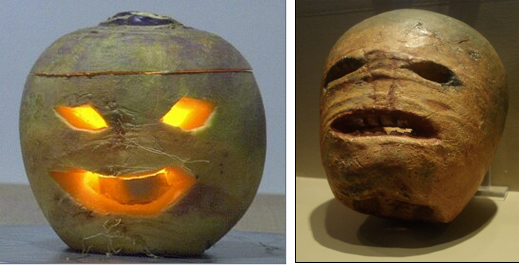
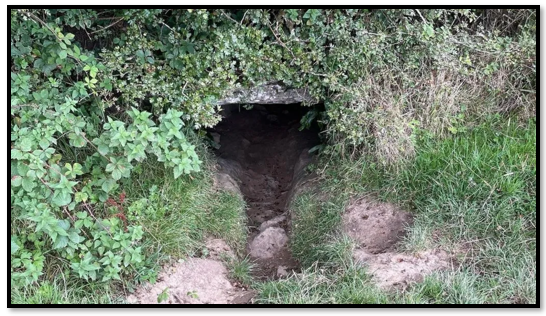
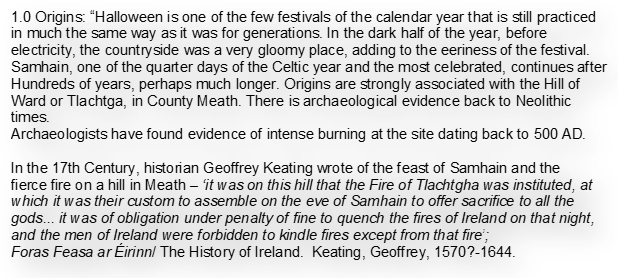
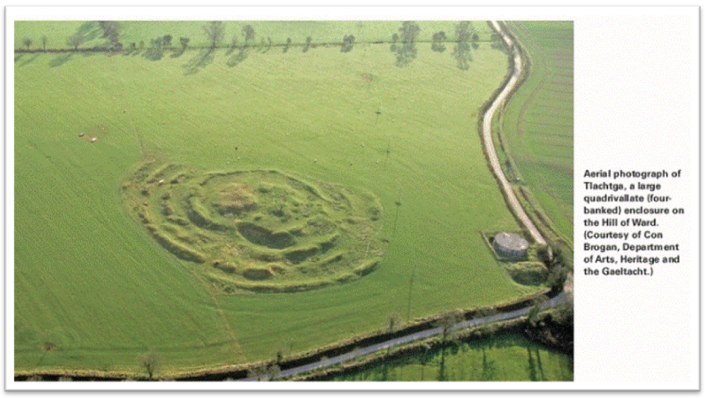
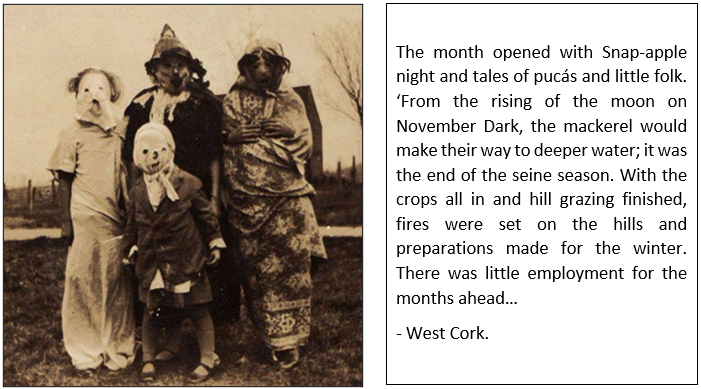
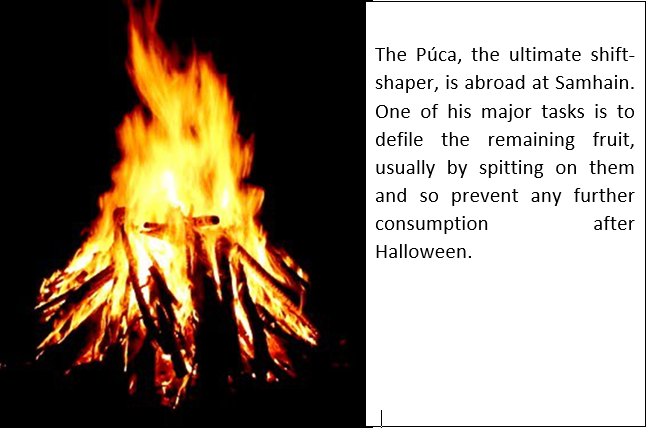
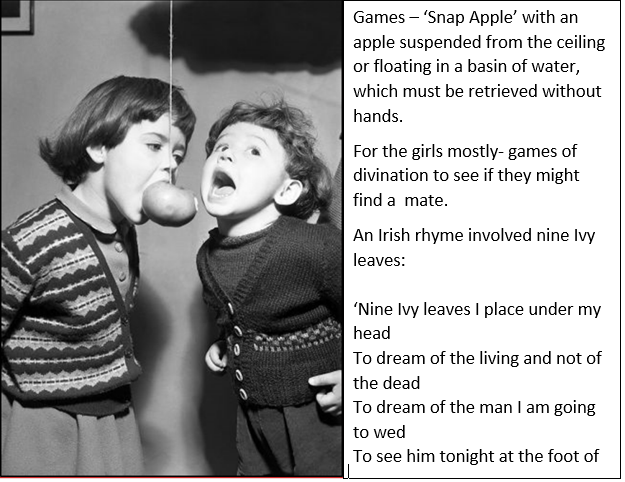
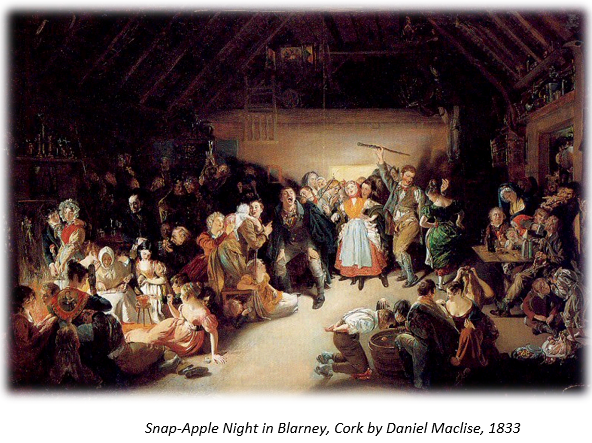
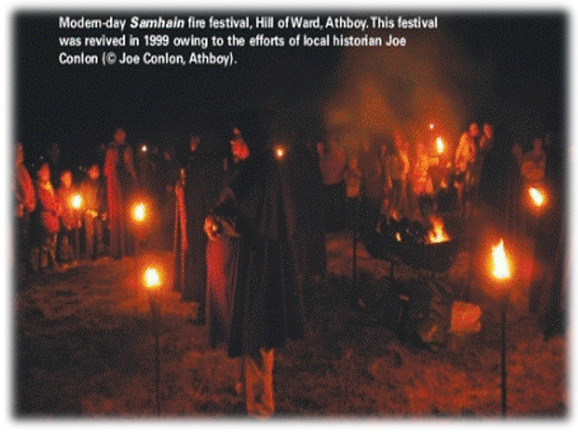
1st November – Samhain/All Souls/Halloween: Samhain, also All Saints Day, is the first of the quarter days in the Celtic calendar and the beginning of the Celtic Year. There is a crowded schedule in the early days of the Irish winter. In the past, the Celts lit the first fires of winter on the Hill of Ward/Tlachgtha at Samhain. Torchbearers then relayed the flame across the land, passing it from one lighted brand to another. Before perfecting harvest techniques and the storage of grass (hay) over winter, surplus animals were slaughtered at Samhain amid great feasting leading to huge ‘bone fires’ or bonfires. Irish people firmly believed that the dead visited on Samhain night. In modern times, there was a tradition of placing a candle in the window to guide spirits home, while leaving out three glasses of freshly collected spring water for them. This belief in the thinning of the veil between living and dead led to the now popular Halloween. Not long ago, the night was celebrated as ‘Snap-apple Night’, mostly based in the home. An bairín breach/the barmbrack or the ‘speckled loaf’, containing oodles of dried autumn fruits is still a favourite.

10th November – Martinmas Eve: The old Roman soldier Saint Martin of Tours was an icon for many in Ireland and still is across Europe. On the eve of his feast day, people would sacrifice a small animal or farm bird at the threshold of the home (cos amuigh agus cos eile istigh) and spill its blood at the four corners of the house for protection. It’s a strange custom to modern eyes. Like all old customs however, there was nothing gratuitous about it. Once common in Ireland, the last remnants were still to be seen in Clare about 15-20 years ago.
December 25th– Nollaig/Christmas: Placed a few days after the winter solstice, it was formalised by the Council of Tours in 567AD. At first, it was a predominantly religious feast day in Ireland and later a secular festival, probably made popular by the Anglo-Normans in the thirteenth century. Most of our native traditions – eating salted fish on Christmas Eve, decorating the byre with foliage, placing a large slow-burning block of timber (bloc na Nollag) at the back of the hearth – have been lost over the years. The one still just about hanging on is ‘the central candle of Christmas’ or ‘Coinneal Mór na Nollag’. The single lighted candle in the window, inviting those passing to partake of Clare hospitality on Christmas Eve is still observed.

December 26th – Lá le Stiofán/Lá an Dreoilín: Saint Stephen, for whom the day is named, was the first Christian martyr. Folklore has it that when hiding from the Romans, he was betrayed by the chirping of a wren. A second and equally engaging story is that the wren became the ‘King of the Birds’ by using his wits. He won a contest as the greatest flyer of all the birds by sneaking a ride in the tail feathers of the eagle. When the eagle flew highest and could fly no higher, the wren emerged and flew above him, making him champion. Either way, the wren, amongst the smallest of our birds, has been paying the price for his fame over countless generations – hunted, killed and brought on display in a holly bush by the ‘Wrenboys’. Some folklorists assert that the wren tradition is a means of honouring nature at winter’s heart in the form of the diminutive wren-king. The wren tradition is genuinely ancient, genuinely our own. It would be sad to see us losing it.
Our generation, for all kinds of reasons, is failing to pass on the unique traditions of our own place to the young. Let’s please ensure their continuance, if only in tribute to those who maintained the customs for us. These customs define our place and give us reason to celebrate as locals. Let’s not lose them.
We barely have time.
MH
30/01/2025