1111 Cuinche was adopted by the Synod of Rathbreasail as a boundary mark for the diocese of Killaloe and that of Limerick. This confirms that the placename ‘Cuinche’ pre-dates the arrival of the Normans and also suggests that Cuinche was a significant landmark on the ecclesiastic map.
‘The see of Luimneach, the Maoilchearn eastward, Ath ar Choinne, Lodan and Loch Gair, and the Laitheach Mhor from Aine westward, and Ard Padraig to the south and Bealach Feabhradh and Tulach Leis, the Feil westward and Tairbeart and Cuinche in Thomond, and Crossa in Sliabh Uidhe an Riogh and the Dubhabhann. Whoever shall go against these boundaries goes against the Lord and Peter the Apostle and St. Patrick and his comhorba and the Christian Church. And the Church of Mary in Luimneach is its principal church’.
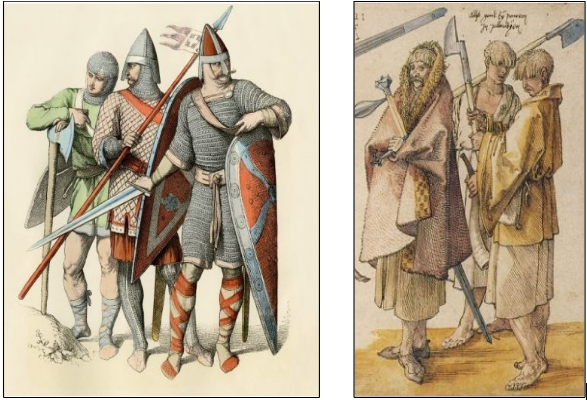
1169 Start of the Norman invasion of Ireland led primarily by Richard De Clare (Strongbow, 1130-1176).
1171 When Henry II visited Ireland, Dónal Mór submitted to him at Cashel and paid homage, thus acknowledging Henry’s lordship of Ireland. In agreeing to pay tribute to Henry II, Dónal Mór became in effect, a tenant-in-chief of the English king.
1172 They had reached Limerick and by 1199, from their base in Limerick city, they felt able to grant territory to their supporters north of the River Shannon, in Thomond. A castle, built on the orders of King John and bearing his name, was completed around 1210
1173 Shortly after this submission Henry attempted to deprive Dónal Mór of his kingdom by granting all of Thomond to one of his knights, Philip de Braose.
1174 When Philip and other Normans, including Strongbow, tried to enforce this claim by invading Thomond, they were repulsed by Dónal Mór’s army at the battle of Thurles, in which over 700 were slain.
1175 Raymond le Gros, another leading Norman adventurer, captured Dónal Mór’s capital of Limerick by bringing a fleet up the Shannon. A year later, however, Dónal Mór re-gained the city and burnt it, rather than suffer it to be held by foreigners. From 1176 up to his death in 1194 the Normans made no further inroads into Thomond.
1189 Richard De Clare’s (Strongbow) earldom passed through Richard’s daughter Isabel de Clare and to her husband, William Marshal after his son Gilbert died childless.
1194 Start of the Norman invasion of Thomond on the death of Dónal Mór O’Brien (who had built alliances with the Normans through the marriage of his daughter to Richard De Burgh and helping Strongbow in defeating some fellow Gaels). His three sons began feuding to replace him, thereby weakening their defences against the Normans and opening the door to conquest of much of Thomond.
1222 Henry III handed Thomond to Donnchad Cairbreach. When he died in 1242, ownership did not pass to his son through inheritance.
1248 Henry III handed over Tradaree to Robert De Muscegros
1275 Robert de Muscegros handed over his castle of Bunratty in Ireland to the king, on condition that as soon as the contention between the king and his subjects in Ireland is settled, and the said Robert has paid all expenses for its repair, munitions, upkeep, and custody while in the king’s hand, it shall be restored to him or his heirs
1276 Richard De Clare’s grandson Thomas De Clare(1245 – 1287) is granted the lordship of Thomond (after 2 other Norman knights failed to overthrow the O’Briens to take up their assignment). Thomas de Clare granted Robert de Muscegros the manors of Aldworth, Compton, and Hampstead Norris, Berkshire, Alvescot, Oxfordshire, and Cottesmore, Rutland, in exchange for Bunratty Castle, Tradaree cantred, and Ui-Corbmaig, all in County Clare. A grant by Edward to him of all of Thomond, to be held as a fief of the crown for the comparatively small service of ten knights.
After receiving the grant, Thomas commanded a large expedition against the Irish in Wicklow; if it was successful he had been promised by the king a supply of knights to help conquer Thomond. His army was severely defeated at Glenmalure and he was lucky to avoid capture.
1277 He was part of another campaign in Wicklow, this time apparently successful. Soon afterwards he moved to Thomond and began to aid the dispossessed Irish king, Brian Ruad O’Brien (who he subsequently murdered while under his protection at Bunratty).
1278 A petition to the king for aid probably resulted in a grant of the knights’ service of Ireland, which he used in laying the foundations of a large castle at Quin in 1279.
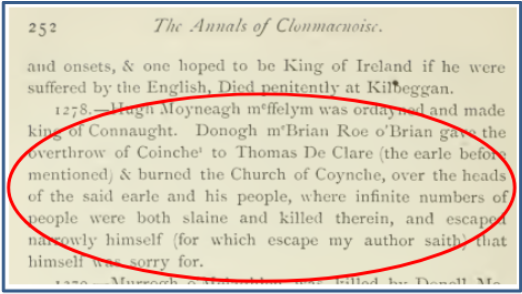
1279 Cil Cuinche was burned by the Irish over some of De Clare’s soldiers. (Description, R.S.A.I., 1900, and a view, R.S.A.I., 1890, p. 292). The ‘Annals of the Four Masters’ tells us that De Clare rebuilt this church in 1278 (before laying the foundations for the castle?). This church is assumed to be the present St Finghins. Is this the location of the original Cil Cuinche?
1280 Thomas sat on the king’s Irish council, advising the justiciar, Robert of Ufford , who with Theobald Butler led a large expedition into Thomond, which put down resistance and allowed the completion of Quin in 1281.
1284 He returned to England but would be engaged in battle with the MacNamara’s for the next 8 years to obtain control and exercise this claim.
1287 He died on his return in 1286. The baton was handed on to his son Richard to conquer the MacNamara’s.
1315 – 1317 The political scenario was radically transformed and complicated by the invasion of Robert de Bruce, King of Scotland, and his brother Edward. King Donogh O’Brien and clan Brian elected to support Edward Bruce and to oppose the English settlement in Ireland. Richard de Clare was now an enemy of Donogh and clan Brian, while he had always opposed clan Turlough. Without the support of Richard de Clare King Donogh fled to Connaught and he later joined the Bruce camp. His rival Muirceartach was now supreme in Clare.
1318 Richard de Clare led an expedition against Conor O’Dea and his clan of Dysart O’Dea, who were faithful supporters of Muirceartach O’Brien and the clan Turlough. Conor O’Dea called upon his neighbouring clans under Felim O’Connor and Loughlin O’Hehir to assist him (Muirceartach was in East Clare at the time). On the tenth of May 1318, Richard de Clare and a strong force of Normans, with the support of the sons of Mahon O’Briain and Brian O’Brian a brother of the late King Donogh, approached O’Dea’s territory. Confidently, de Clare divided his force into three sections. With an inferior force in men and arms O’Dea’s strategy was to set up a trap for de Clare at the ford of Ballycullen near Dysart O’Dea. Richard de Clare at the head of his section raced across the ford after some of O’Dea’s men acting as decoys. Then Conor O’Dea and his army came out of hiding and cut off de Clare’s retreat. Richard de Clare was killed along with most of his section. The remainder of de Clare’s army forced a crossing of the ford and surrounded O’Dea’s army, which retreated towards a wood. Then Felim O’Connor’s and Loughlen O’Hehir’s men joined the battle giving some relief to O’Dea’s men. Still the issue was in doubt until late in the day, Muirceartach O’Briain unexpectedly arrived at the battle scene and routed the remnants of de Clare’s army pursuing them as far as Bunratty. Thus Norman power in Thomond was violently ended thanks mainly to Conor O’Dea and his neighbouring clans.
Upon hearing of the death of her husband and most of his army, de Clare’s widow hastily abandoned Bunratty to government control and fled to England with her only son, then a minor. Young Thomas de Clare, the last male representative of his family died in 1321. The de Clare properties in Thomond, now lost to O’Briain control (except Bunratty Castle), were divided between his aunts Matilda, wife of Robert de Welles and Margaret, wife of Bartholemew de Baddlesmere – both wealthy English landowners who did not pursue their seemingly hopeless claims in such a troublesome area as Thomond. Muirceartach O’Brian now had no rival, either Gaelic or Norman, in Thomond and he ruled without opposition until his death in 1343. De Clare’s castle of Quin was re-captured and destroyed by the McNamaras in 1320, while Bunratty castle, reputedly burnt in 1318 by de Clare’s widow, was captured and demolished by Muirceartach O’Brian and the McNamaras in 1322