From ‘The Man In The Big House’. Stories collected by Eddie Lenihan from the late Jimmy Armstrong of Ballyroughan.
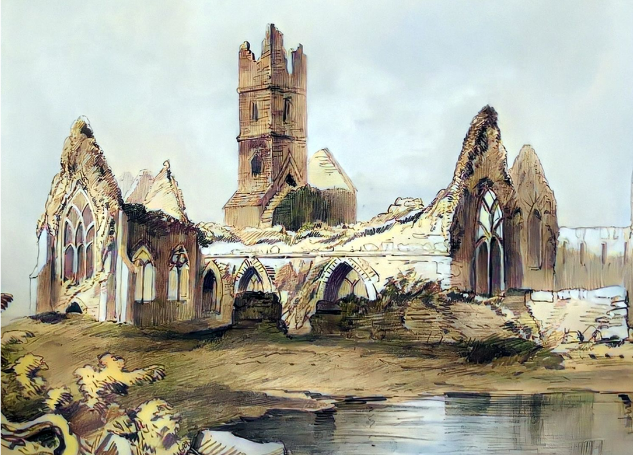
‘Quin Abbey, now; did you ever hear about the founding of that abbey? ‘Twas built, in 1402 I think, by John MacNamara of Daingean.
Well, now, these stories about the founding of it you can judge for yourself. The truth of one of ’em seems to be more authentic than the other one, but you can judge for yourself.
The first story is that he had one son whom he called Sioda MacNamara. An’ one mornin’ he was missing. They were livin’ in Daingean, o course; that’d be, I s’pose, about three an’ a half miles or four from Quin.
They searched everywhere for him. Couldn’t find him. They searched next day, an’ the third day they found him in a pond that was near the castle. I know, now, where the oul’ formation o’ the pond is. ‘Tisn’t a dozen yards from the castle. This oul’ pond, now, last time I saw it, ’twas dry but ‘twould take in an area of about roughly half an acre. An ’twas all rough oul’ ground, you know, an’ lumps here an’ there in it. On these lumps there were bull-rushes growin’ an’ ‘twould give you the idea that at one time ’twas full o’ water.
‘But, anyway, the third day that Sioda was missin’ their neighbours, I spose, or his father, got him in the pond, drowned. He brought him into the castle. He there an’ then took an oath to the Almighty God that if he was restored to life he’d build a monastery for the Dominican friars at Quin. The following feast of Saint Francis, Sioda was playin’ an’ friskin’ around the castle again!
John MacNamara gathered a crowd of neighbours an’ masons an’ they started the abbey in Quin on the ruins of an old Norman castle that was there. There were four round towers in it. He constructed the abbey, an’ the abbey was to be, according to the way I heard it, a thousand paces long, an’ five hundred paces wide. So there’s only, I suppose, an eighth of it there now.
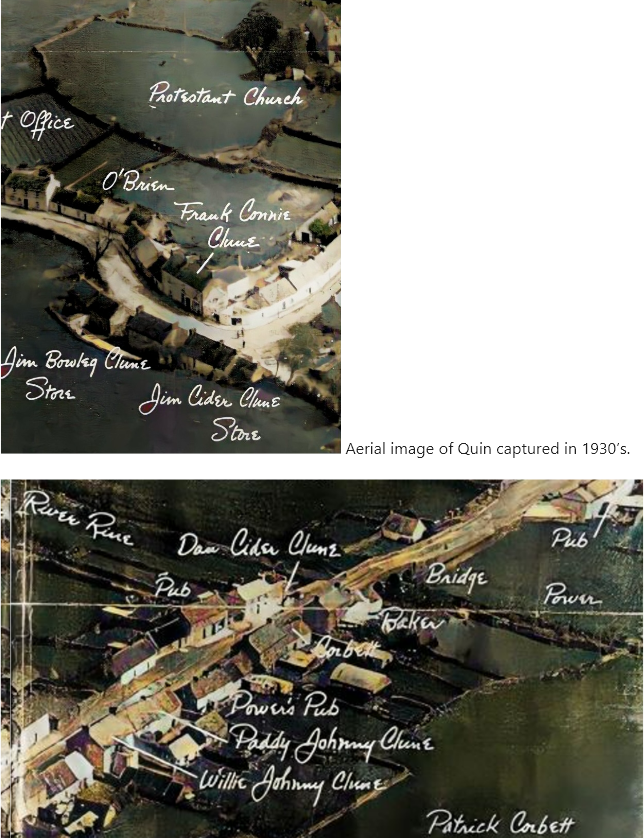
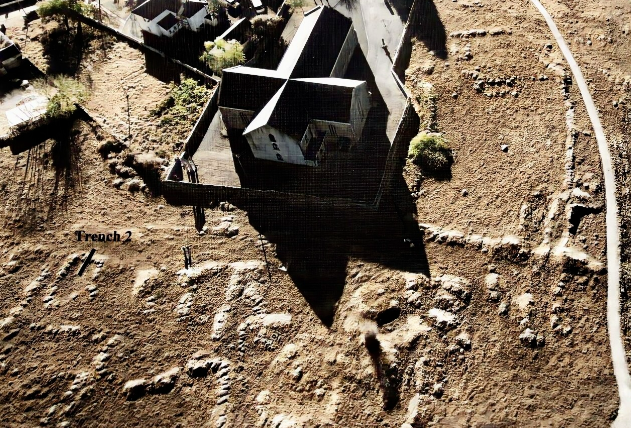
But at the back of the present parish church in Quin that’s in Bobby Clune’s field in Daingean Breac you can see the formation of the walls in the field. If you went up the tower in Quin Abbey, now – the tower is exactly a hundred feet high – an looked towards John Clunes, you’d see all the formation of the houses. The river wasn’t where it is now at all then, an’ the abbey was goin’ right up as far as the present street.
Now, I gave a hand at the building of Saint Finian’s Hall in Quin, an Canon Vaughan, he bought Dan Clune’s house – twas a thatched house – an’ the garden at the back of it. So, they knocked the house, an’ in the sinkin’ of the foundation they went down twelve feet in it, an’ the twelve feet they got were, eight feet of the finest of grey sand an four feet of earth on top of it. They kept that sand to make concrete blocks out of it. They got as far as rock then an’ they filled with stones – they go t’em in the bank the river above the abbey. But, through the sand an’ through the earth there were eight horse-loads o’ bones got in it, an’ skulls. So they came to the conclusion that there should have been a battle fought there one time, when all the bones an’ skulls were there. An’ there was, too.
Well, the other story that’s told about it was this, an all I can say, now, are the words o the man that told it to me. There was a holy man at Tom Fionnlach, an’ John MacNamara of Daingean had several dreams an’ in these dreams he saw friars wandering about looking for a home an’ a place to teach. But he went to this holy man, anyway, to know what his dreams were about. But, the holy man said to him, according to what I was told, “now, the Franciscan friars, you had dreams about ’em. Well, in fact, says the holy man, “I had dreams too about these Franciscan friars, that they wanted a home an’ a school. Is it possible for you to build one?
Well, says John Mac to him, “my son is after bein’ got in a pond, unconscious, an’ I’ll do anything,” says he, “that my son will live.”
“”Is it possible for you, says the holy man to him, “to build an abbey or a monastery for these holy friars?”
“Money is no object to me” says John Mac to him. “Will I build here?”
“No,” says the holy man. “You’ll build at the village of your own parish. Part o’ the foundation is laid for you in an old Norman castle. You’ll build there.”
‘He started the abbey, an as soon as he did his son was as well as ever he was.
So they’re the two stories that were told about the founding of Quin Abbey?
‘According to old local people the abbey was commenced in 1402. I told you that already. But according to Tommy Mac in Creevagh it took thirty years to build it, and, at the opening ceremony that John MacNamara who was responsible for the commencing of it was there, an’ his son was there, Francis Sioda MacNamara, an’ a man whose name was John Clune. This John Clune, in his youth, he got infantile paralysis an’ lost the use of his two legs, an he used to go about on his hands an’ knees. Anyway, at the opening ceremony the friars had him there, an’ John Mac’s son had him there. An’ according to Tommy Mac — who claimed that he was a descendant of John Mac that founded the abbey – when they opened it John Mac was ninety-four years of age. An’ according to Tommy Mac the friars prayed over John Clune who was goin around on his hands an knees, an’ after some prayers he stood up an walked about. An’ the friars said that as long as the parish ơ Quin would be the parish o Quin ‘twould never be without a MacNamara or a Clune family. An’ ’tis full o MacNamaras an’ Clunes today.