| English Name | Alternative name/spelling | Irish Name | Derivation | Feature | Location |
| Attycuil | Áit Tígh Cuil/Coill? | place of the house in the field/wood | Old Townland name, village/settlement | Rathclooney | |
| Aughadina | Acadh Ghoinide? | Acadh-field, Áth-ford, Each-horse | Old Townland name , bridge | ||
| Ballycrighan | Baile Uí Chreacháin | Townland | |||
| Ballyfinshan | Baile na Fuinseann? | townland of the ash trees | Old Townland name? | see Molands survey 1703 | |
| Ballyhickey | Baile Uí Icí | Townland | |||
| Ballymaconagh | Baile Mhic Dhonnchú? | Old Townland name? | see Molands survey 1703 | ||
| Ballyvergin | Baile Uí Mheirgin | Townland | |||
| Ballyvroghaun Eighter | Ballyogan | Baile Uí Bhruacháin Íochtarach | Townland | ||
| Ballyvroghaun Oughter | Cahirgiridane | Baile Uí Bhruacháin Uachtarach | Uí Bhruacháin-family name, Bruacháin-sloping ground | Townland | |
| Boolareagh | Buaile Fhraoigh | Fraoigh-heather | Old Townland name | ||
| Caherloghan | Cathair Lócháin | Townland | |||
| Cahershaughnessey | Cathair Sheachnasaigh | Townland | |||
| Carrahan | Carrachán | Townland | |||
| Classagh | An Clasach | Old Townland name? | see Molands survey 1703 | ||
| Clooney | Cluaine | Townland | |||
| Corbally | An Corrbhaile | Townland, Lough, Church, Graveyard | |||
| Craganashanagh | Creagáin an Seannach? | crag of the fox | Old Townland name? | see Molands survey 1703 | |
| Cragganaweer | Creagáin an Mhaoir | Crag-steep rocky land, Maoir-steward | Old Townland name, Lough | ||
| Cranagher | Cahergall | Crannchuir | Townland | ||
| Curraghmoghaun | Corroghmougha | Currach Múcháin | Townland | ||
| Derrahalla | Doire Shaileach? | Sally wood | Old Townland name | ||
| Derrybeg | Doire Beag | little wood | Wood | Derrymore | |
| Derrycalliff | Doire Mhic Amhlaoibh | Townland | |||
| Derrycrannagh | Doire Crannach | of trees | Old Townland name | ||
| Derryfadda | Doire Fada | long wood | Wood | Derrymore | |
| Derryhumma | Doire hOmna | Omna-an oak, tree trunk | Wood | Derrymore | |
| Derrymore | Doire Mór | big wood(land) | wood, Old Townland name | Derrymore | |
| Derrynacahney | Doire na Caithne | Arbutus wood | Wood | Derrymore | |
| Derrynagullion | Doire na gCuilleann | holly wood | wood, Old Townland name | ||
| Derrynaskeagh | Doire na Sceiche | whitethorn wood | wood, Old Townland name, bridge | Derrymore | |
| Feenagh | Fionach | Townland | |||
| Fiagh | Fiach | Old Townland name | see Molands survey 1703 | ||
| Hurlers Cross | Crosaire na h-Iomanaí | Cross roads | |||
| Kearney’s Cross | Crosaire Ó gCearnaigh | Cross roads | |||
| Kildvoydan | Cill Bhaodáin | St Boydaun | Townland | ||
| Kilgobbin | Cill Ghobáin | Townland | |||
| Knockaclara | Cnoc an Chláraigh | Old Townland name? | see Molands survey 1703 | ||
| Knockanoura | Cnoc an Amhra | Townland | |||
| Knockaphreagaun | Cnoc an Phréagáin | Townland | |||
| Lassana | Leasanna | Townland | |||
| Lean | Leána | a swampy place | Old Townland name | ||
| Mac Duagh’s | Abhainn Mhic Dhuach | River | Maghera | ||
| Maghera | Mach, Macha, Machaire, Má | An Machaire | field (amach-outside), large field/plain | Townland | |
| Muckinish | Mucrois | Townland | |||
| Nester’s | Bridge | Rylane | |||
| O’Briens Big Lough | Lough | ||||
| O’Briens Little Lough | Lough | ||||
| Rathclooney | Racloane | Ráth Cluaine | Townland | ||
| Rylane | An Reighleán | Townland | |||
| Sandhill | Bridge | ||||
| Spancillhill | Cnoc Uarchaille | Cross roads | |||
| Sraheen | Sraithín | Townland | |||
| Tobernalaghan | Tobar na Leaghan | Well | 200m WNW Maghera Cross Rd | ||
| Tobercreile | Well | Knockaphreagaun | |||
| Toonagh | Townagh | Tamhnach | Townland | ||
| Toonagh | Tamhnach | tamhnach-arable place or field | Castle, House |
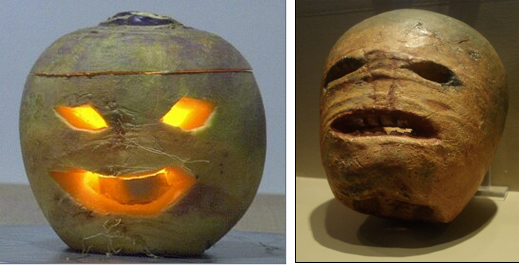
Seán na Gealaí
Halloween is the direct descendent of Samhain. It was the night when the gap between this world and the spirit world narrowed. Known as Oiche Shamhna or ‘spirit night’, the souls of the dead were expected to return to the family home. The Church introduced the Feast of All Saints (Nov1) and the Feast of All Souls (Nov 2nd) to counter Samhain. Evil spirits were also thought to be abroad and people avoided travelling alone on this night.
“Deireann na daoine go mbíonn sidheogaí amuigh oidhche Shamhna”, Schools’ Collection (NFCS 249).
Origins of Samhain
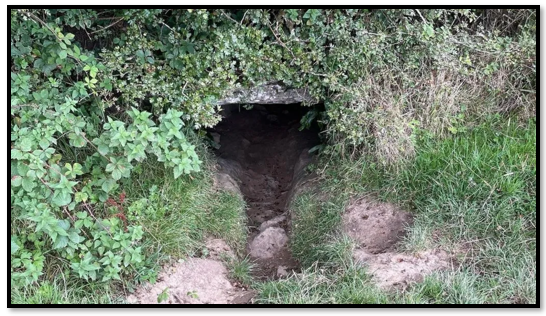
Contender 1- Tulsk, County Roscommon
Oweynagat Cave, Uaimh na gCat, meaning the ‘Cave of the Cats’ in Rath Croaghan. The Book of Leinster names it as dorus iffrin na Hérend – Ireland’s Gateway to Hell. Demons and all kinds of creatures emerge from here on Oiche Shamhna.
Echtra Nerai (the Adventures of Nera) is first mentioned in the 10th century Cath Maige Mucrama story, happening at Samhain.
Oweynagat Cave is also said to be the home of the Morrigan. She is portrayed as a goddess of battle and war, with the power to transform into crows or ravens. Her dreaded cry was frequently heard over battlefields.
Echtra Nerai, the Adventures of Nera
An Irish text taken from the Ulster Cycle, dating to the tenth century entitled ‘Nera and the Dead Man’, tells of the warrior Nera who accepts a dare during a dark and stormy Samhain night to tie a withy around the ankle of a hanging dead man. As he does so, the corpse suddenly comes to life and asks Nera to carry him on his back. Nera complies. After some adventures Nera gets the dead man back to his tree. All of this takes place at Samhain at Rath Croaghan/Cruachan, hence its association with Halloween.
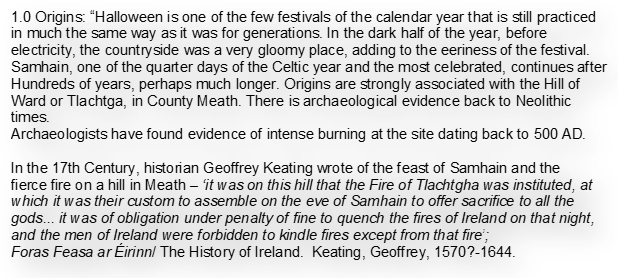
Contender 2 – Tlachtga, Meath
The original Tlachtga was a druidess of considerable power and importance, the daughter of Mug Ruith who lived on Valentia Island in Kerry. He is said to have lived through the reign of nineteen kings, with his lifespan stretching back to the time of Christ on earth. Tlachtga and her father could travel the world on the Rath, a fabulous spinning wheel of fire that easily transported them. Mug Ruith sought out knowledge and learning like few before him and it was in this manner that he and Tlachtga travelled to study under Simon Magus (Simon the Sorcerer), who is mentioned in the Bible.
Simon Magus and Mug Ruith sent Tlachtga out into the world to gather as much knowledge as she could find. Upon her return they realized that her knowledge far surpassed their own!
They were outraged and such was their jealousy that they set the three sons of Simon Magus upon Tlachtga, who defiled her. She returned to Ireland where she gave birth to three sons, Dorb (Doirb), Cuma (Cumma) and Muach.
It was on the hill of Ward in county Meath that Tlachtga brought her three sons into the world, and it was there that she died, unable to sustain her life in the face of the utter grief and despair she felt at the indignity she had endured.
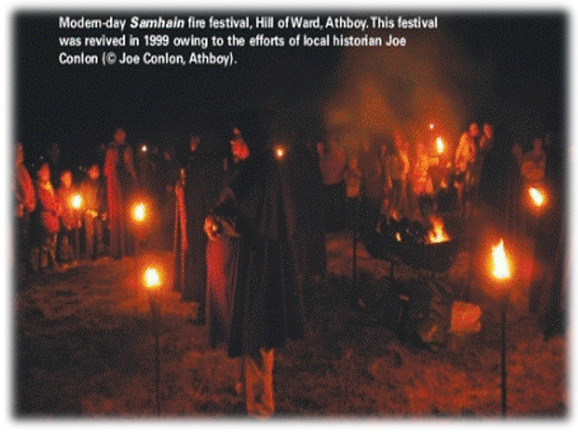
In recent years a renewal of the annual gathering on the hill of Ward now attracts hundreds of people at Halloween. A walk from Athboy up towards the Hill itself culminates with a celebration, with elaborate ceremonies and an acknowledgement of the cultural gift to Ireland and the world that Tlachtga represents.
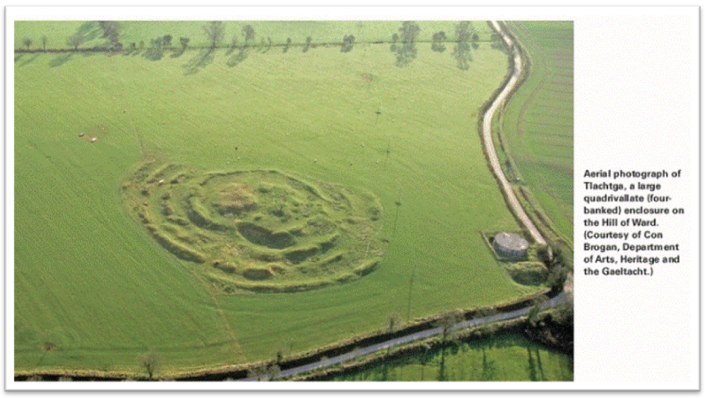
In the ancient kingdom of Mide, Tlachtga was considered an important assembly place alongside Tara, Teiltun and Uisneach. These four ‘corners’ are recorded as having been the location of fortresses constructed by high king Tuathal Techmar at the foundation of Mide in the early decades of the first millennium AD.
‘Much of the (archaeological) evidence points towards a long history of ritual activity. Large quantities of animal bones – a sign of large scale feasting have been found throughout all phases of the site. The lack of evidence of any residential or day to day activity strengthens the idea that it most likely it was set aside purely for ritual or celebratory activity.
There have been finds in all three phases of the site, including scattered Bronze Age human remains and the skeleton of an infant between seven and ten months old… The child burial, next to a ritual deposit of cow bones, dates to AD 450 – around the time of the arrival of Christianity.
“The child was clearly buried with care and having not found any evidence of burials on the site, we’d have to guess that This child belonged to someone significant”.
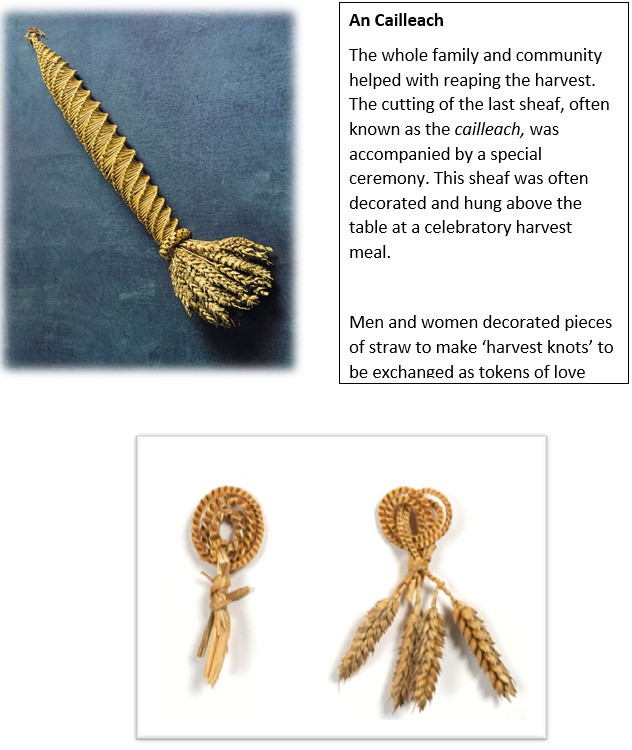
Harvest knots and Guises
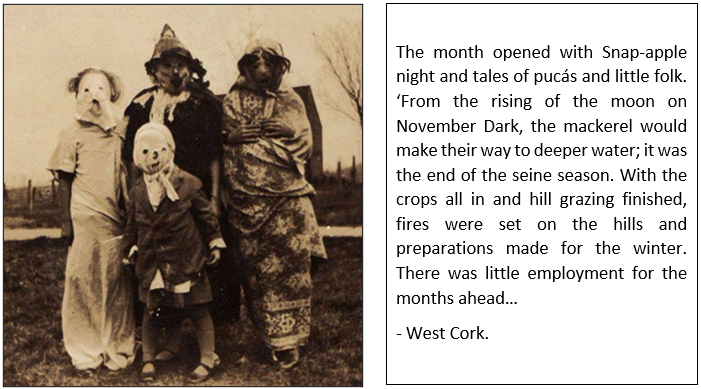
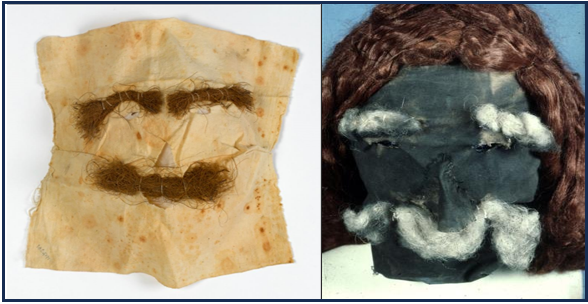
Homemade masks made by village boys calling to local houses on Oiche Shamhna
Outdoors
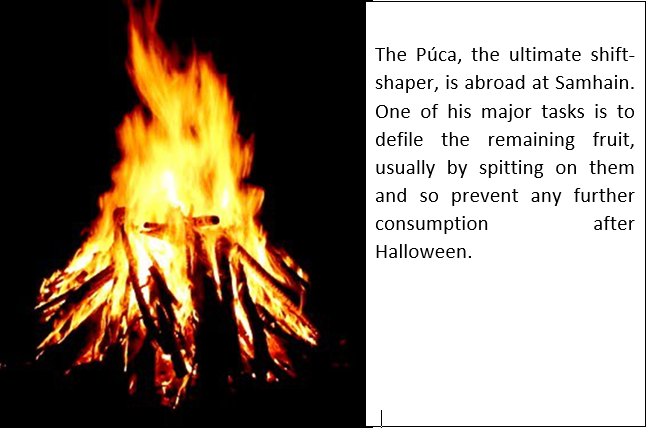
Unlike May when the fairies are active, November Eve brings malevolent spirits. It is the night for community bonfires, especially in housing estates in the cities and towns. Collecting the last handful of fruit and nuts.
Indoors
Families would attempt to have a celebratory supper on Oiche Shamhna. Family supper might be colcannon or pandy. They would first secure the house by sprinkling Holy Water and possibly placing a religious object in the thatch near the front door.
Typical Samhain Food included pancakes, stampy (a potato and apple cake, crusted with barley, enhanced with sea spinach and rock samphire & cooked with oil) apple cakes, nuts, blackberry pies.
An bairín breac/the barmbrack or the ‘speckled loaf’, containing oodles of dried autumn fruits is still a favourite treat, with lashings of butter.
Tokens inside the traditional loaf included the ring as a symbol of love and marriage, a thimble (spinsterhood); a button (bachelorhood); a stick (to be beaten by the spouse); a rag (poverty); a coin (wealth) and a crucifix (the taking of religious orders).
Future Reading