This month we return to the village end of the parish to the townland mostly associated with the new cemetery (although technically in Ballykilty, it does look across to the site of an old burial ground in Kildrum, but more on that later). Kildrum is just one kilometre south east of the village, facing the new cemetery.

At 38 hectares or 0.17 square miles, it is one of our smaller townlands and competes well for the least populated. Kildrum in its original form was Coill Droma, meaning the wood on the ridge. It contains a  hill that peaks at all of 34metres in Kildrum and Feaghquin. Beyond it is the remnants of old woodland in Ballymacloon North which likely stretched across this hill at one time.

It has never been called any other name and has been recorded as such since 1585 (or a variation on the Irish and English spelling).

Kildrum was originally owned by the McNamaras but was given to a Robert Dixon as part of the Cromwellian forfeitures. It was described in this hand-over as containing 54 acres. Many of the soldiers and adventurers given land in Ireland did not take up the option but instead sold it on. This may explain why Nicholas Arthur ended up owning this townland and much more around Quin. He appears to have ‘backed the wrong horse’ in the form of James II because the loyal (Sir) Donough O’Brien was able to purchase the then forfeited land of Mr Arthur.

Recorded residents

1855 Griffiths Valuation: Cornelius Clune, Patrick Corbett

1901 Census: James Conlon (94) & domestic servant, Patrick & Ann Clune plus 9 children

1911 Census: Thomas & Bridget O’Hanlon plus 4 children, Patrick & Ann Clune plus 4 children

Ringfort

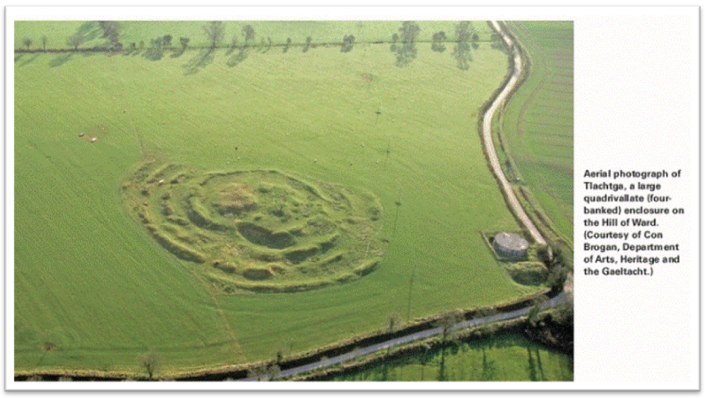
The remnants of Kildrum ringfort can still be seen from aerial imagery, but unfortunately, not much remains of its physical structure. This fact was also noted by TJ Westropp following his visit to the site in 1902. Like similar forts in this area, this one has its share of local folk tales attached, all of which has helped to prevent its complete removal from the landscape. Within the bounds of the ringfort was a souterrain, the site of which can also be seen from aerial imagery. This was most likely used as a cold and safe underground storage space for food.

Aerial image of Kildrum ringfort and a drawing of how it might have looked

From Thomas J Westropp:

“The townlands to the east of Quin abound in forts; but, being populous and divided into numerous farms, the antiquities have suffered not a little, even since 1839 (when visited by OS surveyors-my insert). About half-way between Quin and Knappogue the large fort of Kildrum has been much levelled since that date. It has a souterrain in its garth, but it is now closed.”

Taken from Proceedings of RIA section C, no. Xvi, pp 371-391. Published 19 august 1909.

Burial ground

A burial ground or Cillín is shown on the first OS maps, to the north of the ringfort. It was not unusual to find such ‘un-blessed’ burial sites within close proximity of features considered to have special religious or folk attachment. Fairy forts were often used for this purpose.

Concluding comment

Kildrum today is the location of one of the country’s few free-range pig farms. This is a novel business being pursued by one of our locals. The address of this farm is Lios na Sí, Kildrum, presumably inspired by the above mentioned fairy or ringfort! its lovely to see new placenames taking inspiration from the heritage of the area.


There is not much else to cover within this townland as it has always been sparsely populated. The O’Halloran family name is still present and represents the sole residents of the townland today. Long may the remains of the ringfort and souterrain be in place for future generations to see, even if its only from the air!!

Historical references:

Mensal Tithes to be paid to the (CoI)Bishop of Killaloe by occupiers in Kildrum:

From the ‘Inchiquin Papers’:
1703 Sir Donough (O’Brien) purchased from the Commissioners for Sale of Forfeited Estates the lands of Daganbrack, Creevagh, Cahercalla, Maddara, Keevagh and Kildrum, totaling 440 acres, formerly held by Nicholas Arthur, who was attained for treason on account of his adherence to James II.

1768. Map of Killdrom [alias Kildrum], parish of Quin, barony of Bunratty, … containing 56 acres 1 rood. Scale: 40 perches to 1 inch. Surveyed by Henry Hewett. 21 F. 138 (8)

1848. Agreement for a lease by Sir Lucius O’Brien, 5th Bart., to Patrick Corbett for half of the lands of Kildrum, barony of Upper Bunratty, for 2 years at £20 yearly. 22 May 1848. 1 p. MS 45,089 /5

1883. Map of Kildrum, parish of Quin, barony of Bunratty Upper, containing 50 acres 29 perches, statute. Surveyed by Stephen Markham. 21 Feb. 1883. 21 F. 151 (63)

1884. Notice of intention by Thomas Corbett to sell his tenancy of Kildrum (£30). MS 45,255 /5
What did the Anglo Normans ever do for us?

We are well aware of the impact of the Anglo-Norman invasion on our history, the undermining of Gaelic society and the replacement of our native structures. Poor old Diarmuid MacMurrough takes a lot of blame for all of this, despite the fact that Henry II in England had already sought and had been given approval by Pope Adrian to invade and civilise us. Henry was just waiting to finish his war in France before sorting us out!

Anyway, in they came, conquered, settled, married and eventually becoming more Irish than even ourselves, ‘níos gaelaí ná na Gaeil féin’! But besides building towns and castles, robbing our women (and probably taking our jobs!), what did the Anglo-Normans do for us – if anything?

Well, for one, they gave us a whole new suite of names, both forename and surname, to choose from.

The Norman influence on Irish surnames

Following the invasion of 1169, a large number of Anglo-French first and last names entered into Ireland. Many, such as Power, Browne, Fleming, Joyce, Burke, Barry, Costello, Nagle, Nugent, D’arcy, Roche and Walsh/Welsh/Wallace, are nowadays considered Irish and are commonly found in Clare. So, too, are those with the Fitz prefix such as Fitzmaurice, Fitzgerald, Fitzgibbon and Fitzpatrick which most people would regard as Irish as the shamrock. Fitz, meaning ‘son of’, can be considered the Norman version of Mac (it derives from the Latin/French ‘fils de’, meaning ‘son of’). Burke came from de Burgh, Roche from de Roiste, Power from de Paor.

In 1366, a law was passed that “Every Englishman do use the English language, and be named by an English name, leaving off entirely the manner of naming used by the Irish.” This was introduced to dissuade the settlers from adopting Celtic prefixes or forms of surname. It didn’t have much affect as many settler families added Mac or ‘O’ and Norman names evolved into an Irish form (eg McHenry, McArthur).

In 1465 a law was passed enacting “that every Irishman that dwells betwixt or amongst Englishmen in the County of Dublin, Myeth, Vriell, and Kildare … shall take to him an English Surname of one town, as Sutton, Chester, Trym, Skryne, Corke, Kinsale; or colour, as white, blacke, browne; or arte or science, as smith or carpenter; or office, as cooke, butler ….”

Many of the trades of the early medieval period such as Archer, Butler, Cooper, Carpenter, Draper, Skinner, Tanner found their way into our surnames. Other introductions from this period came from the mercenary soldiers who accompanied the Norman invasion: Walsh (meaning Welsh), Joyce and Fleming (from Flemish mercenaries) are examples.

Incidentally, the Normans usually took their surnames from the place of their family origins. So, D’arcy originates in Arcy in Normandy. De Clare originates in Clare in Suffolk where the Anglo-Norman family were based. While De indicated their place of origin, Le was used to describe them, eg Le Poer meant ‘a poor person’.

De Burgh – Burke – from a placename in Suffolk, France

Le Botilier – Butler – Occupation bottle steward

De Barra – Barry – from an estate in Wales

Le Waleys – Walsh – the Welshmen

De Angulo – Costello/Nangle – from Nangle Pembrokeshire

What of their influence on forenames?

 Many of the Normans forenames introduced here were of a biblical or European saintly origin.

 In 1922, Reverend Patrick Woulfe wrote extensively on the topic of Irish name origins as follows:

In the same manner Norman and English names became current in Irish families during the thirteenth and subsequent centuries. These have now almost completely supplanted the old Gaelic names. The names borne by the Normans and by them introduced into Ireland, were of three kinds :

 (1) names of Scandinavian origin which their ancestors had carried with them to Normandy ;

(2) names of Germanic origin which the Frankish conquerors had brought across the Rhine and which had ousted the old Celtic and Latin names from France ; and

(3) Biblical names and Latin and Greek names of saints,, which the Normans began to adopt about the beginning of the eleventh century.

Together with these came in a few Celtic names from Brittany, a small number of Anglo-Saxon names, some Danish and Norse names from England, and one or two British or Welsh names. These were nearly all very rare and most of them soon died out. Of the Anglo-Saxon names, only two, Edmund and Edward, survived. Alfred has been revived in recent times. At the period of the Invasion, Frankish names were by far the most popular among the Normans, but Biblical and saintly names were coming rapidly into favour.

The following is a list, in order of frequency, of the more common names borne by the early Anglo- Norman invaders, the Biblical and saintly names of Latin and Greek origin being printed in italics :

William, Robert, Richard, John, Walter, Roger, Ralph, Adam, Hugh, Henry, Thomas, Nicholas, Gilbert, Geoffrey, Elias, Peter (Piers), Osbert, Reginald, Jordan, Simon, Alan, Stephen, Philip, David, Arnold, Alexander, Laurence, Baldwin, Herbert, Martin, Maurice, Godfrey, Andrew, Alfred, James, Samson, Turstein, Warin, Ailward, Daniel, Edward, Gregory, Bernard, Benedict, Hamon, Matthias, Michael, Gerard, Gervase, Lambert, Wilkin, Patrick, Edmund, Edwin, Hubert, Ivor, Joseph, Oliver, Mark.

 The following in alphabetical order were rare :

 Abraham, Adelard, Ailmer, Antony, Augustine, Brian, Clement, Constantine, Estmund, Eustace, Everard, Gocelin, Isaac, Leonard, Luke, Matthew, Miles, Milo, Odo, Osbern, Osmund, Pagan, Ponce, Randulf, Redmund, Rodulf, Silvester, Turold, Ulf, Vincent.

 The following names only came in, or at least became popular, at a later period :

Bartholomew, Christopher, Francis, Gerald, George, Paul, Roland, Theobald.

 Women’s names among the Normans were nearly all of the Biblical or saintly class:

 Agnes, Alice, Amelina, Anastasia, Annabella, Catherine, Cecily, Christina, Dorothy, Egidia, Eleanor, Evelyn, Frances, Honora, Isabella, Johanna, Matilda, Margaret, Susanna.

 The name Mary does not seem to have come into use in Ireland before the end of the16th century. Brigid only began to be used about the same period.


Extracted from ‘Sloinnte Gaedheal is Gall’, Patrick Woulfe 1922

Out with the old, in with the new

The Anglo-Normans also brought with them new animal species such as the rabbit and fallow deer, new foods such as wheat, orchard fruits, mutton and farming practices such as hay-making. They introduced us to continental European religious saints and practices of the Roman Church. European religious orders soon followed such as the Franciscans, Augustinians, Cistercians, Dominicans etc. These replaced the structures of the native Irish Christian Church.

Up to then, the Irish natives did not adopt the name of saints as they considered this to be placing themselves on a par with the saint. Such naming convention was reserved for those of higher status in the monasteries. This was circumvented by use of the prefix Maol or Giolla meaning follower or servant. The Normans changed all of that and it was now acceptable to be called Peter, James, Michael, John, Mary, Brigid or Margaret.

Very few of us to this day do not have either a forename or surname that is not of Norman origin. Eventually, arising from the Gaelic Revival in the late 19th century, new Irish language versions of these forenames appeared such as Séan, Seamus, Peadar, Máire, Bríd, Mícheál, Cathal and many more appeared.

The Irish Church did not condemn the practice of slave-trading by the Irish until the invasion by the Anglo-Normans and the encroachment of the Roman Church. The story of Patrick (Patricius, son of a Roman administrator), which was introduced here after the Norman conquest, presents the native Irish as uncivilised pagan slavers who needed to be brought to heel. So the Normans inadvertently gave us our native saint and a forename for a good chunk of our population for generations following.

Out with the new, in with the old

Children are rarely given these European saint names today. Authentic Gaelic forenames are much more popular. We are nevertheless, unlikely to see the demise of the Anglo-Normans surnames that were introduced here. But all of us Mikes, Jimmies, Johnnys, Paddys, Kittys, Cathys, Maggies and Bridies can thank the Normans for what they brought us!