This townland was the ancient seat of the Hickey family, who were hereditary physicians to the O’Briens, Kings of Thomond. Today, it is dominated by the presence of the local Clooney-Quin GAA grounds. It was previously dominated by Hazelwood House, the bishops residence, the lead and zinc mine, ringfort and wedge tomb. The resident families living nearby who found employment within the big house and clergy house made up most of the area’s population.
The townland is part of Clooney parish but is closely associated with Quin due to the proximity of the two.

1.56 km² /0.60 square miles/384 acres
1855 Griffiths Valuation
Reverend Daniel Corbett, Hugh Singleton, Charles Mahon
Household & Population statistics 1881-1901
1881 Census – 9 households, Population 47
1891 Census – 8 households, Population 47
1901 Census – 7 households, Population 32
1911 Census – 7 households, Population 34

1901 Census details for Ballyhickey
Patrick & Bridget McInerny, daughters Margaret, Mary Ellen, Delia, sons Henry, Patrick.
Michael & Ellen Donohue, daughters Nora, Ellen, son James.
Mary Anne Meade, son Michael, daughter Bridget.
Hallam George & Eva Studdert, sons Reginald Hallam, Richard Robert, servants Theresa Haurahan, Delia Blackwell, Mary O’Dea, Margaret Kelly.
John Collins, daughter Mary.
William & Ellen Morton, son Patrick, grandson Thomas Lynch.
Robert H Little (Parish Priest), servants Frances Treacy, Margaret Barry.
1911 Census details for Ballyhickey
Patrick & Bridget McInerny, daughters Margaret, Delia, son Patrick, niece Mary Anne Casey
Michael Donohue, daughter Nora Hourigan, son-in-law James Hourigan (Tailor), grandson Patrick Hourigan.
Michael Meade & sister Bridget, nieces Ita & Ellen Clancy.
Eva Studdert, sons Reginald Hallam, Clare Hallam, Brother-in-law Richard Robert, Governess Lilian Beatrice Tate, visitor Maud Beatrice Henn, servants Margaret Conlon, Hannah & Kate Kavanagh, Mary Horan, Edward Grennan.
John Collins, daughter Mary.
William & Ellen Morton, grandsons Thomas & William Lynch.
Stephen Slattery (Parish Priest), servants Patrick & Gretta Feighery.
Births in Ballyhickey 1818-1880 (spellings are as recorded)
| Child’s name | Father’s name | Mother’s name | Date of Birth | ||
| John | Donohue | James | Heath | Mary | ??.01.1838 |
| Mary | Sweeny | Michael | Keane | Ann | ??.03.1836 |
| Margaret | Halloran | Michael | Baker | Mary | 02.05.1838 |
| Nancy | Leasey | Thomas | Frauley | Bridget | 05.06.1843 |
| Pat | Halloran | Michael | Baker | Mary | 06.03.1833 |
| Daniel | McInerny | Thomas | Haugh | Mary | 06.12.1823 |
| Michael | Bourke | John | Molony | Catherine | 07.08.1820 |
| John | Mangan | Patrick | Hennessy | Mary | 07.08.1820 |
| Mary | Hickey | Patt | Meer | Bidy | 07.08.1841 |
| Mary | Heihir | James | Hease | Mary | 08.10.1836 |
| Patrick | Mullins | Patrick | McNamara | Sally | 09.10.1821 |
| Eliza | Halloran | Michael | Hegarty | Bridget | 10.01.1833 |
| Mary | Scanlan | Roger | McNamara | Bridget | 10.04.1847 |
| Ellen | Scanlan | Roger | McNamara | Bridget | 10.04.1847 |
| Bridget | Crow | Martin | Grey | Susy | 10.11.1818 |
| Patrick | Hehir | Michael | Kean | Margaret | 11.05.1824 |
| Michael | Roughan | Timothy | Moylan | Margaret | 11.10.1820 |
| John | Mealy | John | McInerny | Mary | 12.04.1834 |
| Anne | Heihir | James | Hease | Mary | 12.04.1839 |
| Connor | Mangan | Patrick | Hennissy | Mary | 13.06.1819 |
| Hugh | Mangan | Patrick | Hennissy | Mary | 13.06.1819 |
| Eliza | Gorman | David | Nihile | Eliza | 15.09.1816 |
| Pat | Donohoe | James | Heath | Margaret | 16.01.1835 |
| Hugh | Mangan | Patrick | Hennessy | Mary | 16.12.1821 |
| Patrick | Bourke | John | Molony | Catherine | 17.03.1818 |
| Denis | Garrihe | Michael | Brennan | Biddy | 17.09.1822 |
| Ellen | Martin | William | Moylan | Mary | 19.03.1845 |
| Eliza | Scanlan | Rhody | (?) | Bidy | 19.05.1845 |
| Mary | Hogan | Michael | Hays | Anne | 22.01.1819 |
| Patt | Crowe | Martin | Grey | Susana | 23.02.1821 |
| Thomas | Molony | Thomas | Lynnane | Margaret | 24.04.1834 |
| John | Scanlon | Rodger | Scanlon | Bridget | 24.08.1853 |
| John | Molony | Thomas | Linnane | Brigid | 27.05.1823 |
| Margaret | Lacy | Thomas | Frawly | Bridget | 27.10.1847 |
| Martin | Donohoe | James | Heath | Margaret | 28.01.1850 |
| Michael | Molony | Thomas | Linnane | Margaret | 28.05.1837 |
| Mary | Ireton | James | Hewitt | Mary | 29.06.1844 |
| Mary | Mangan | Patrick | Hennesy | Mary | 29.08.1816 |
| John | Hogan | Michael | Hayes | Anne | 30.05.1816 |
| John | Sweeny | Michael | Keane | Ann | 30.06.1837 |
| Patrick | Lynch | John | 30.11.1824 | ||
| Bridget | Sweeny | Michael | Keane | Nance | 31.03.1841 |
| Mary Bridget | O’Donohoe | Michael | McGuane | Ellen | 19.01.1878 |
| Pat | O’Loghlen | John | Halloran | Lizzie | 27.11.1880 |
| Kate | Reynolds | Edmund | Flahey | Mary | 02.07.1876 |
| Michael | Reynolds | Edmund | Flahy | Mary | 02.09.1874 |

Marcella McMahon (nee McNamara) 1919-2020, originally from Hazelwood, Ballyhickey, was asked to write an article in 2014 on her memories of Dangan School. Marcella and her three sisters played Camogie with Clooney, which was the first Camogie club in County Clare.
You can read Cella’s article here:
https://ebw.pms.mybluehost.me/memories-of-dangan-school-by-marcella-mcmahon/
Left: Mick Hennessy, Clare hurler, after whom the Clooney-Quin GAA grounds in Ballyhickey are named. Mick was from Toonagh, a stones throw from these grounds. He played for Clare in the 1933/34 league campaign.
Tom O’Halloran of Ballyhickey has been recorded as part of the QHG Oral History Archive. These interviews can be viewed by following the link below:
https://ebw.pms.mybluehost.me/tom-ohalloran-ballyhickey-quin/

National Monuments
Ballyhickey Ringfort CL034-136–
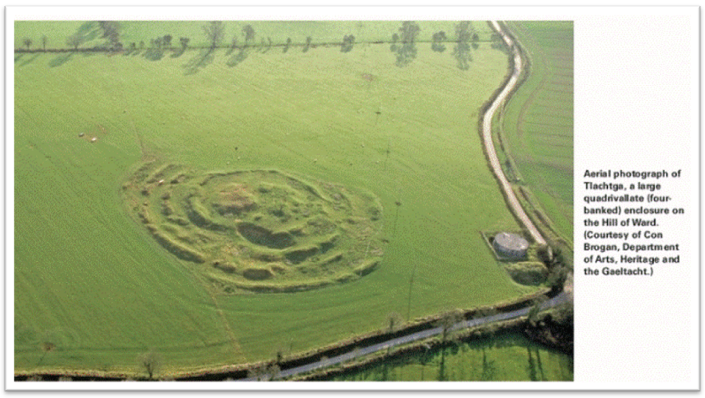
This ringfort is located in close proximity and west of the Clooney-Quin grounds. Its a circular level terrain fort positioned at edge of slight natural ridge with excellent views to the N, E and W. The fort has a total site footprint of approximately 0.4ha. Univallate for the entire circuit with two opposing entrance features consisting of simple breaks through the bank. Both of these may be original features. No evidence for any internal features on the surface. The ramparts have been heavily truncated by ploughing but are still apparent on the surface. Interior under pasture.
“The ringfort comprises a slightly raised, sub-circular, earthen platform of c.60m (c.200ft) in diameter. Although now only a single univallate fort with a low bank remaining to a maximum height of 1m, it was likely once surrounded by a deep ditch which was probably later filled to facilitate tillage. The fort is divided by an 18th or early 19th century stone wall. It may even, originally, have been a stone fort, with walls three meters thick and five metres high, as were common in limestone areas.…The diameter is unusually large for a common medieval homestead, indicating that the residents held a ‘high status’ position in local society. Some anomalies on the internal surface may indicate the subsurface remains of medieval structures. This fort was likely the home of the renowned medical family of Ó h-Íceadha, who were the physicians to the kings and Earls of Thomond for generations”.
From an article by Martin Breen and Ristéard Ua Crónín.
Enclosure CL034-135
Listed as ‘Enclosure’ in the RMP (1996). Indicated as an enclosure with trees on the 1842 and 1921 edition of the OS 6-inch map, and situated on a gentle S and SW-facing slope. A subcircular area (int. dims. 33m N-S; 28m E-W) defined by a narrow wall spread (Wth 1.2-2m; H 0.5-0.8m) which is partly collapsed. There is no visible entrance or internal features, but there are ash trees growing on the perimeter with hazel in the interior.
Fulacht Fia(dh) CL034-202 Mound CL034-203003 Field System CL034-203—
Enclosure CL034-203002 Large Enclosure CL034-136– Ringfort Cashel CL034-134—
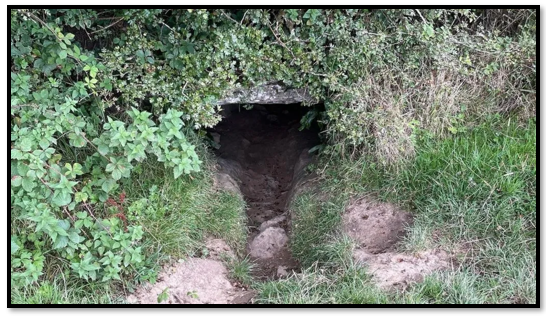
Ballyhickey Megalithic Wedge Tomb CL034-137001

Ballyhickey, Clooney Parish. This small cist of course gritstones is quite perfect, and is unusual in having parallel sides and level cover. The axis lies E.N.E. The north side is of one block 6’8” long and 16” thick. The south side has two, parallel to which, and about 3’ away, is another and thinner slab. The west end is 7’ 2” long and 8” to 9” thick. The cist is 8’1” long, and the interior 7’4” east and west by 4’2” north and south. The cover is somewhat pear-shaped; and, broken into two, it does not overlap the west end. It lies in a plantation to the side of Hazelwood House, and is shown correctly in a little sketch on the map of 1840.
Westropp – Cists, Dolmens and Pillars of East Clare, P 101
Hazelwood House
Richard Robert Studdert, J.P., who was born in 1837, lived here. He was the son of Robert Studdert of Lough Graney House. In 1878, while two hundred and seventy-nine acres were in the hands of Ed. Singleton, Hugh Singleton of Hazelwood is recorded as owning one thousand, five hundred and thirty-five acres, of which three hundred and ten acres surrounded the house. He married Jane Massy of Waterpark, by whom he had a son. Edward Singleton of Preston Deanery, Northamptonshire, and of Hazelwood, which he inherited on his father’s death. Born in 1834, he married Sarah Ranson in 1866. His son, Hugh Ranson Singleton, was born in 1867. The Studdert family is recorded as resident in the 1901 and 1911 census, as noted above.
Hazelwood was destroyed by fire in 1921.
For more information on the house and families that lived there, see:
https://ebw.pms.mybluehost.me/hugh-singleton-of-hazelwood/
“HUGH SINGLETON, of Hazelwood, d. Sept. 29, 1878, aged 82. Erected by his daughter ANNIE M. MAGEE.” – tombstone memorial on south wall of the Protestant Church in Quin (now demolished).
Wellpark Cottage
In 1837, Wellpark House was the residence of the Dr MacMahon, Roman Catholic Bishop of Killaloe. It later became the parochial house and is now in the hands of the Meere family.
Wellpark is an early nineteenth-century, medium-sized, two-storey, three bay house, facing south, with an extended front west bay. A yard and utility buildings adjoin the rear. It is situated in a pleasant wooded garden. The house was reconstructed and re-embellished in the twentieth century.

Ballyhickey Lead and Silver Mines
The mine in Ballyhickey was opened in 1834. Between 1834 and 1838 a steam engine and engine house were erected on site and 2,500 tonnes of ore were extracted from an opencast mine (2,500 tons of ore were shipped from Clarecastle to Wales for smelting).
Mining appears to have died out rapidly and by 1840 production had declined to around 40 tons per month with the ore considered to have been nearly “worn out”. The works were reopened in 1853 and cleaned out but no ore was produced, and it is believed that production was ceased in 1854.
‘Former mine complex, dating to c.1834-1840, comprising rubble stone and brick chimneystack, built c.1837 and rubble stone ruin of engine house. Open pit now filled with water with masonry plinths/piers on either side probably used for mounting extraction gantry. This mine was operated by John Taylor and Co. and was discovered during the course of exploration to find extensions of the Kilbreckan Lode (information from Mining Heritage Trust of Ireland website). Like the Kilbreckan silver mines (RPS321), this site is an important aspect of the county’s 19th century industrial heritage. It is believed to have been one of the richest and most important mines in County Clare. It has been proposed as a candidate for inclusion in the RPS’.

This was by far the most important of the Clare mines. J. Taylor, in ‘a note to P. M. Taylor’s ‘paper (alp. cit., p. 386), describes the’ galena (the ore from which lead is extracted) ‘as occurring in huge veins of calcite. The ore gave 77 per cent of lead, but only 15 oz. of silver to the ton. The main vein or bunch was 16 to ‘20 feet wide and almost pure galena. Blende and -copper pyrites were associated. Ballyhickey is called a’ lead and silver mine on the engraved 6” map of the Ordnance Survey. Attention was first called by the occupier; who noticed blocks of galena when making drains.
J. Taylor took up work here for the Adventurers in 1836, and the early promise of the mine was remarkable for the district (Reports by J. T for 1836, etc.) 1,300 tons of ore were raised by 1838. Weaver (1838, p. 66) notes that the deepest working in 1837 was 13 fathoms, and that a steam-engine WZLS being furnished. 2,500 tons of ore were shipped to the Dee from the neighbouring port of Clare (Clarecastle), then newly constructed on the Fergus, in three years or so of working. Taylor’s report for 1839, however, opens with the following words :
“ The rich discoveries of lead in the County of Clare have been of short duration; they were very unusual and remarkable in their character, and, unfortunately, their *decline has been nearly as rapid as their rise.”
In 1840 the return was about 40 tons of ore per month; but the ore-ground was regarded as nearly worn out. Hunt (1848) gives an output of 119 tons of ore (only 32 tons of lead) for 1845, and 83 tons (22 tons of lead) in 1846. The ore had evidently fallen off in quality, and only the name of the mine occurs, in the records for 1847-9 and again in 1853. It is revived in the Lists of Mines from 1860 to 1865.
https://www.geologicalmaps.net/IrishHistMapsDownload/B02138.pdf
Extracts from ‘A_1640_register_of_the_Thomond_Papers’
For example, see the deposition to two Gaelic witnesses, Morrice Hicky of Rossmanagher and John Hinchy, which mentions that the former was in a ‘feild of wheate which was a reapeing for Mr George Colpace’, before being attacked by Confederate insurgents. This is an interesting reference to cultivation of wheat on the Thomond estates. The fact that Morrice Hicky was literate and signed the deposition with a good hand suggests that he was of the learned Uí Iceadha medical lineage whose original patrimony was Ballyhickey near Quin. See Deposition of Morrice Hicky & John Hinchy, 5/9/1653, 1641 Depositions, Trinity College Dublin (Ms 829, fols 108r-109v). Footnote 40, P.34
Probably the most egregious example of the fourth Earl obtaining royal patents to lands was the 1621 grant to the earl of the manors of Bunratty, Moy-Ibrickan, Crovreaghan, Dunass, Ennistymon, Clonroad, Kilrush and Finavarra. These grants involved privileges such as courts-leet and frank-pledge, various emoluments, and ‘free warren and chase and to impark to the extent of 2,000 acres’. The lands granted under patent include those that had formed the lordship lands of the Meic Conmara at Cratloemoyle and Cratloekeel, Danganbrack, Quin and Clooney, among many others. Other lands can be identified as the hereditary lands and castles of a number of leading Gaelic literati families, such as the Clann Chraith at Islandmacgrath, the Uí Dhálaigh at Finavarra, the Uí Iceadha at Ballyhickey, the Clann Bhruaideadha at Knockanalban and the lands of the Uí Dhuibhdhábhoireann at ‘Kiltybreak’.
Extracts from ‘A_sixteenth_century_bardic_poem_composed’
The granting of tribute-free lands to literati families in exchange for providing specialised services to the ruling lineage points to the semi-feudalised arrangements that operated in Gaelic lordships. From existing records we can deduce territorial arrangements amongst the learned professional families in West Clann Chuiléin. According to an inquisition held at Galway in 1586 the tributary lands of Seán Mac Conmara, Lord of West Clann Chuiléin , are set down. Ardkyle in Feenagh parish and Ballyhickey in Clooney parish were cited as subject to Mac Conmara rent but that uncertainty existed to the quantity of rent levied. It is probable that Ardkyle, the patrimony of the Ui Mhaoilchonaire historian-chroniclers and Ballyhicky, the patrimony of the Uí íceadha hereditary physicians, were immune from rent and tribute.
The Irish Fiants contain useful references to members of the learned families. For example, in 1602 ‘Donell oge O Hicky of BallymcDonell chirurgeon’ [i.e. surgeon ] received a pardon. Donell, as a surgeon, was following the hereditary occupation of the Uí íceadha lineage in Killuran parish of Tulla barony. The Irish Fiants of the Tudor Sovereigns: During the Reigns of Henry VIII, Edward VI, Phillip & Mary, and Elizabeth I, Fiant 6615, p. 547
Closing Comments
Ballyhickey, the homestead of the Uí h-Íceadha clan. The name originates from the Irish Íc, to heal. The ringfort, like many others in our parish and country are easily over-looked. Their importance as heritage and historically important features may be lost when we take our eye off the story or the context of this piece of our landscape. The more we read and inform ourselves of the story, the better we are likely to appreciate and maybe even ptrotect this part of our local history.
Other References to Ballyhickey
In defence of the Uí Iceadha/Hickeys:

-Critique of a negative assessment made by a 16th-century writer named Lindanus regarding the state of medicine and physicians in Gaelic Ireland. The Irish Septs had a sophisticated system of hereditary medical families who were highly educated and well-regarded in Gaelic society. These physicians studied contemporary European Latin medical texts (from sources like Hippocrates and Galen) which they translated into Irish, demonstrating a strong connection to mainstream European medical knowledge. They ran medical schools, had high social status under Brehon law, and were patronized by the Gaelic aristocracy.
Extract from an 1863 Geological Survey of mid-Clare: