A long stick or staff
This sparsely populated townland is adjacent to Craggaunowen and directly facing Cullaun townland and the entrance to the Cullaun demesne.
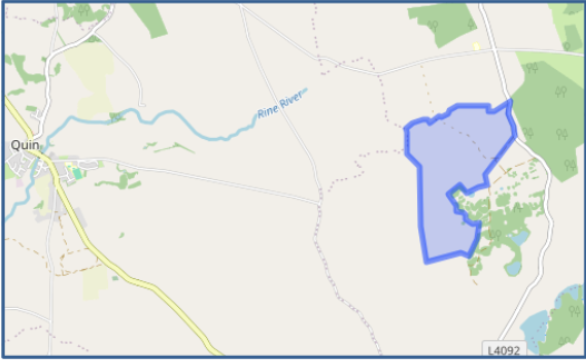
Placename confirmed to Ordnance Survey Boundary Surveyor in 1839 by Rev Daniel Corbett PP, R. Studdert, Rector. Recorded also as Cappaghnamadgh (Cappanamuddagh). Ceapach na Muide
Ceapach – tillage plot; na Muide – of the mud.
99.92 hectares / 0.9992 km²/0.39 square miles/246.91 acres
1825 Occupiers of land in Cant (Cappaghnamadgh) on 1st May eligible for tithe payment
Mr James Frost
1855 Griffiths Valuation – occupiers/property owners
1. Occupier James Frost, Owner Crosdale Maloney
2. Occupier Mary Fere, Owner Crosdale Maloney. John Bermingham, Freeholder
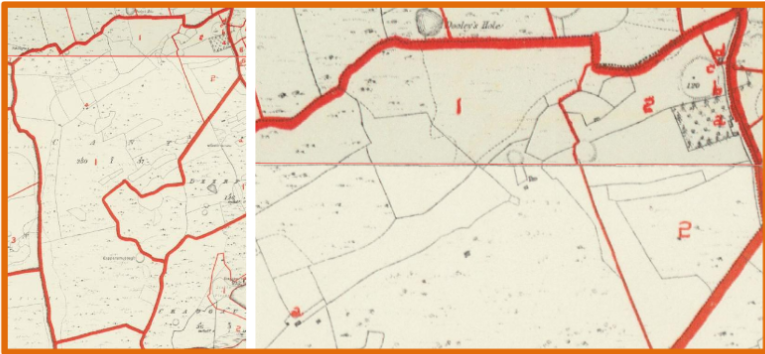
Richard Griffith began his work as a civil servant in the early 1820s and was appointed Boundary Commissioner in 1825. Griffith and his team of surveyors, draftsmen and spademen established the boundaries of townlands, civil parishes, baronies and counties for the Ordnance Survey of Ireland. Griffith then became instrumental in the work of the Valuation Office, which surveyed land and buildings to ascertain their value for taxation purposes. The result of his work, the Primary Valuation of Ireland, was published for the entire island of Ireland between 1847 and 1864. Griffith and his team placed a rateable valuation on every piece of property in Ireland, which became the basis of a property tax called rates, which was used to fund the local Poor Law Union, including the Workhouse.
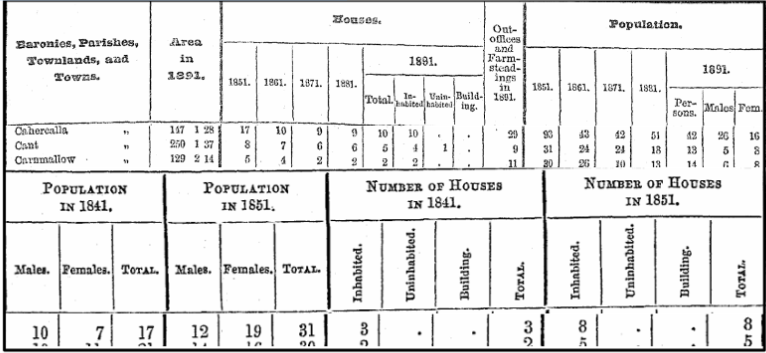
Census Records for Cant
1841 Census: Population 17; Households 3
1851 Census: Population 31; Households 8
1861 Census: Population 24; Households 7
1871 Census: Population 24; Households 6
1881 Census: Population 18; Households 6
1891 Census: Population 13; Households 4
1901 Census
Michael & his sister Marghet Phayer.
Mary McDonnell, sons Patrick, John.
1911 Census
Michael & his sister Margaret Fair.
Patrick McDonnell & his brother John.
1926 Census
Patrick McDonnell & his brother John (both single farmers)
Martin O’Brien & his sister Margaret.
1918 Quin Subscribers to Major Redmond Memorial Fund
John McDonnell, Patrick McDonnell DC.
Surnames found in this townland
Fere may be a variant of Fahy or O’Fearghail/Farrell. The Frost family was highly prominent throughout the broader Dangan and Quin area. Notably, James Frost of this wider clan was a well-known local historian who published The History and Topography of the County of Clare in 1893. Bermingham is an Anglo-Norman surname that became deeply integrated into Connacht and Munster (including East Clare) over the centuries. Other surnames found in records are Broggy, Coalman, Garvey, Lyddy, Lynch.
Death of Dr Patrick McDonnell, Quin Dispensary District
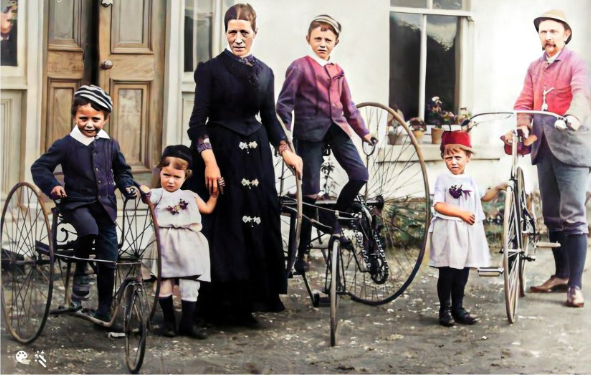
Right: Dr Patrick McDonnell pictured with his family in the late 1880’s. A medical doctor, he was originally from Broadford, but was then living in Cant.
Also in this photo is his wife Ellen nee Johnston from Clonlara to whom he married in 1877. Their four children were John, Catherine, George and Mary. Dr McDonnell died as a result of an accident in 1890.
EXTRACT FROM THE SATURDAY REPORTER OF APRIL, 28th. 1890
Death of Dr McDonnell. We regret to hear of the death, under particularly unusual circumstances, of Dr McDonnell of Quin, which occurred last Thursday night the 25th inst. He was attending a sick call on Wednesday last, and while returning, was thrown from his trap a short distance outside the village. From the nature of his injuries, he appeared to have alighted on the back portion of the bend, the skull being fractured on that spot. His servant boy was with him in the trap at the time, and the occurrence was also witnessed by a Mr Carmody, a neighbouring farmer, who was in an adjoining field, and they assisted in removing him to a house in the vicinity where he was attended by Dr Scanlon of Tulla and Dr Jennings of Ennis, who rendered all the aid that medical skill could give, but, though he rallied (?) at first, he succumbed on Thursday night. The deceased gentleman was a son of Mr John McDonnell of Broadford, and leaves a widow and young family, for whom universal sympathy is felt in their sad bereavement. He was, for several years, Medical Doctor of Quin Dispensary District, and was extremely popular on account of his generous disposition.
The remains were interred at Broadford yesterday, the funeral cortege being the largest ever witnessed in that part of the County.
EXTRACT FROM THE “SATURDAY RECORD’ OF APRIL, 28th. 1890.
Through the death of Dr. McDonnell, who was a former President of the Clare County Board G.A.A., the ties in the County Championships which were to be played on Sunday in Doora were postponed, as a mark of respect to his memory.
Extract from the “Saturday Record of May, 1st. 1890.
Quin Dispensary.
For the vacancy in the Medical Officership, held for a number of years by the late Dr. McDonnell, whose death it was our painful duty to announce in our last issue, the names of several gentlemen are spoken of as probable candidates for the office.
Dr O’Mara of Limerick, son of Mr James O’Mara, Dr Purceli, son of Mr Mather Purcell, Bauroe House, Feakle, a cousin of deceased, Dr Hannan, son of Mr P. Hannan, Killula, and Dr McDonnell, brother of deceased gentleman.
Drs. McDonnell, Hanna and Purcell are all in practice in England. The Committee of Management has not yet fixed the date of election. The salary is £100 with fees under various Acts which substantially increases it.
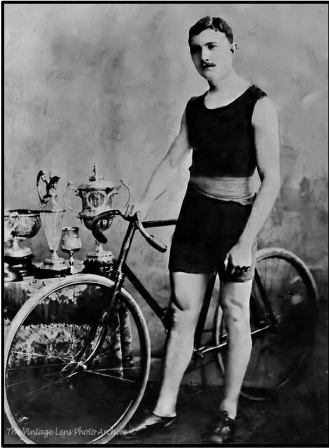
From ‘Vintage Lens’ Facebook November 2023:
Yesterday, I posted a photo of a family from Quin with their bicycles c.1888. The father of the family, Dr Patrick McDonnell, died not long after the photo was taken, in 1890. Sadly the mother, Ellen McDonnell, née Johnston, also died in the 1890s, leaving five children: George (1879-1939), John (1882-1915), Mary (1884-1948), Catherine (1885-1968), Hanora (1889-1956). John emigrated to New York in 1908. Mary and Hanora went to the UK and Catherine became a Sister of Mercy nun in Kilrush (Sister Aquinas).
The eldest, George Patrick McDonnell, is pictured here. He kept up cycling and won several competitions. He ended up as a civil engineer in Mullinahone in Co Tipperary. Not only was he a keen cyclist but an inventer too. He patented the ‘Tipperary Starter’ for cars in 1915. In a newspaper ad that year it was said: ‘Start your own car from the seat….without ratchets, free wheels, electricity or other trouble givers, and no possible danger from back fire.’
Previous to that, in 1913, he had also applied for a patent for a grass trimmer. This is how it was described in the ‘Cork Examiner’: ‘Apparatus for trimming grass edges of roads, sidewalks, grass plots, etc., comprises a special rotary cutter acting as a supporting wheel, an adjustable undercutting-knife, and means for discharging the cut turf at one side, or for elevating it into a cart. The ordinary wheel and cutting wheel are mounted on an axle, on which is pivoted a support for the seat, and a frame carrying the draught shafts. The undercutter, a continuation, and a guide-plate are connected by bars to the seat support, and are adjusted by rotating a screwed rod connecting the seat support to the draught frame. The plate discharges the material at the side of the machine or into elevating-apparatus. The cutting part of the wheel is preferably secured by screws, so that it may be detached for sharpening or shaping.’
National Monuments
CL043-010 Cappanamuddagh Ringfort Enclosure (Right)
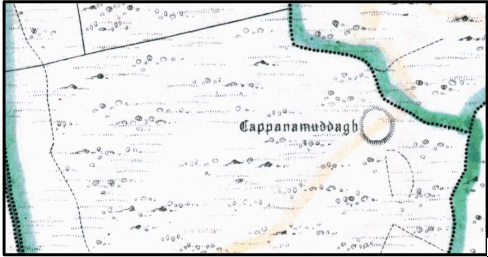
CL035-086 Enclosure
Description: On a gentle S-facing slope, in improved, gently undulating pasture. A circular area (diam. 20m) defined by a well-formed sod-covered wall of stone (int. H 0.5m; ext. H 1.15m; Wth at top 2m; overall Wth 7.25m). Thorn trees grow around top and sides of bank. There is no obvious entrance gap. The interior has a slight tilt downslope to E. An irregular heap of stones covered in vegetation is located within the centre and other loose stones are scattered around the interior. A linear limestone ridge (long-axis NE-SW) projects (L c. 55m) from exterior of monument at E and appears naturally formed. A laneway (long-axis NE-SW) flanks the exterior of the monument to N. A field fence (long-axis NW-SE) is located c. 2.5m to W and a stone wall townland boundary (long-axis NE-SW) is located c. 4m to N.
CL035-090 Enclosure
Description: On a low rise, having a steep E-facing slope where there is a small valley (long-axis N-S), in improved gently undulating pasture. Not visible at ground level. Depicted on all historic OS mapping as an oval area (34m N-S; 31m E-W) defined by a single enclosing element. A small field and settlement is shown adjoining to S. According to local information this land was intensively improved sometime prior to the 1980s. Enclosure (CL035-095—-) is c. 65m to ENE.
CL035-095 Enclosure
Description: On a plateau on a low, gently undulating ridge, overlooking a small valley to the immediate W, in improved pasture. Depicted on all OS historic mapping as an oval area (33m N-S; 30m E-W) defined by a single enclosing element. Not visible at ground level. According to local information this land was intensively improved sometime prior to the 1980s. Enclosure (CL035-090—-) is c. 65m to WSW.
CL035-097 Enclosure
Description: On a low, yet distinctive knoll, in improved pasture, overlooking woodland to E and gently rolling pasture elsewhere. Depicted on the 1840 edition OS 6-inch map as a large oval area defined by a single enclosing element. The monument is shown as a sub-oval area (30m N-S; 19m E-W) defined by a single enclosing element on the 25-inch OS map and 1921 edition of the OS 6-inch map. Not visible at ground level. This knoll was clearly used as a well-drained vantage point with land sloping down steeply to N and E. According to local information this land was intensively improved sometime prior to the 1980s.
Descriptions courtesy of Mary Tunney, National Monument Services
Baptisms in 1800’s
| Date | Child’s name | Father’s F/n | Mother’s maiden name | Sponsors | ||
| 22.04.1826 | John | Broggy | Lot | Steele | Anna | James Hannin(Mannion?) |
| 24.02.1822 | Patrick | Coalman | Cornelius | Ready | Honora | Michael Torpey, Margaret McNamara |
| ??.05.1836 | Ellen | Fair | Michael | Baker | Maria | William Ready, Maria Liddy |
| 13.04.1838 | Michael | Fair | Michael | Baker | Mary | Thomas Meany, Honor Baker |
| 18.04.1840 | John | Fair | Michael | Baker | Mary | Pat McDonnel, Bridget (?) |
| 05.07.1841 | Margaret | Fair | Michael | Baker | Mary | Pat Liddy, Mary Meany |
| 12.01.1826 | Briget | Garvey | James | Birmingham | Mary | Maichael Cain |
| 22.04.1826 | Timothy | Lyddy | James | Roughan | Nancy | Daniel Lynch |
| 30.01.1835 | Ann | Lynch | John | Reddy | Joan | William Ready, Mary Meany |
| 22.12.1845 | Bridget | McDonnel | James | Molony | Mary | Tom Hogan, Judy Donnelan |
| 17.03.1850 | Catherine | McDonnel | James | Molony | Mary | Michael Murphy, Mary Meany |
| 20.11.1844 | Margaret | McDonnell | James | Molony | Mary | Pat Hogan, Mary Hogan |
| 25.07.1852 | James | McDonnell | James | Molony | Mary | Thomas Molony, Honora Molony |
| 25.04.1855 | Michael | McDonnell | James | Molony | Mary | Michael Fa(?), Anne Fai(?) |
| 30.11.1861 | John | McDonnell | James | Maloney | Mary | Patt Hallinan, Margaret Fair |
| 06.10.1864 | Winnifred | McDonnell | James | Molony | Mary Cotter | |
| 08.11.1857 | Thomas | McDonnell | James | Moroney | Mary | Thomas McDonnell, Margaret McDonnell |