Know your Townland – Cragbwee/An Chraig Bhuí
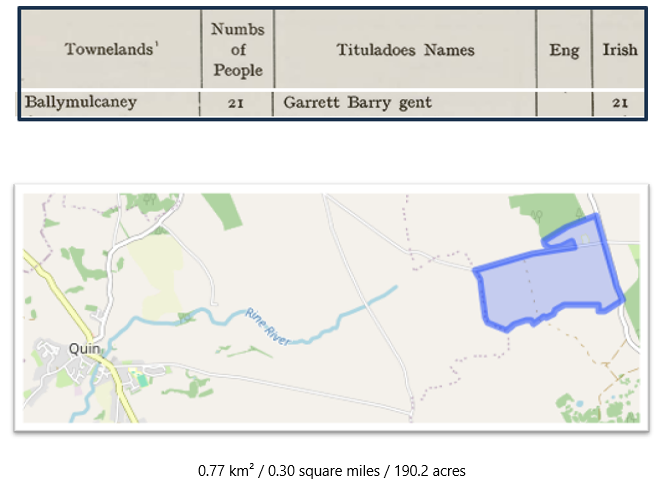
Freeholders in Cragboy May 22nd 1819 (Leasing land from Richard Creagh)
John Clune, James Clune, John Halloran, John Meany, Thomas Meany. Bryan O’Connell, Daniel O’Connell.
Occupiers of land in Cragboy on 1st May 1825 eligible for Tithe payments:
Tim Molony, Widow Keane, James Clune, John Halloran, Thomas Meany, John Meany.
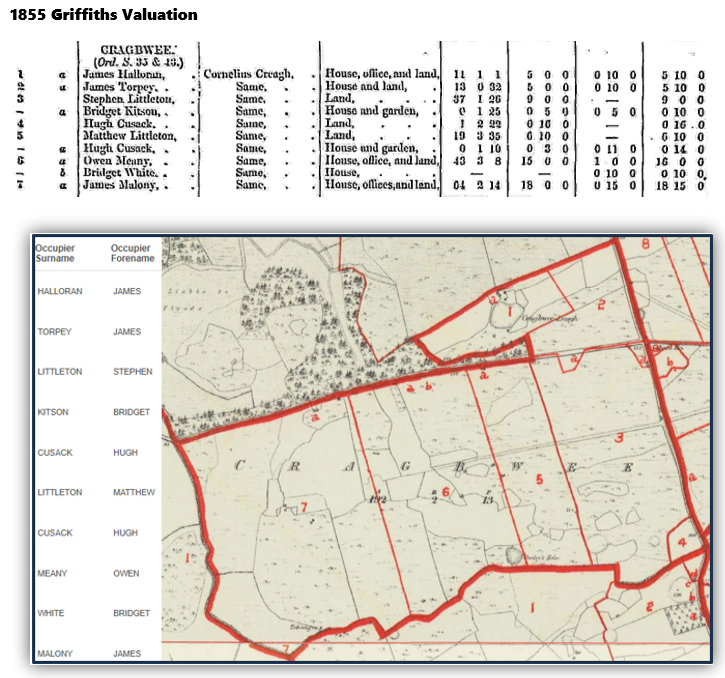
1841 Census Records: Population 82; Households 13
1851 Census Records: Population 38; Households 5
1861 Census Records: Population 30; Houses 9 (?)
1871 Census Records: Population 29; Houses 10 (?)
1881 Census Records: Population 28; Houses 11 (?)
1891 Census Records: Population 25; Households 8
1901 Census record: Population 16; Households 6
William & Bridget O’Neill
Michael & Bridget O’Shea, sons Patrick, Matthew, mother-in-law Mary Vaughan.
Michael Halloran.
Michael Halloran
Owen & Catherine Moloney, sons (?), Patrick, Thomas.
Thomas & Bridget Fitzgerald.
1911 Census record: Population 19; Households 5
William & Bridget O’Neill
Michael & Bridget O’Shea, sons Patrick, Matthew, Michael, daughters Mary, Ann, Bridget, Agnes, step mother-in-law Mary Vaughan.
Michael Halloran.
Owen & Catherine Moloney, sons Patrick, Thomas.
Timothy & his sister Catherine Connell.
1926 Census record: Population 14; Households 4
William & Bridget O’Neill
Bridget O’Shea, sons Michael, John, daughter Agnes, Mary Vaughan.
Owen & Catherine Moloney, son Thomas.
Timothy & Anne Connell, his sister Anne Connell, servant Jerimiah McMahon.
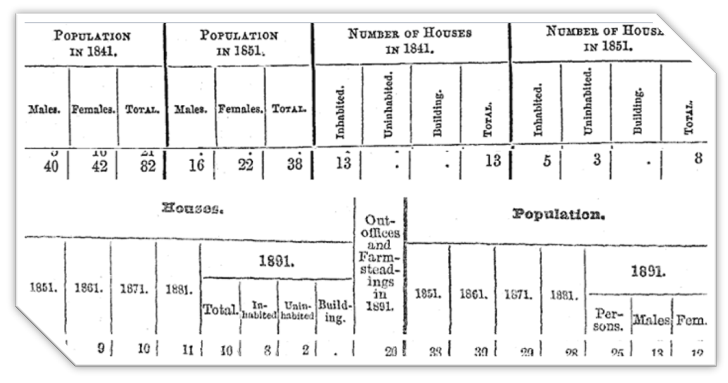
National Monuments
CL035-171—- : Ritual site – holy well
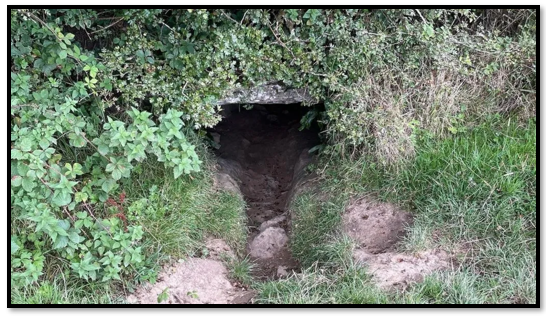
Description: Cut into a S-facing slope, in improved, gently undulating pasture. Depicted and named on all OS historic mapping as ‘Toberagee’ and meaning ‘well of prayer’ or ‘praying well’ having been anglicised from the Irish ‘Tober an Guí’. Frost (1893) refers to six holy wells in the Parish of Quin including Toberagee, which he indicates is associated with St. Finghin.
This is a natural spring originating from a fissure in the limestone bedrock. The rock appears to have been excavated and encloses a U-shape in plan around the spring SW-N-SE. The external ground level at N is c. 2.7m above the level of water in the well and the ground level at SW and SE is c. 1.5m above water level. The U-shaped area at upper ground level is defined by a low, roughly constructed wall (H c. 0.55m; T 0.8m) SW-N-SE. The well is open (Wth 2.4m) at S from where a water and weed filled channel (long-axis N-S) extends (L 12m ; Wth 2m) to a land drain (long-axis E-W) at S. Water can be seen seeping from the back of the rock at N, just above present water level and water is flowing slowly in the channel. A number of thorn trees enclose the well SW-N-SE and spread out to E and W of the well. A cashel (CL035-086—-) is located c. 175m to the east in the townland of Cant.
CL035-096—- : Ringfort – cashel :
Description: In improved pasture, on a gentle S-facing slope. Pockets of native woodland W-NW and forestry and woodland to E. A circular area (diam. 22m) defined by a well-preserved, substantial stone wall (int. H 0.85m; ext. H 1.25m; Wth at top 1.7m; overall Wth 6.4m). There is evidence of stone facing along the interior of the wall top at E. An entrance gap (Wth 3m) is located at N. The interior has a gentle WSW-facing slope and the surface is uneven due to the presence of rock outcrop and loose stones. A portion of collapsed drystone wall (L 8m; Wth 2.5m) extends in a curvilinear fashion from the interior of the enclosing elements at SSW. The ground between this collapsed wall and the main enclosing elements appears sunken.
CL035-092—- : Ringfort – cashel :
Description: In a generally level area, in mixed woodland. A large, oval area (c. 40m N-S; c. 45m E-W) defined by a collapsed stone wall (int. H 0.6m; ext. H 0.9m; Wth at top 1.5m; overall Wth 6.6m) which is covered in moss and ivy. A later stone wall of different construction has been built on top of the enclosure wall NW-E-SW. A linear field wall (long-axis c. NNW-SSE) truncates the monument across the W sector. The interior is generally level and the surface is very uneven due to rock outcrop and a scatter of loose boulders. It is possible that there may be internal walls/structures, however this is not definitive due to dense vegetation and fallen trees.
Compiled by: Mary Tunney, Alison McQueen and Vera Rahilly NMS 2018.
Some Baptisms in Cragboy in 1800’s
| Date | Child’s name | Father | Mother | Sponsors | ||
| ??.06.1832 | (?) | (?) | (?) | MacNamara | (?) | (?) MacNamara |
| 07.10.1845 | Mary | Baker | Michael | Neil | Margaret | Mary Neil |
| 08.05.1842 | Mary | Baker | Michael | O’Neill | Margaret | Michael and Bridget O’Neill |
| 01.09.1852 | Michael | Brin(?) | John | Ryan | Norry | Anne Halloran |
| 27.05.1841 | Anne | Clune | Martin | Roughan | Ellen | John Lynch, Bridget Many |
| 24.06.1845 | John | Clune | Martin | Roughan | Ellen | James Doherty, Mary Liddy |
| 20.03.1850 | Michael | Cooley | Patt | Meaney | Bridget | Bridget Cooley |
| 19.07.1816 | Thomas | D(?) | Patrick | Co(?) | Cecil | William Richardson, Margaret Brennan |
| 10.02.1825 | Margaret | Doloughty | Tim | McNamara | Mary | Patrick Corbett |
| 14.02.1817 | Catherine | Dooly | Pat | Magher | Margaret | Catherine Bridgeman |
| 18.06.1819 | Anne | Dunn | Thomas | Ryan | Mary | John MacNamara |
| 19.12.1823 | Anne | Garvey | James | Keogh | Mary | Batt Garvey |
| 28.11.1816 | Mary | Grady | James | Scanlan | Sara | Tom Hogan, Brigid Egan(?) |
| 15.07.1850 | Mary | Halloran | James | Marrinan | Margaret | Michael Simons, Anne Marrinan |
| 25.12.1843 | Catherine | Halloran | John | Lyons | Catherine | Patt Lyons, Margaret McNamara |
| 31.08.1846 | Johanna | Halloran | John | Lyons | Kity | Stephen Lyons, Johanna Lyons |
| 20.02.1850 | Bridget | Halloran | John | Lyons | Cath | Margaret Lyons |
| ??.02.1838 | Pat | Halloran | John | McGrath | Bridget | Thomas and Bridget Halloran |
| 17.09.1842 | Michael | Halloran | Thady | Fitzgerald | Anne | Tom Lynch, Mary Fitzpatrick |
| 23.09.1843 | James | Halloran | Thady | Fitzgerald | Anne | James Fitzgerald, Mary McNamara |
| 30.09.1845 | Margaret | Halloran | Thady | Fitzgerald | Anne | Joseph Fitzgerald, Bridget McNamara |
| 08.12.1840 | Mary | Halloran | Tim | Fitzgerald | Nance | James Halloran, Betty Simon |
| 09.07.1817 | James | Hartigan | John | Shannon | Brigid | Mary MacNamara |
| 12.03.1823 | Fanny | Higgins | Michael | Daxon | Fanny | Nancy Torpy |
| 28.05.1829 | John | Keane | Michael | McInerny | Margaret | Thomas Moylan, Nancy McInerny |
| 03.06.1830 | Mary | Keane | Michael | McInerny | Margaret | Catherine McInerny, John Molony |
| 13.05.1825 | John | Linane | Thomas | McDonnell | Mary | James Nelan |
| 19.05.1817 | John | Malone | Edmund | Gorman | Helen | John Halloran |
| 23.06.1823 | Eleanor | Malone | Edward | Gorman | Eleanor | David Power, Mary Cusack |
| 24.04.1842 | Michael | Meany | Denis | Molony | Mary | James Molony, Mary Meany |
| 16.09.1823 | Michael | Meany | Michael, Weaver | |||
| 02.09.1844 | Patt | Moloney | Patrick | Mac | Bridget | Mary Slattery |
| 01.10.1829 | Briget | Molony | James | (?) | Briget | John Callahan, Nancy O’Keeffe |
| 25.01.1825 | Mary | Molony | James | Hogan | Bridget | John Molony |
| 06.06.1838 | James | Molony | James | Hogan | Bridget | Patt and Mary Molony |
| ??.12.1838 | Bridget | Molony | John | Garvey | Honor | Patt Reddin, Ann Molony |
| 30.11.1839 | Tim | Molony | John | Garvey | Honora | Anne Garvey |
| 16.12.1842 | Thomas | Molony | John | Garvey | Honora | Anne Molony |
| ??.04.1835 | Catherine | Molony | John | Hogan | Bridget | Bridget Molony |
| 14.10.1836 | Mary | Molony | Michael | McNamara | Bridget | Ellen Carmody |
| 05.08.1841 | Tady | Molony | Michael | McNamara | Bidy | D(?)y (?)arry |
| 18.04.1853 | Margaret | Molony | Pat | Meany | Anne | James and Margaret McDonnel |
| 03.12.1840 | Thomas | Molony | Pat | Slattery | Mary | Pat Burns, Mary Moony |
| 18.04.1846 | Pat | Molony | Pat | Slattery | Mary | Mary Meany |
| 19.05.1839 | John | Molony | Patt | Slattery | Mary | Andrew and Mary Nixon |
| 19.11.1845 | Pat | Molony | John | Garvy | Nancy | Pegy Molony |
| 01.04.1816 | Margaret | Neal | Michael | McNamara | Anne | John (?) |
| 02.10.1828 | Michael | O’Neil | Michael | McNamara | Norry | Judith Lillis |
| 22.02.1827 | Briget | Savage | Robert | Taylor | Hanna | Briget Benice, Pat Savage |
| 09.05.1825 | Peter | Shea | John | Brigid | John Halloran | |
| 29.07.1822 | Elizabeth | Shea | John | Hoskins | M | Patrick Connelly |
| 07.07.1818 | Michael | Stanton(?) | Patt | Carmody | Mary | Austin King, Peggy Stanton |
| 27.02.1821 | Patrick(?) | Tuohy | James | Newham | Alicia | Dan and Sara Canomody |
| 17.07.1817 | Cate | Elizabeth Timans | ||||
| ??.02.1855 | Mary | Molony | James | Meany | Anne | Owen Meany, Bridget Meany |
| 19.12.1864 | John | Molony | Patt | Meany | Anne | James Collins, Hanna Collins |