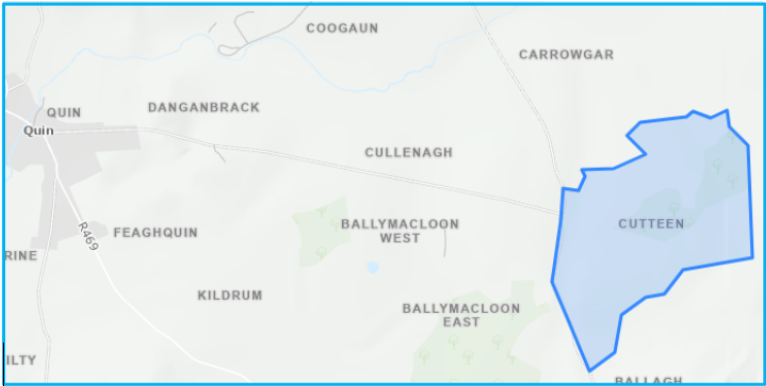
Travelling east from the village along the school road, you will eventually reach a tee-junction. Immediately in front of you is the townland of Cutteen. This townland is large in terms of spatial footprint but small in terms of population. This has not always been the case, as the records below will attest. Like many other townlands in Quin, the biggest depopulation did not arise as a result of the Great Famine, but 20-30 years later as a result of changed agricultural practices. The move from labour intensive tillage to grazing, allied to the forceful removal of tenants from the land, resulted in mass emigration and a demographic change that has left its mark to today.

85.59 hectares / 0.8559 km²/ 0.33 square miles / 211 acres
1659 Census for Cotteene: Tituladoes: Mahon McNenda; James Houregan. Population: 26 Irish

1855 Griffiths Valuation – occupiers/property owners

Landlord: Crosdale Maloney

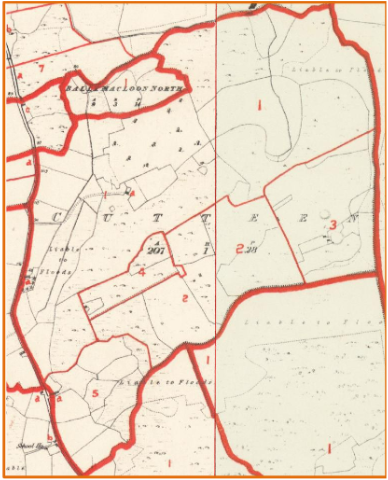
Occupiers: James Wolfe (parcels 1&2), Charles Quilligan(3), Thomas McDonnell(4), Patrick Markaham(5).
Census Records for Cutteen

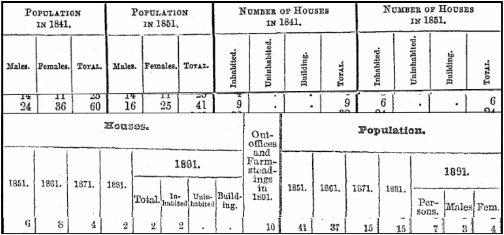
1841 Census: Population 60; Households 9

1851 Census: Population 41; Households 6

1861 Census: Population 37; Households 8

1871 Census: Population 15; Households 4

1881 Census: Population 15; Households 2

1891 Census: Population 7; Households 2

1901 Census Population: 9, Households: 3

  • Margaret Wolfe, sons Michael, John, servant Ellen Moloney.
  • Michael & Sarah Kiely.
  • Susan Meaney, sons Patrick, John.

1911 Census Population: 5, Households: 2

  • John & Kathleen Wolfe, servant Lizzie Callaghan.
  • Michael & Sarah Kiely.


1926 Census Population: 7, Households: 3

  • John & Kathleen Wolfe, sons John Joe, James Edward, Patrick Clement.
  • Corney Clune.
  • Michael Markham.

1918 Cutteen Subscribers to Major Redmond Memorial Fund

John Woulfe; Patrick Hayes

From Quin Petty Sessions 12th Nov 1906

“That the defendant did at Cutteen in said district and county on 16th September 1906 unlawfully, feloniously and of malice aforethought, attempt to kill and murder one Michael Wolfe”.

The case against Patrick Meaney was referred for trial at the next assizes to be held for the County of Clare.

The above case is an exception for the Quin Petty Sessions Court. Most cases from within Quin and the surrounding district involve animal cruelty, absence of lighting on pony & trap during designated hours, allowing animals to wander onto the public road or adjoining properties, occasional inebriation etc.


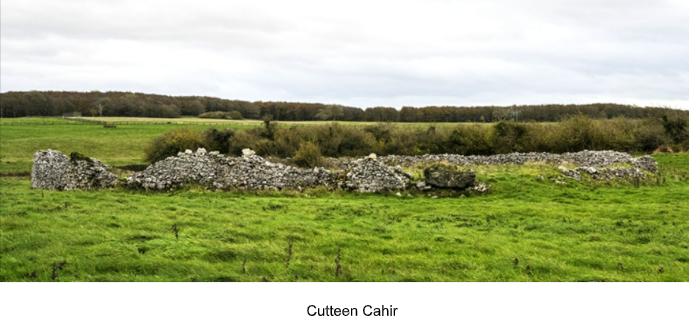
National monuments in Cutteen
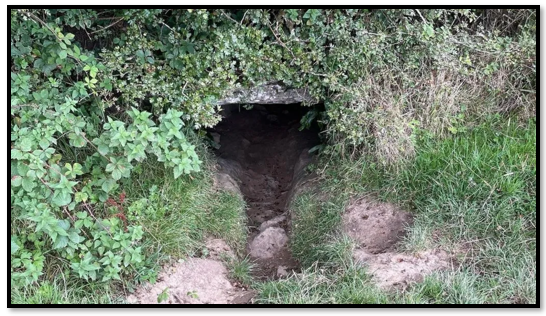
CL042–097 Souterrain

CL043-002 Enclosure

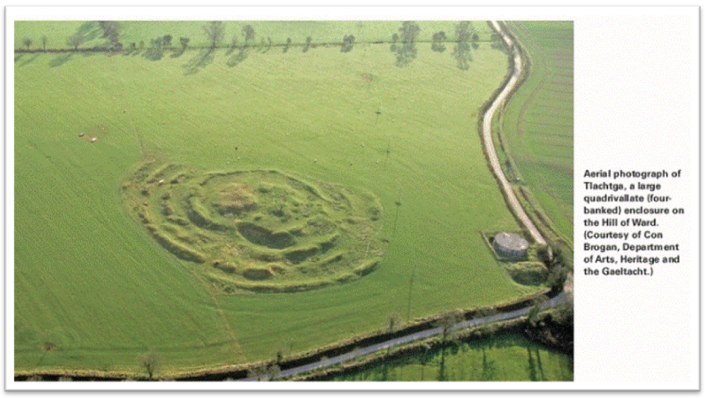
CL043-003 Enclosure Cutteen Cahir (see image on Left)

Common surnames found in Cutteen records

Wolfe/Woulfe, Meaney/Meany, Markham/Markahan.

Baptisms in 1800’s

Child’s name Date of baptism Father Mother’s name Sponsors
Mary (?) ??.05.1836 Pat Markam   Bridget Mulcready
Nancy Carney 27.06.1834 John Kinely(?) Mary Honor Egan
Eliza Hasset 08.10.1836 Michael Liddy Honora Ellen McDonnell
James Hurley 0?.02.1843 Patt Hassett Bridget James Hurley, Margaret Hurley
Pat Hurly ??.02.1841 Pat Hasset Peg John Nihil, Miss Hasset
Nanny Hurly 17.12.1844 Pat Hassitt Margaret Pat Hassitt, Ellen Hassett
Pat Lynch 16.02.1833 John Reidy Judy James (?)annory, Mary Hasset
Jane Malone 05.12.1819 Edmund Gorman Ellen William Reidy
Sally Markaham 16.03.1846 Patrick Grady Mary Nancy Markaham
Margaret Markaham 19.05.1839 Patt Graddy Mary Catherine McNamara
Michael Markahan 17.08.1833 Pat Grady Mary Stephen Markam, Catherine Grady
Patt Markham 17.02.1843 Patt Neavill Bridget John Neavill, (?)
Peter Meara 05.07.1824 Thomas Dugan Mary Mary Quinlivan
Thomas Meehan 16.10.1821 William Quinlivan Brigid James Quinlivan
Patrick Meehan 16.09.1823 William Quinlivan Bridget William Kenny, Jane Quinlivan
Daniel Nevil 27.02.1842 Thomas Fox Nanty James Wolf, Mary Wolf
Margaret Nevill 26.05.1839 Thomas Fox Anstace Michael Fox, Mary Ryan
Thomas Nevill 09.12.1844 Thomas Fox Nanty Patt Cullinan, Peggy Clune
Bridget Slattery 04.02.1833 Pat Taylor Jane Robert and Catherine (?)agh
Winifred Slattery ??.10.1835 Pat Taylor Joan Michael McDonnell, Winifred Brassil
Ellen Slattery 29.07.1838 Pat Taylor Joan Pat Molony
Honora Wolf 31.01.1835 Daniel Moran Catherine Thomas Meany, Ellen Wolf
Daniel Wolf 06.11.1836 Daniel Moran Cate James Moran, Judy Nash
Jane Wolfe 31.03.1843 Daniel Moran Cate Kitty MacNamara
Catherine Woulfe 24.02.1854 James Clune Margaret Patt Clune, Catherine Woulfe
Michael Burke 30.01.1859 Thomas Donnellan Mary John Carthy, Eliza Hanneen
Patt Halloran 06.11.1864 John Brennan Ellen Margaret O’Neill
John Moylan 12.06.1855 James Slattery Margaret Daniel Woulfe, Mary McDonnell
Mary Moylan 11.07.1857 James Slattery Margaret Bryan McMahon, Margaret Taylor
Maria Wolfe 23.05.1864 James Clune Margaret Matt Clune, Cath Woulfe
Ellen Woulfe 08.04.1855 James Clune Margaret Corney Clune, Catherine Clune
Daniel Woulfe 11.04.1857 James Clune Margaret Dan Woulfe, Mary McNamara
Margaret Woulfe 15.03.1859 James Clune Margaret Patt Clune, Margaret Clune
(?) Woulfe 22.02.1861 James Clune Margaret Michael Clune, Margaret Clune
Bridget Woulfe 02.02.1862 James Clune Margaret James Clune, Ellen Clune
Honora Woulfe 04.01.1866 James Clune Margaret Matt Clune, Anne Clune
Michael Woulfe 30.03.1867 James Clune Margaret Thomas Clune, Bridget Clune
John Woulfe 01.05.1869 James Clune Margaret Thomas McNamara, Mary McNamara
James Woulfe 09.04.1871 James Clune Margaret Michael McNamara, Kate McNamara
Corney Woulfe 08.05.1873 James Clune Margaret Clune, Anne Moylan
Martin Woulfe 26.09.1874 James Clune Margaret Pat Meany, Mary Meany

What did the Anglo Normans ever do for us?

We are well aware of the impact of the Anglo-Norman invasion on our history, the undermining of Gaelic society and the replacement of our native structures. Poor old Diarmuid MacMurrough takes a lot of blame for all of this, despite the fact that Henry II in England had already sought and had been given approval by Pope Adrian to invade and civilise us. Henry was just waiting to finish his war in France before sorting us out!

Anyway, in they came, conquered, settled, married and eventually becoming more Irish than even ourselves, ‘níos gaelaí ná na Gaeil féin’! But besides building towns and castles, robbing our women (and probably taking our jobs!), what did the Anglo-Normans do for us – if anything?

Well, for one, they gave us a whole new suite of names, both forename and surname, to choose from.

The Norman influence on Irish surnames

Following the invasion of 1169, a large number of Anglo-French first and last names entered into Ireland. Many, such as Power, Browne, Fleming, Joyce, Burke, Barry, Costello, Nagle, Nugent, D’arcy, Roche and Walsh/Welsh/Wallace, are nowadays considered Irish and are commonly found in Clare. So, too, are those with the Fitz prefix such as Fitzmaurice, Fitzgerald, Fitzgibbon and Fitzpatrick which most people would regard as Irish as the shamrock. Fitz, meaning ‘son of’, can be considered the Norman version of Mac (it derives from the Latin/French ‘fils de’, meaning ‘son of’). Burke came from de Burgh, Roche from de Roiste, Power from de Paor.

In 1366, a law was passed that “Every Englishman do use the English language, and be named by an English name, leaving off entirely the manner of naming used by the Irish.” This was introduced to dissuade the settlers from adopting Celtic prefixes or forms of surname. It didn’t have much affect as many settler families added Mac or ‘O’ and Norman names evolved into an Irish form (eg McHenry, McArthur).

In 1465 a law was passed enacting “that every Irishman that dwells betwixt or amongst Englishmen in the County of Dublin, Myeth, Vriell, and Kildare … shall take to him an English Surname of one town, as Sutton, Chester, Trym, Skryne, Corke, Kinsale; or colour, as white, blacke, browne; or arte or science, as smith or carpenter; or office, as cooke, butler ….”

Many of the trades of the early medieval period such as Archer, Butler, Cooper, Carpenter, Draper, Skinner, Tanner found their way into our surnames. Other introductions from this period came from the mercenary soldiers who accompanied the Norman invasion: Walsh (meaning Welsh), Joyce and Fleming (from Flemish mercenaries) are examples.

Incidentally, the Normans usually took their surnames from the place of their family origins. So, D’arcy originates in Arcy in Normandy. De Clare originates in Clare in Suffolk where the Anglo-Norman family were based. While De indicated their place of origin, Le was used to describe them, eg Le Poer meant ‘a poor person’.

De Burgh – Burke – from a placename in Suffolk, France

Le Botilier – Butler – Occupation bottle steward

De Barra – Barry – from an estate in Wales

Le Waleys – Walsh – the Welshmen

De Angulo – Costello/Nangle – from Nangle Pembrokeshire

What of their influence on forenames?

 Many of the Normans forenames introduced here were of a biblical or European saintly origin.

 In 1922, Reverend Patrick Woulfe wrote extensively on the topic of Irish name origins as follows:

In the same manner Norman and English names became current in Irish families during the thirteenth and subsequent centuries. These have now almost completely supplanted the old Gaelic names. The names borne by the Normans and by them introduced into Ireland, were of three kinds :

 (1) names of Scandinavian origin which their ancestors had carried with them to Normandy ;

(2) names of Germanic origin which the Frankish conquerors had brought across the Rhine and which had ousted the old Celtic and Latin names from France ; and

(3) Biblical names and Latin and Greek names of saints,, which the Normans began to adopt about the beginning of the eleventh century.

Together with these came in a few Celtic names from Brittany, a small number of Anglo-Saxon names, some Danish and Norse names from England, and one or two British or Welsh names. These were nearly all very rare and most of them soon died out. Of the Anglo-Saxon names, only two, Edmund and Edward, survived. Alfred has been revived in recent times. At the period of the Invasion, Frankish names were by far the most popular among the Normans, but Biblical and saintly names were coming rapidly into favour.

The following is a list, in order of frequency, of the more common names borne by the early Anglo- Norman invaders, the Biblical and saintly names of Latin and Greek origin being printed in italics :

William, Robert, Richard, John, Walter, Roger, Ralph, Adam, Hugh, Henry, Thomas, Nicholas, Gilbert, Geoffrey, Elias, Peter (Piers), Osbert, Reginald, Jordan, Simon, Alan, Stephen, Philip, David, Arnold, Alexander, Laurence, Baldwin, Herbert, Martin, Maurice, Godfrey, Andrew, Alfred, James, Samson, Turstein, Warin, Ailward, Daniel, Edward, Gregory, Bernard, Benedict, Hamon, Matthias, Michael, Gerard, Gervase, Lambert, Wilkin, Patrick, Edmund, Edwin, Hubert, Ivor, Joseph, Oliver, Mark.

 The following in alphabetical order were rare :

 Abraham, Adelard, Ailmer, Antony, Augustine, Brian, Clement, Constantine, Estmund, Eustace, Everard, Gocelin, Isaac, Leonard, Luke, Matthew, Miles, Milo, Odo, Osbern, Osmund, Pagan, Ponce, Randulf, Redmund, Rodulf, Silvester, Turold, Ulf, Vincent.

 The following names only came in, or at least became popular, at a later period :

Bartholomew, Christopher, Francis, Gerald, George, Paul, Roland, Theobald.

 Women’s names among the Normans were nearly all of the Biblical or saintly class:

 Agnes, Alice, Amelina, Anastasia, Annabella, Catherine, Cecily, Christina, Dorothy, Egidia, Eleanor, Evelyn, Frances, Honora, Isabella, Johanna, Matilda, Margaret, Susanna.

 The name Mary does not seem to have come into use in Ireland before the end of the16th century. Brigid only began to be used about the same period.


Extracted from ‘Sloinnte Gaedheal is Gall’, Patrick Woulfe 1922

Out with the old, in with the new

The Anglo-Normans also brought with them new animal species such as the rabbit and fallow deer, new foods such as wheat, orchard fruits, mutton and farming practices such as hay-making. They introduced us to continental European religious saints and practices of the Roman Church. European religious orders soon followed such as the Franciscans, Augustinians, Cistercians, Dominicans etc. These replaced the structures of the native Irish Christian Church.

Up to then, the Irish natives did not adopt the name of saints as they considered this to be placing themselves on a par with the saint. Such naming convention was reserved for those of higher status in the monasteries. This was circumvented by use of the prefix Maol or Giolla meaning follower or servant. The Normans changed all of that and it was now acceptable to be called Peter, James, Michael, John, Mary, Brigid or Margaret.

Very few of us to this day do not have either a forename or surname that is not of Norman origin. Eventually, arising from the Gaelic Revival in the late 19th century, new Irish language versions of these forenames appeared such as Séan, Seamus, Peadar, Máire, Bríd, Mícheál, Cathal and many more appeared.

The Irish Church did not condemn the practice of slave-trading by the Irish until the invasion by the Anglo-Normans and the encroachment of the Roman Church. The story of Patrick (Patricius, son of a Roman administrator), which was introduced here after the Norman conquest, presents the native Irish as uncivilised pagan slavers who needed to be brought to heel. So the Normans inadvertently gave us our native saint and a forename for a good chunk of our population for generations following.

Out with the new, in with the old

Children are rarely given these European saint names today. Authentic Gaelic forenames are much more popular. We are nevertheless, unlikely to see the demise of the Anglo-Normans surnames that were introduced here. But all of us Mikes, Jimmies, Johnnys, Paddys, Kittys, Cathys, Maggies and Bridies can thank the Normans for what they brought us!