
Mushroom Hunting
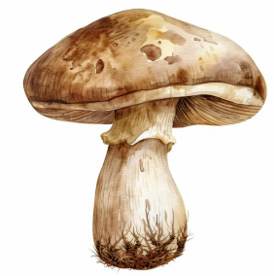
In early to mid-September, a signal, unheard by the rest of the family would resonate in our house, urging my father to rummage for some large paper bags and a walking stick. This signal was as assured as the one calling house martins, swifts and swallows to prepare for their end of season departures to the south. My father’s journey was shorter but no less important – he was going in search of mushrooms.
His hunt brought him not to semi-darkened woods with damp floors where mushrooms might be found. Instead, he searched in the shadows of low hanging branches in fields of rich grass, beside the limpid waters of the Cottoner’s River, an active stream flowing from the McGillicuddy Reeks hills to the south. Owned by his friend Brendan, the field was as meticulously prepared for mushroom harvesting as if for haute cuisine. Importantly, no artificial fertilizers had ever been used here. Our two local experts had long since determined that manmade growth promoters were a disaster for their favorite autumn treats. Cattle had been briefly moved in a few weeks earlier, to do what cattle do – they ate plenty while fertilizing the ground. Then they were removed and the ground allowed to rest.
After a month or two, the meadows had a thin carpet of new growth. This sheltered but did not impede the fungal shoots. The first mushrooms appeared as pale button-size apparitions in the sward, like orphaned fairy children. They were not hampered by high grasses. The game was on!
It was with this background in mind that my father confidently drove to one of his designated hunting grounds in his ancient yellow Fiesta. He was no longer a garsún and I am sure that those passing by as he meandered through the fields must have wondered what he was up to. However, he was oblivious in his epicurean quest. In time he returned home with his bounty. He positively skipped into the house with his paper bag of goodies. Saying nothing but wearing his ‘cat has got the cream’ smile, he bounced into action.
A quick dip in water and a skilled peel saw the mushrooms ready. If the kitchen stove was hot, he would place a cluster of treats on the surface, coated with butter, to simmer for a while. Soon the subtle smell of fresh cooking filled the kitchen. While the mushrooms baked, a pot of tea was brewed. Soon afterwards the tea and mushrooms were consumed with relish by our rustic foodie.
Only one feast outdid this impromptu meal.
Occasionally, following a damp muggy evening, lingering warmth in the shifting autumn weather prompted strong fungal growth. The following day the father would seek out the overnight mushroom motherlode. He returned home with a king’s ransom. Many of the mushrooms were the size of dinnerplates. These beauties demanded special attention. They got it in the company of streaky rashers!
Much is written about the perfect food combination. Lemon and fish, pork and apples, and say, lamb and mint are up there with the best of them. In the rustic corner, it’s hard to beat lamb’s liver and onions. However, none I would argue, works better than wild mushrooms and streaky rashers.
In preparation, the mushrooms were placed in a heavy skillet pan with butter, and then the rashers were added. Magic occurred in the pan. The result was not so much a meal as a gourmand’s delight. The mushrooms released a rich dark sauce that stained and flavoured the bacon. My father, who most of the time would hardly boil water for a cuppa, now nursed his special meal with infinite care. He would not exchange this fry-up for the finest ribeye steak.
In the coming weeks he returned many times to the River Field, until the cache of mushrooms was exhausted. Nature is always generous at season’s end, with offerings of nuts, apples, blackberries, and other fruits. For my father, however, he seldom saw these, as he chased the perfect mushrooms on the autumn floor.
Michael Houlihan.
03/09/2026