An entry in the Occurrence Book at Coolgardie Police Station, Western Australia, for June 17th, 1893 read as follows:

“At 7 p.m. Patrick Hannan reported at the station that he and Thomas Flanagan had discovered payable alluvial gold on the 15th inst. about thirty miles east north east of Coolgardie and unearthed 100 oz.in two days. Hannan states that there is no water on the field.”

It was the opening chapter in the story of the greatest gold find ever, thought to be worth more than 1,100 million dollars to the Australian economy and it all began with a Quin native!

Patrick ‘Paddy’ Hannan was born at Gorteen, Dangan on the 26th April 1840. The family later moved to Ballyroughan, about 6 kilometres east of Quin. This was during a period of great strife and severe food shortages in Ireland, with the worst year of the Famine in 1847. As a teenager he worked a little with the Armstrong family at Ballyroughan House.

There was local mining activity near Quin in Hannan’s youth, with Kilbricken lead-zinc mine worked from 1834-1854 and Ballyhickey mine from 1834, intermittently operating until 1854. It may have been these enterprises that prompted Patrick in 1863 to emigrate to Australia to try his hand at prospecting.  Like many Clare residents the young Paddy was met by relatives on his arrival.

Initially Hannan tried working in the Ballarat and Bendigo gold fields in Victoria, and later moved to New Zealand. After six years he was back in Australia spending time at several gold-digging centres across the country, without much success. In 1889 he was amongst the first wave of miners in Western Australia.

He was joined there by two fellow Irishmen, Thomas Flanagan from Ennis and Daniel O’ Shea from County Cork. Hearing some rumours they decided to try their luck east of Coolgarlie town.

In June 17th 1893 while supposedly searching for a wandering horse or perhaps creating some space for himself, Hannan happened on some gold ingots on the scrubland surface. He and his colleagues dug deeper and found yet more gold pebbles.

They lodged their claim at the police station in Coolgarlie in August 1893. News of their gold find spread quickly, leading to a rush to find new nuggets of gold. Prospectors began arriving in huge numbers in the area.

Ballyroughan Townland, (blue shading), north of the Kilkishen road from Quin

Initially for new arrivals, there was little or no food, accommodation or, most importantly, water to be had. This led to much distress and many early deaths were listed amongst the miners.

The local gold field became known as the ‘Golden Mile’. In time it was deemed to be the ‘richest square mile in the world’. New mining companies were constantly being created to speculate on the riches pouring forth from the ground there. In time Government agencies laid on better amenities to the area, especially piped water. For transport a new rail line was added from Perth. Two towns – Kalgoorlie and Boulder – grew out of the gold rush.

Patrick Hannan’s right as the discoverer of the huge gold field was never disputed. In 1897 he was feted like royalty on his return to Kalgoorlie. Over time civic offices, the railway station and a statue in Kalgoorlie’s Main Street were named after him.

Oddly, neither Paddy Hannan nor his compatriots benefitted greatly from the new wealth coming from the gold field. Their own site failed to deliver any significant quantities of gold. Patrick received an annual pension of €150.0 dollars from the Government of Western Australia in acknowledgement of his founder role. He lived out his life in Melbourne in the care of his cousins. He died there at the age of 82 and is buried in the city’s cemetery.

What is known of the character of the man Patrick Hannan? An 1897 article in the newspaper The Kalgoorlie Miner recorded him as being ‘pleasant and genial as his nationality could not well prevent him from being, while in appearance, a ruddy complexion betokens a healthy and outdoor life. Concerning himself, he is not disposed to be very communicative’.

This year marks the 100 year anniversary of Patrick Hannan’s death in Melbourne in November 1925.

The Ballyroughan Hannan’s were related to the Dangan Lynch’s. Patrick Hannan is an ancestor of Fergal Lynch, the current Priomhóide of Scoil na Mainistreach and ex county hurler.

The Kalgoorlie gold field is still active. 132 years after Patrick Hannan’s initial find, mining there is now on a huge industrial scale, with pits running hundreds of metres deep. Gold is still being found.

MH, 2025.

______________________________________________________________________

Sources: Michael Mac Mahon, ‘Paddy Hannan from Quin, Pioneer of the Golden Mile’, The Other Clare, Volume 5, 1981.

Ann McNamara, historian, Quin Heritage.


Seán na Gealaí

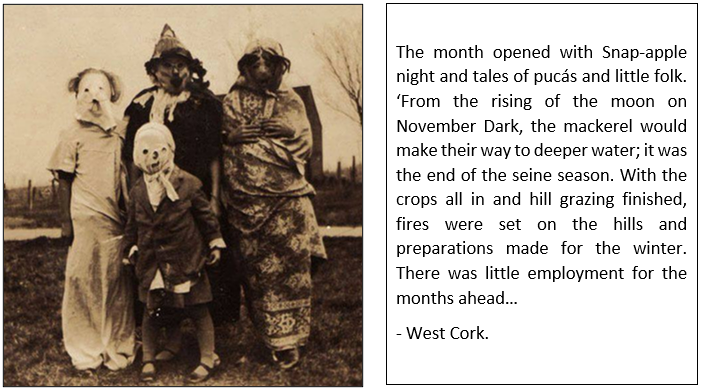
Halloween is the direct descendent of Samhain. It was the night when the gap between this world and the spirit world narrowed.  Known as Oiche Shamhna or ‘spirit night’, the souls of the dead were expected to return to the family home. The Church introduced the Feast of All Saints (Nov1) and the Feast of All Souls (Nov 2nd) to counter Samhain. Evil spirits were also thought to be abroad and people avoided travelling alone on this night.

   “Deireann na daoine go mbíonn sidheogaí amuigh oidhche Shamhna”, Schools’ Collection (NFCS 249).

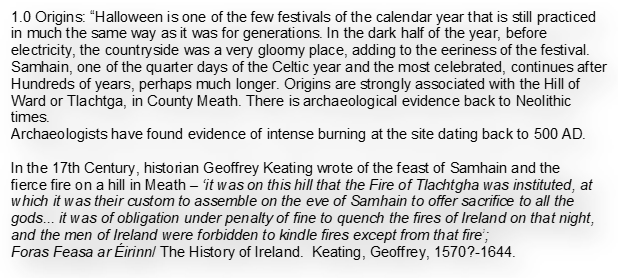
Origins of Samhain

Contender 1- Tulsk, County Roscommon

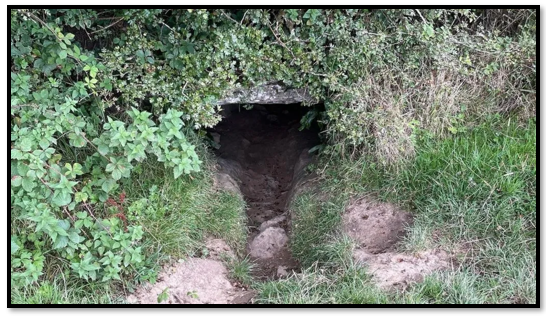
Oweynagat Cave, Uaimh na gCat, meaning the ‘Cave of the Cats’ in Rath Croaghan. The Book of Leinster names it as dorus iffrin na Hérend – Ireland’s Gateway to Hell. Demons and all kinds of creatures emerge from here on Oiche Shamhna.

 Echtra Nerai (the Adventures of Nera) is first mentioned in the 10th century Cath Maige Mucrama story,  happening at Samhain.

Oweynagat Cave is also said to be the home of the Morrigan. She is portrayed as a goddess of battle and war, with the power to transform into crows or ravens. Her dreaded cry was frequently heard over battlefields.

Echtra Nerai, the Adventures of Nera

An Irish text taken from the Ulster Cycle, dating to the tenth century entitled ‘Nera and the Dead Man’, tells of the warrior Nera who accepts a dare during a dark and stormy Samhain night to tie a withy around the ankle of a hanging dead man. As he does so, the corpse suddenly comes to life and asks Nera to carry him on his back. Nera complies. After some adventures Nera gets the dead man back to his tree. All of this takes place at Samhain at Rath Croaghan/Cruachan, hence its association with Halloween.

Contender 2 – Tlachtga, Meath

The original Tlachtga was a druidess of considerable power and importance, the daughter of Mug Ruith who lived on Valentia Island in Kerry. He is said to have lived through the reign of nineteen kings, with his lifespan stretching back to the time of Christ on earth. Tlachtga and her father could travel the world on the Rath, a fabulous spinning wheel of fire that easily transported them. Mug Ruith sought out knowledge and learning like few before him and it was in this manner that he and Tlachtga travelled to study under Simon Magus (Simon the Sorcerer), who is mentioned in the Bible.

Simon Magus and Mug Ruith sent Tlachtga out into the world to gather as much knowledge as she could find. Upon her return they realized that her knowledge far surpassed their own!
They were outraged and such was their jealousy that they set the three sons of Simon Magus upon Tlachtga, who defiled her. She returned to Ireland where she gave birth to three sons, Dorb (Doirb), Cuma (Cumma) and Muach.

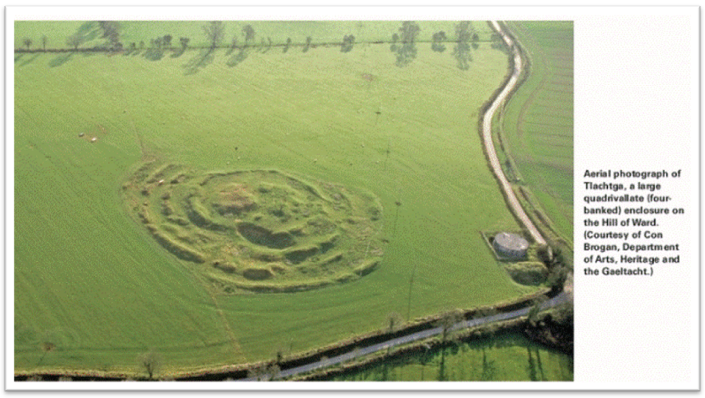
It was on the hill of Ward in county Meath that Tlachtga brought her three sons into the world, and it was there that she died, unable to sustain her life in the face of the utter grief and despair she felt at the indignity she had endured.

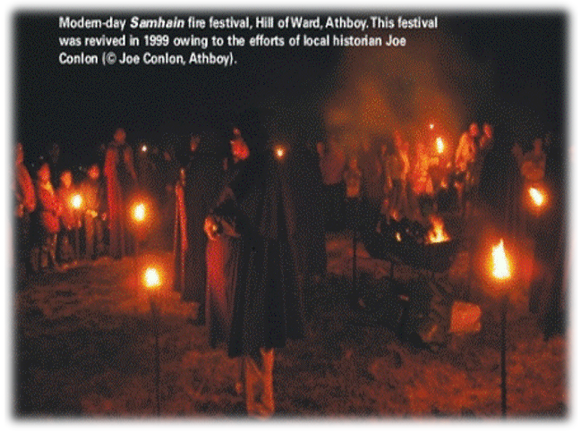
In recent years a renewal of the annual gathering on the hill of Ward now attracts hundreds of people at Halloween. A walk from Athboy up towards the Hill itself culminates with a celebration, with elaborate ceremonies and an acknowledgement of the cultural gift to Ireland and the world that Tlachtga represents.

In the ancient kingdom of Mide, Tlachtga was considered an important assembly place alongside Tara, Teiltun and Uisneach. These four ‘corners’ are recorded as having been the location of fortresses constructed by high king Tuathal Techmar at the foundation of Mide in the early decades of the first millennium AD.

‘Much of the (archaeological) evidence points towards a long history of ritual activity. Large quantities of animal bones – a sign of large scale feasting have been found throughout all phases of the site. The lack of evidence of any residential or day to day activity strengthens the idea that it most likely it was set aside purely for ritual or celebratory activity.

There have been finds in all three phases of the site, including scattered Bronze Age human remains and the skeleton of an infant between seven and ten months old… The child burial, next to a ritual deposit of cow bones, dates to AD 450 – around the time of the arrival of Christianity.

“The child was clearly buried with care and having not found any evidence of burials on the site, we’d have to guess that This child belonged to someone significant”.

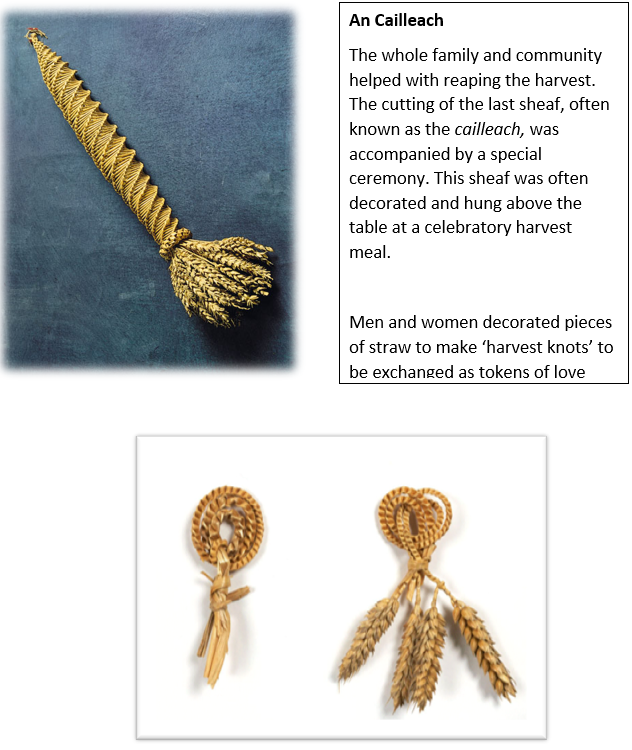
Harvest knots and Guises


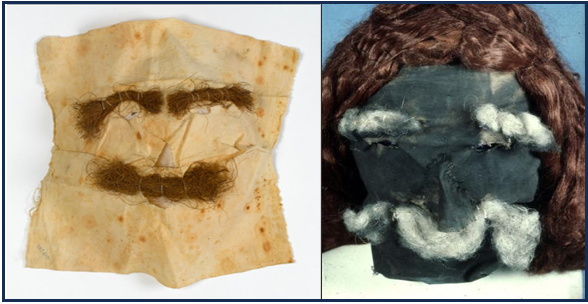
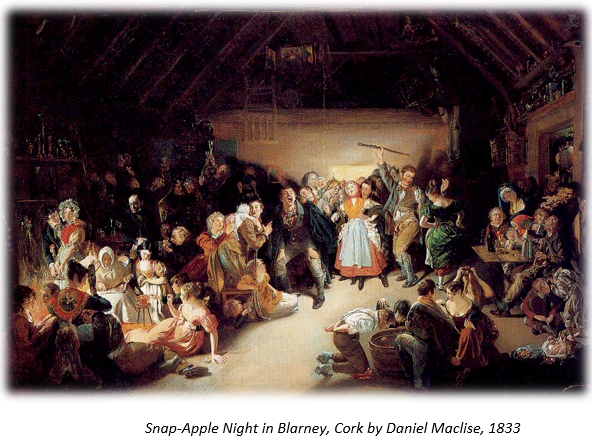
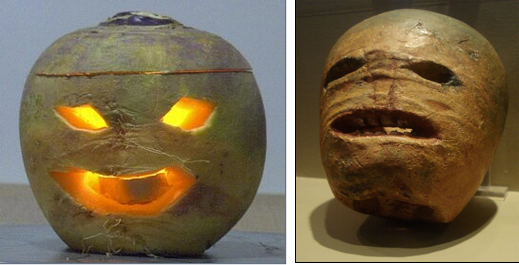
Homemade masks made by village boys calling to local houses on Oiche Shamhna

Outdoors

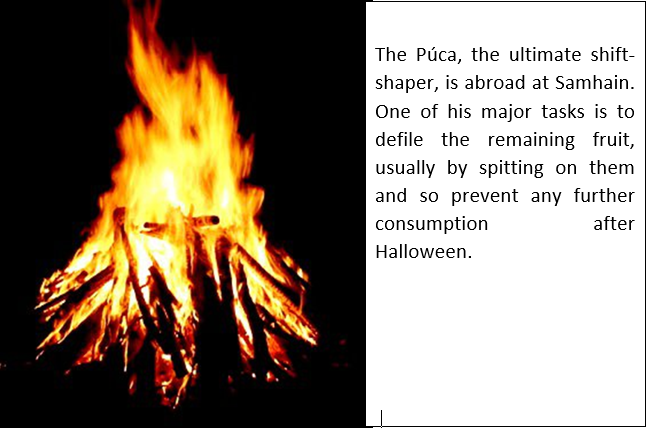
Unlike May when the fairies are active, November Eve brings malevolent spirits. It is the night for community bonfires, especially in housing estates in the cities and towns. Collecting the last handful of fruit and nuts.

Indoors

Families would attempt to have a celebratory supper on Oiche Shamhna. Family supper might be colcannon or pandy. They would first secure the house by sprinkling Holy Water and possibly placing a religious object in the thatch near the front door.

Typical Samhain Food included pancakes, stampy (a potato and apple cake, crusted with barley, enhanced with sea spinach and rock samphire & cooked with oil) apple cakes, nuts, blackberry pies.

An bairín breac/the barmbrack or the ‘speckled loaf’, containing oodles of dried autumn fruits is still a favourite treat, with lashings of butter.

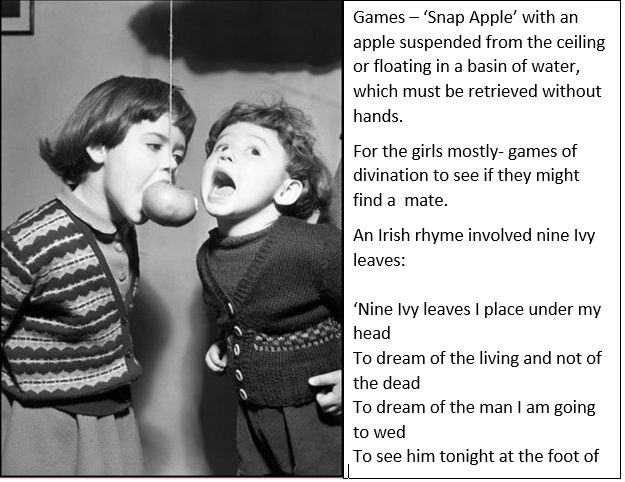
Tokens inside the traditional loaf included the ring as a symbol of love and marriage,  a thimble (spinsterhood); a button (bachelorhood); a stick (to be beaten by the spouse); a rag (poverty); a coin (wealth) and a crucifix (the taking of religious orders).

Future Reading