Postal Services in the Quin Area 1831 – 2026
(This article was originally written by Maura O’ Loughlin and first published in ‘Images and Memories’ Quin Clooney Maghera Dangan 1994. The original text has been edited, with additional information added to provide further context for the reader.)
King Charles, in 1631, ordered his postmaster to open a regular means of communication between the metropolis, Edinburgh, West Chester, Holyhead and Ireland. By 1657 there was a weekly post to the cities which was further improved to a twice weekly one by 1663. The penny post was introduced to Dublin in 1773, but the major improvement of the service began when the Duke of Richmond became the first Postmaster General of the united services after the British and Irish post offices were amalgamated in 1831.
It was in this year that a penny post was established in Quin. Only the gentry were involved in sending and receiving post, due to the great expense incurred and due also to the educational and literacy status of the populace.
There were four methods of transporting post at this stage: 1. Mail coach – Bianconi’s coach that travelled from Limerick to Ennis. 2. Mail car, this linked Limerick, Broadford and Tulla. 3. Horse post – this connected Ennis and Ardrahan to meet the Galway mail coach. 4. Foot post this existed between Newmarket and Quin.
In January 1832, a Mr. Usher inspected the mail coach road between Limerick and Ennis and advised changing the route due to the terrible conditions of the road: to travel by Sixmilebridge, Quin and Clarecastle instead of Bunratty and Newmarket. There was a foot post established between Quin and Newmarket in 1838 possibly due to the change of route.
The Limerick-Ennis railway was completed in 1859 and some years later Captain Stacpoole M.P., arranged for the railway to carry the mail for a nominal charge of £50 p.a. Newmarket-on-Fergus was a railway sub office, which meant that it received most of its mail from the railway instead of the district office.
In 1893 Ardsollus became a railway sub-office also, with John Heffernan as postmaster. However, after only eight years, in 1901 the Ardsollus office closed and a mail box was put in its place and this still exists.
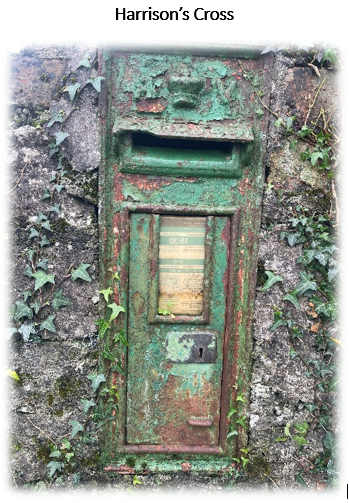
Quin can be justifiably proud of its wide variety of post boxes. The oldest mail boxes in the county are Victorian (1837-1901) and there is one at Harrison’s Cross in Clooney, with VR casting on it. On the wall of Mc Carthy’s shop in Quin (opposite Mike Clune’s) there is an Edwardian post box 1901 – 1910. The original location for that box was Hassett’s Cross opposite Malachys.
Gaffney’s Post Office Quin Village (Additional information)
Pat Henchy recalls how his grandmother Mrs. Gaffney once had the Post Office situated in the last house at the corner as one goes out the Tulla road. ‘My great grandmother died in 1942, she was Elizabeth Clune from Gorteen who married a man called Mc Grath. He was in the R.I.C. in Clonbur in Spiddle and he died in the early part of the century. I presume the Mc Grath’s already had a post office as she came to Quin and took it over. She had a number of children, and her daughter, my grandmother, took it over from her. Subsequently my mother took over the Post Office from her mother who died in 1962. She only kept it for less than a year and had a number of women who ran it for her, as did her mother before her.
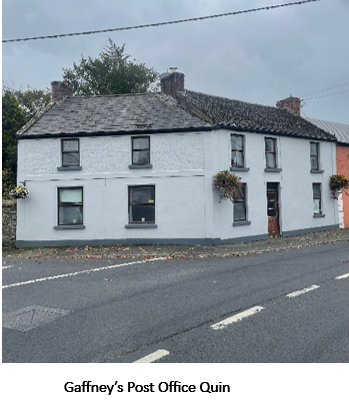
My mother and father both had jobs (Mrs Henchy was a teacher in Quin National School) and it wasn’t really viable to be paying somebody. I remember the telephone exchange and telephone booth, people used to come in making phone calls. Every morning the three post men used to come in, the mail was delivered at 7 o’ clock by the P&T man from Ennis, amongst whom, was Alfie Hanrahan (from the Clarecastle family of Hanrahans). The three post men were Johnno Sammon, Davie Cooney and John Melody. Jack Fahy used to be there now and again. They’d come there at 7 and be sorting out their letters and then they’d go away on their three bicycles. When my mother gave it up, to my memory a number of people in the village applied for it’.
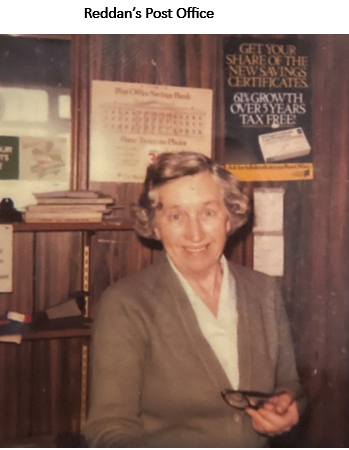
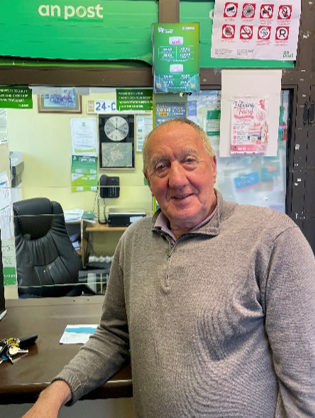
Nancy Reddan was successful in her application to the P&T to open a Post Office in 1963. Our present Postmaster Mike Reddan tells me, ‘At the time my mother ran a public house, but she had to close it to make way for the new post office that would service the village. When my mother had it, there was one postman Davy Cooney who served Quin for over twenty years. They lost him when the post became centralized in Ennis. Nancy retired in 1992 and died a year later. My father Séamus then took it over and then handed it to me in 2004. In 1995 it became automated and you can’t even sell a stamp now without it going through a computer. But the services are vast, you can pay your ESB, Water bill, put money into a Bank, and they have an An Post bank. They have forty-two services now, so it’s a busy post office’.
Mike Reddan
Great changes have taken place with regards to the postal service in the Parish since its introduction in 1831. From the postmen who cycled from house to house, bringing letters, news, and a familiar face to every door, to today’s fully automated postal service. Today the pace of life is different and technology has transformed how we communicate. Yet, through all these changes, the post office remains part of the story of Quin – a reminder of the days when a letter could bring excitement, news from far away or a connection with someone dearly missed. The story reflects the changing face of rural Ireland.