
Quin Famine Pot
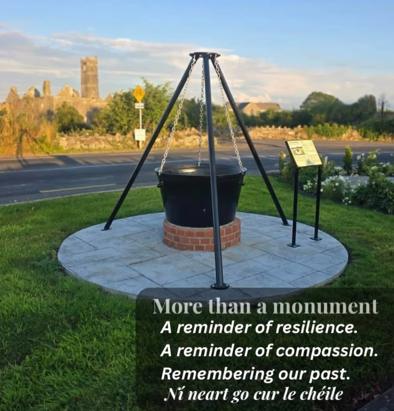
Quin Tidy Towns recently put on public display, a famine pot, donated by local farmer Cyril McMahon. This is yet another example of the great work of this very active community group. We thought it might be a fitting time to post a little bit more information on these pots and the impact of the famine on the this parish.
SOUP KITCHENS
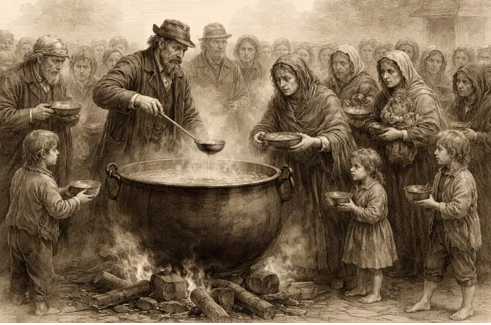
In February 1847, the British Government passed the Temporary Relief Act (often called the Soup Kitchen Act) and local committees around Ireland set up hundreds of public kitchens where food could be distributed to people who were starving and unable to work. About three million people were fed and long lines of hungry men, women and children queued for hours outside these kitchens waiting for their portion of soup.
The British Government sourced 600 cast-iron cauldrons from a foundry in Shropshire, costing between £2 and £3 each. These pots, called Coiri an gorta, or Brachán pots, were 4 feet in diameter and 2½ feet in depth. Each pot could hold about 60 gallons of food.
THE FOOD
The soup kitchen authorities bought in large quantities of oatmeal or maize, (Indian meal or yella’ meal), and rice. Local vegetables like parsnips, turnips, beet, and onions might be added if available. The famine soup was not a balanced diet. It was poor in vitamins and minerals and over time the lack of nutrients led to scurvy and other diseases.
The pot was supported by a tripod and a fire lit under it. The food was heated and the resultant watery soup or stirabout was ladled out to those in the queue. A pot of this soup could feed up to 500 people.
The people held their soup in tin cans, small kettles, or bowls. Three million Irish people were being fed in the soup kitchens every day.
Despite the great need for famine relief, Sir Charles Trevelyan, the British Assistant Secretary to the Treasury, ensured that the soup kitchens were closed on December 1847. This decision was made on purely ideological grounds. He believed that feeding hungry people created dependency on the government, and he wanted to transfer the costs to the Irish landlords. The British Government relief was short-lived.
Quakers in Ireland, England and America all donated pots as did the Sultan of Turkey. The then Sultan of Turkey sent 1,000 pounds in aid and 5 ships containing provisions. These docked in Drogheda and were offloaded by Ottoman sailors. We are also aware of the generous donation sent to famine relief in Ireland by the Choctaw native Americans.
The enormous pots were made of solid cast iron and were used to hold soup or stirabout as it was called. This was an attempt to feed 8 million people affected by famine caused by the failure of the staple diet of potato crops in successive years. The workhouses were feared and hated by the Irish but with hunger driving millions to emigrate those remaining had little or no choice to join the thousands who were fed a thin gruel daily. These huge pots fell out of use after the famine ended in 1852 and many were used by farmers to hold grain or water to feed animals on farms dotted around the country.
THE RELIGIOUS SOCIETY OF FRIENDS
During the Great Famine, there were about 3,000 members of the Society of Friends, usually called Quakers, in Ireland. They established their own Central Relief Committee in November 1846 and set up their own soup kitchens. Using funds from Quakers who lived abroad, they bought 294 famine pots and worked tirelessly to feed thousands of Irish citizens.
They provided famine relief before the British relief started and continued long after the British relief system was closed in December 1847. The Quakers saved tens of thousands, possibly hundreds of thousands of Irish lives without engaging in proselytizing.
THE FAMINE POTS NOW
After the Famine, the cast-iron pots were used for other purposes. Farmers used them to store seeds, hold grain or other foodstuffs. Some homeowners used them as flowerpots, plant pots or outdoor ornamental items to brighten up their gardens.
We must not forget the sad history of the famine pots. Their historic importance is highlighted by having them on display to the public in several places around the country, now including Quin. This display will greatly add to the cultural heritage of the village.
From Dúchas 1930’s Schools Folklore Collection (Ballycar):
Relic of the Famine days in Quin
The iron pots in which the free soup and meal were prepared for the relief of the poor in Quin are still in existence. One is in possession of Mr Dan Clune and is used as a water trough. It is on a farm 200 yards outside the village on the Quin-Tulla road. The other is in the possession of Mr Frank Clune. He has it as a water trough in his Quinville farm.
THE DIARIES OF JOHN SINGLETON
The following extract, from the diary of the most prominent local landlord, gives a flavour of what life was like for the people of Quin and nearby parishes during the imposed famine:
1846
On the 10th of January, they were still talking of a memorial to the Government “for the furtherance of drainage and other useful public works for the employment of the people during the apprehended season of distress and for the permanent benefit of the county”
“Up at 7, breakfast at 8, chapel at 9 … a long and agreeable walk” is a fair summary of Mr. Singleton’s diary around this time. The newspapers of the period report regular attacks for arms by groups of armed men and on March the 2nd Singleton speaks of “the state of the county-Whiteboy outrages of such frequent occurrences”
In his own district of Quin, Singleton noted on the 2nd of April: “Many poor people in direct distress for want of food and almost all of employment”. Meetings, resolutions and subscription lists were not much good without employment;
8th April: “Mr. Hill, Co. Surveyor here to lay out some work in Quin for the relief of the poor… the village is to be improved and thank God that something is about being set in foot at last after such long delay.”
The failure of the potato crop was not curtailing John Singleton’s social round:
“April 25th—went to dinner this day with Sarah, Mary and John to Castlecrine Where we had as usual a cheerful and agreeable party, near 3 when we returned.” In May Singleton went to his farm at Baltard in West Clare, and here he found his tenants “with few exceptions are free from the prevailing distress and many having potatoes to sell”. He came back to Quin to find the Indian meal being distributed to those in need. On the 10th and 11th of May he wrote: “busily engaged with the poor this day in want of work and food, half of the applicants for the former were obliged to be rejected and heart rending and difficult was the task” On the evening of the 16th of May, “a pleasant little party and dinner this evening” but on the 19th, “too many still in want of employment to enable them to purchase their daily meal”
The relief works set in train by the Board of Works were not always welcome; they planned a new road from Quin to Ennis but on the 10th of June Singleton “rode up to the parish of Doora where assisted in pacifying the poor people who were giving opposition to the Doora Road”
The weather through the summer was variable, but on the 17th and 18th of August came “the wettest days and the heaviest fall of rain remembered for many years day and night! considerable damage done to the corn cut and uncut and to the potatoes and hay irreparable!! Attended Relief Committee at Quin when we adjourned sine die”. This adjournment implies an expectation which was doomed to failure.
The weather at the end of August was kind and the harvest was good “save the unfortunate potatoes whose complete failure is now well ascertained to be universal, and the complaints and lamentations of the people loud and general in consequence both on the part of those whose sufferings will be great and those who make a pretext of it, God help the one and forgive the other! The landlords in the long run will be the real sufferers”
Before the end of September the Relief Committees in Quin and Newmarket were active again; grants were being given for the building of roads and other relief work, but there was a lot of unrest. On the 3rd of September: “To Ennis this day, sad disturbances going on in the county, horses being shot taking in corn to market; farmers cruelly beat for threshing and selling it, armed parties disguised traversing the roads intimidating the country people calling at the different houses swearing and threatening the inhabitants.”