Rootin’ for gold near Ballykilty

From ‘The Man In The Big House’. Stories collected by Eddie Lenihan from the late Jimmy Armstrong of Ballyroughan.

“There was an old man living by himself at Ballykilty, an to go to his house you’d pass down at the back of the old Quin school, down a place they call Rine. Below Rine was the townland of Ballykilty, an’ you pass down Ballykilty on the road to Mooghaun. There was a road then, turning to the right just below Ballykilty wood, an that was a continuation, I’d say, of the old road that was made in Brian Boru’s time. “Twas going on to Ard Solas, that old road. But ’twas on that old road that this old man lived.
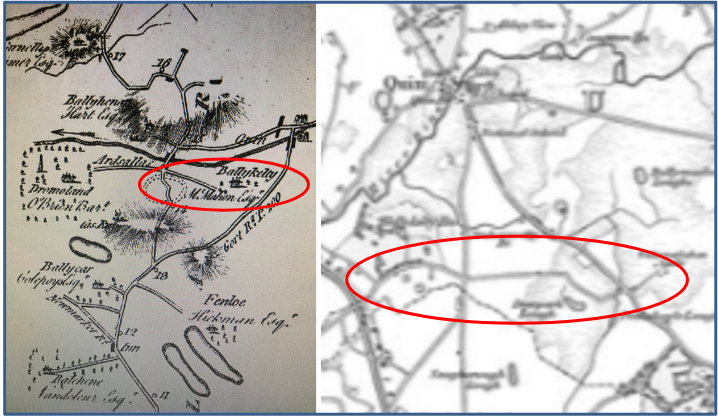
The old road that was made in Brian Boru’s time, shown here on the left, went from Ballymarkahan Castle to Ardsollus.

‘But, this fellow I knew well, now, we’ll call him Tom, he was workin’ with a local farmer an’ maybe three or four nights in the week he’d go to this old man, you see, to keep him company. Anyway, ‘twould be after Christmas one year, in January, that Tom went to the old man and this night he was tellin’ him that there was a ruin of an old house about seventy or eighty yards from the fort that was in his field. An’ Tom knew the field as well as he knew his left hand; ’twas across the road from the gate of the farmer ne was workin’ for. I spose thered be about ten or twelve acres in the field, an ’twas at the far side o’ the field from the road the fort was. Now, about seventy or eighty yards from the fort there was a ruin of an old house, an’ the old man told him that there was supposed to be gold buried under the flag of the entrance door to this old house, but a life would have to be lost in the getting of it.

“T’would be got alright but there would have to be a life lost in the getting of it. Anyway, Tom said no more, but the followin’ day he was tellin’ some o the boys around Quin about what the old man was tellin’ him about the gold being buried under the flag o the door of this ruin of the old house. But anyway, Tom, one evenin’ that he was goin’ home he went to inspect it an’ outside the door the entrance door o’ the old house, there was a heap o’ stones, and, coverin’ these stones there was moss and grass.

‘Now, to describe the house to you. An I saw the house! T’was down to the tops o’ the windows. The formations of the windows were there but the top lintels were gone off of ’em, you see. One gable end of the house was standin’ an the other was knocked.

An I spose twould be about forty yards at the Moohaun side of the oul house this old man, he had a galvanised shed made for calves there, an’ he had a door in the house an’ all.

‘But at the back, then, ổ the ruin ở the oul house there was what I could call a haggart where, I suppose, the occupants, they had a garden. This was enclosed by another wall. Well, from the end of the ruin o the oul house up to the old man’s house that he had made for the calves, there was a double wall; ’twas built with dry stones, an’ there’d be rough stones on top of it.

‘Anyway when Tom told the boys around Quin about the yarn that the old man told him about the gold bein buried they made up a plan, that some night they’d go to dig for it. An’ they’d have to wait, o course, until everyone was in bed, the old man in particular. “Twas on his land, you see. But they agreed, anyway, to go of a moonlight night in June or July that year.

‘So, they waited until the month o July, and one night that there was a full moon, an’ Tom, Christy, Joe, Martin an’ another John— we’ll leave their family names out of it ‘cos some of ’em are still alive – they went an’ they armed with pickaxes an’ shovels. An’ Martin, he brought a bottle o’ holy water in case of any evil spirits. But anyway, they went at about eleven o’ clock or half eleven, when they thought that everyone was in bed, you see. An’ they went to this old house an’ they started rootin’. They rooted down, rooted the heap o’ stones that was in the front o’ the entrance door, an’ what was mixed with the heap o’ stones, Tom told me, was old lime mortar, an’ the stones weren’t very big.

‘Anyway, they went down about four feet an John threw up loose stones out of the hole with a shovel. The next thing he came a big flag (stone).’

“The flag was bigger than the hole that they had made so he started rootin’ down one side o’ the hole to make it wider, d’you see, so that he’d come to the edge o’ the flag. While he was rootin down one side o the hole what came along the top o the wall from the old man’s house only what they thought was a white cat. An’ he jumped up on the wall o the ruin o the old horse an’ jumped across the formation o’ the windows until he came between the first window from the door an the second window.

He sat there above on top o’ the wall an’ he started spittin’ at ’em, Tom told me. A cat spittin’, now, did you ever hear him?

“Tssshhh! “Tssshhh! An every spit that hed give, Tom told me the sparks o fire used to come out of his mouth. An didn’t the boys start peltin’ him with stones. An’ he jumped across the window again an’ ran along the top o the double stone wall that the old man, I s’pose, built. He went up on the galvanised the house that the old man had for the calves an’ sat above on the galvanised about forty yards away from ’em, an he spittin. An’ the boys started peltin’ him with stones again so he went up the roof the house an’ down the other side an’ they saw no more of him.

‘But John, anyway, he was below in the hole an he throwin’ up the loose stones out of it, an’ the mortar, an’ he came to the side o the flag. There was a hole down an’ a stone fell down, an fell down the hole. Now, surely to goodness, Tom told me, that from once the stone fell down until it reached the bottom it took about a minute to fall. “Twas unknown the depth of it!

John, anyway, he said that they’d get up the flag whatever depth it was. So he started at the other side o’ the hole an’ as soon as he started at that side, in from the fort came what they though was a sheep. An’ the sheep came slowly in from the fort, an’ when ’twas about halfway between the fort an’ the hole they were opening the sheep took a jump an’ landed into the hole by the side of John. John, he was pitched, I s’pose, about forty yards away with the shovel in his hand, whatever it was that put him out of the hole an ilyin’ though the air. They all ran, out to the road, an left shovels an’ hacks an’ all after ’em. “Twas Martin that had the bottle o holy water but ‘twas Christy that got the contents o’ the bottle goin’ out the field. When they went out on the road they didn’t know what to do. When the old man would come next day an see the hole open an the heap o stones up out of it there’d be holy murder. But, John agreed to go back an’ close the hole some hour ‘ the morning, I s’pose it might be three or four ‘ clock in the morning, for fear the old man might see it. So he did; he went back an’ he brought a crowbar an’ three shovels an a pickaxe out with him. He left’em at a house in Quin until they’d give ’em back to the owners?

“Another place they thought to find something was at Quin Ab-bey. Oh, they did. Now, under Quin Abbey there’s supposed to be a cellar, and, in the cellar the ware of the abbey is supposed to be, cups an’ saucers an’ mugs an’ jugs an’ teapots, an unknown what. ‘Tis unknown, I spose, what they’d be worth now.

‘But didn’t some ‘ the boys, they thought to look for ’em one night. At the back o the abbey, now, facing Daingean Breac castle, there’s an arch. You can see it plain. Well, at the outer portion of the arch there’s a building, a square building. Up about the height of an ordinary man’s chest, under the arch, there’s a window, an’ you can look down an I spose ‘twould be ten or twelve feet down to the bottom. Now, below, if you look down the window, you can see the formation of a door below at the bottom, an above on top then ’tis the sky you’ll see when you look up. You can get at this building from above too. If you go up the stairs when you go in the entrance gate o the abbey you’ll go up to a green patch. Continue on over straight, an’ there’s a drop down then, beyond, down in this square building, an’ a couple of iron bars goin’ across ‘But, what did they do, these three fellows? They thought the formation o’ the door below, you see, was the entrance to the cellar, an’ they brought in a ladder one night, an a crowbar, when all the boys in Quin were in bed, an’ the girls as well. They brought up the ladder up the stairs, anyway, an they put it down from the green patch, down to the bottom. One of ’em went down with his crowbar an’ he took two or three stones out o’ the top o this entrance door. An’ whatever look he gave wasn’t there a friar standing by the side of him. He left the crowbar there. He told me he didn’t know how he went up the ladder. An’ himself an’ another one of ’em, they pulled up the ladder an’ off with ’em as fast as ever they could. I can tell you they went out of the abbey a lot faster than they came in. An’ that finished ’em with the cellar an the ware. But later on they had to come back again, bring ladder an’ all, put it down again an’ bring up the crowbar for fear anyone might see it below an’ know what was being done. I don’t know which of ’em went down for it, though. I’d say it wasn’t the man that saw the friar. If ’twas myself that was in it I’d leave the oul crowbar there to the devil.
 

This once highly populated townland has been called by various spellings of its English name since first recorded in the inquisitions in 1586. Sometimes it was found with East or West added. Its current official Irish translation derives from Cé, meaning quay, which belies explanation given the situation of the townland. The inquisitions in 1641 recorded it as ‘Ceab’ while John O’Donovan, in 1839, suggested Ceabhach/Céabhach meaning ‘a land producing marshy grass’, both of which make a lot more sense!

Today, we could count the number of families living here on two hands. The figures given for baptisms and past census give a totally different picture of what it harboured in the past when up to 26 families lived here.

88.6 hectares / 0.88km²/0.34 square miles/219 acres

This townland is situated both sides  of the road to Ennis having left the village.

Inchiquin Papers – extracts referencing Keevagh

13-14 June 1699. Lease and release by John Durey to Sir Donough O’Brien, 1st Bart. of 24 acres in Keevagh, parish of Quin, barony of Bunratty in consideration of £40.

In 1703 Sir Donough purchased from the Commissioners for Sale of Forfeited Estates the lands of Keevagh, Daganbrack, Creevagh, Cahercalla, Maddara and Kildrum, totaling 440 acres, formerly held by Nicholas Arthur, who was attained for treason on account of his adherence to James II.

Land transfers in Keevagh in 1641

Freeholders in 1821

Keevagh: Laurence Corbett, James Corbett, Patrick Cody, James Halloran.

Keevagh West: H. Rev. Fitzgerald (resident in Dublin).

The above List of Freeholders contains the names of landholders who were registered to vote in Keevagh in 1821. A freeholder was a man who owned his land outright (in fee) or who held it by lease which could be for one or more lives (for example, his own life or for the lives of other people named in the lease). A significant percentage of the population was included in freeholders’ lists in the time period covered by this list (1796-1820), when both Catholic and Protestant 40 shilling freeholders were qualified to vote. A 40 shilling freeholder held a freehold worth at least 40 shillings per annum above the rent, enabling the inclusion of substantial farmers in the voters’ list. In 1829 the franchise level was increased to 10 pounds (there were 20 shillings in a pound), thus barring the 40 shilling freeholders whom Daniel O’Connell had mobilized and consequently confining the vote to landlords.


Occupiers of land in Keevagh on 1st May 1825 – eligible for tithe payments

Keevagh East: John Massey, John Doolaghty, Widow McNamara, Tim McGrath, James McGrath, John Moylan.

Keevagh West: James Boland, Patt Hallaran, Michael Downes, Cody Denis, Lawrence Corbett.

 Census Records for Keevagh

1841 Census: Population 140; Households 26

1851 Census: Population 31; Households 4

1861 Census: Population 42; Households 6

1871 Census: Population 29; Households 7

1881 Census: Population 17; Households 4

1891 Census: Population 11; Households 3


1901 Census: Population 7; Households 2

John & Mary Burke, nephew Patrick Gallagher.

Patrick Hogan, niece Delia Hogan, grand nephews Patrick & Michael Hogan.

1911 Census: Population 7; Households 2

Thomas & Catherine Moylan, servants Mary O’Callahan, Matthew Moloney.

Bridget Hogan, sons Patrick & Michael Hogan.

1926 Census: Population 13; Households 2

Thomas Moylan Head Married English Only
Catherine Moylan Wife Married English Only
Mary A Moylan Daughter   English and Irish
Cecelia Moylan Daughter   English and Irish
Patricia Moylan Daughter   English and Irish
Kathleen Moylan Daughter   English and Irish
Francis Moylan Daughter   English Only
Anne Gregan Sister in Law Single English Only
Matilda Custy Servant Single English Only
John Burke Servant Single English Only
Bridget Hogan Head Widow English Only
Pat Hogan Son Single English Only
Michael Hogan Son Single English Only

Some Baptisms in Keevagh in 1800’s

Date Child’s Forename Father’s Surname Father Mother Sponsors
15.12.1844 Thomas (?) Michael McGrath Mary John Curtin, Margaret McGrath
05.04.1832 Margaret Boland James Flanagan Briget Briget Quigly
??.06.1837 Bridget Boland James Flanagan B. Michael and Briget Cody
31.01.1840 Mary Boland James Flanagan Bridget Bridget Boland
06.04.1843 Pat Boland James Flanagan Bidy Pat Boland, Bidy Boland
25.01.1827 Briget Boland Pat Flanagan Mary Denis Carly(?), Margaret Carley(?)
10.05.1829 Michael Boland Pat Flanagan Mary Briget Boland, Michael Kitchin
27.10.1831 Pat Boland Pat Flanagan Mary Nancy McNamara, Thomas Halloran
19.10.1843 Kity Boland Pat Flanagan Mary Pat Halloran, Bidy Flanagan
??.08.1838 James Boland Pat Flanagan Mary Michael Downs, Mrs. Boland, Janes
??.05.1836 Margaret Boland Pat Flannagan Mary Dennis and Briget Cody
18.04.1828 John Boland Patrick Flanagan Mary Denis Cody, Briget Corley
15.10.1844 Mary Boland Patt Flanigan Mary Bridget Cody
05.03.1847 Mary Boland Patt Flanigan Mary Mary Donohoe
07.09.1825 Catherine Brick John Halleran Mary James Boland
03.02.1822 Bridget Brick John Halloran Mary Patrick Cody, Sally Halloran
26.09.1816 Michael Brick John Halloran Mary John Halloran, Honora Boland
29.08.1817 Michael Brick John Halloran Mary John MacNamara
22.04.1828 John Brick(?) John Halloran Mary Anne Halloran
05.08.1830 James Bricke John Halloran Mary Michael McNamara, Hanagh Lawler
14.01.1844 Patt Coady John Donoughue Mary Patt Corbett, Sarah MacNamara
21.09.1842 Michael Coady(?) Denis Lawler Judy Pat Corbett, Bidy Corbett
11.04.1845 Susan Cody Dennis Lawler Hannah John Hennesy, Mary Clune
03.10.1848 John Cody Dennis Lawler Susan Margaret Cody
08.05.1842 Nancy Cody John Donohoe Mary Denis Coady, Bidy Coady
27.05.1846 John Cody John Donohoe Mary Lawrence Downes, Kate Downs
23.06.1850 Mary Cody John Donohoe Mary Patt Corbett, Margaret Cody
29.11.1816 (?) Cody Patrick Fraly Pat Boland, Betty Cody
23.06.1850 Mary Coffee James McGrath Mary Margaret McGrath
16.02.1855 Mary Coffey Michael McGrath Mary John McGrath, Mary Moylan
26.08.1830 Michael Coleman John Haneen Margaret Pat Halloran, Sally Halloran
04.10.1843 John Collins John Reddin Bridget Michael McGrath, Mary Doloughty
29.05.1844 Michael Corbet Pat Coady Margaret Thomas Corbet, Bridget Corbet
12.08.1817 Margaret Corbett James Halloran Honora Anne Corbett
28.11.1844 Bridget Corbett John Doloughty Mary Patt and Bridget Corbett
31.01.1849 Mary Corbett John Doloughty Mary Patt and Norry Corbett
15.03.1821 Nancy Corbett John Horan Margaret Patt Corbett, mary Corbett
21.02.1830 Margaret Corbett John Moran Margaret James Corbett, Briget Moylan
22.03.1817 Pat Corbett John Margaret James McNamara
??.06.1840 John Corbett Matt Harkins Mary Patt Doloughty, Anne Corbett
03.02.1848 Mary Corbett Matt Harkins Mary Patt Halloran, Bridget Corbett
24.01.1830 Pat Corbett Pat Cody Margaret Lawrence Corbett, Briget Corbett
26.12.1831 Briget Corbett Pat Cody Margaret Denis Cody, Briget Cody
??.01.1838 Laurence Corbett Patt Cody Margaret Laurence and Anne Corbett
25.10.1843 Norry Corbett Tom Shea Nanny Pat Corbett, Bidy Corbett
27.02.1853 Mary Corbett Tom Shea Anne Laurence and Margaret Corbett
05.06.1828 Briget Corry James Hehir Mary Thomas Moylan, Nancy Corry
05.06.1828 John Corry John Corry Betty Michael Henissy, Catherine Moylan
23.01.1837 Bridget Cremins Daniel McNamara Hannah Pat Hogan, Ellen McNamara
30.08.1823 John Doolaghty Tim Rochford Brigid Laurence Corbett
22.05.1823 Thomas Downes M Kitchen Catherine
22.05.1823 Mary Downes M Kitchen Catherine
06.07.1825 Anna(?) Downes Michael Chichin Catherine Pat Cody
08.04.1821 Ellen Downes Michael Kidson Catherine Patt Cody, Mary Frawley
08.10.1826 Martin Downs Michael Kitchin Catherine Pat Carley, Ellen Lawler
21.01.1830 Lawrence Downs Michael Kitchin Catherine Patrick Corbett, Catherine Lawler
04.01.1825 Patrick Fraley Patrick Patrick Henessy
06.09.1819 Judy Griffy James Cummin Johanna John Corbett
26.01.1835 Tim Halloran Pat Grady Bridget Pat Halloran, Bridget McDonnell
16.02.1836 Pat Halloran Pat Grady Bridget Michael McNamara, Nancy Halloran
01.05.1842 Bridget Halloran Patrick Grady Bridget Patrick Cody, Bridget Halloran
14.03.1846 Pegy Halloran Patrick Grady alias Birley(?) Nancy Michael Halloran, Margaret Grady
01.12.1838 Thomas Halloran Patt Grady Bridget Michael and Margaret Grady
10.03.1848 Thady Halloran Patt Grady Bridget Dennis Cody, Bridget McDonnel
??.07.1837 Mary Halloran Thomas Corbet Ann Pat Doloughty, Margaret Fraley
28.06.1835 Bridget Halloran Thomas Corbett Anne Michael Doolaghty
07.04.1839 Mary Halloran Thomas Corbett Ann James and Catherine Halloran
18.02.1841 Anne Halloran Thomas Corbett Anne James Lynch, Mary McNamara
06.01.1843 John Halloran Thomas Corbett Nancy Michael Corbett, Bidy Corbett
??.04.1839 Margaret Healy(Mealy?) Pat Cody Margaret Dennis Cody, Sally Russell
23.11.1845 Thomas Henry Luke Molony Mary Patt Hickey, Bridget Gorman
08.02.1829 Mary Hogan John Crow Sally Kitty(?) Gerin, David Moylan
08.03.1816 Pat Hogan Thomas Moylan Honor Hogan
18.01.1832 Nancy Kinavane Thomas Gerin Briget Nancy Corry, John Hogan
29.06.1845 John Lachford John Glynn Margaret Tom Heihir, Bridget Glynn
19.07.1816 Margaret Lyddy Patrick Halloran Mary Patrick Fahy, Cate MaGrath
12.05.1842 Mary Mac Michael Clune Mary James Mac, Mary MacNamara
11.03.1817 Pat MacNamara James Woulfe Mary James MacNamara
25.04.1833 Anne McGrath James (?)man Mary Margaret McGrath
07.12.1834 Thomas McGrath James Cremmins Mary John Hogan, Margaret McGrath
06.08.1829 Margaret McGrath James Crimens(?) Mary Honor McInerny, (?)
20.04.1818 Mary McGrath James Crimmin Mary Catherine Corry
04.10.1820 Martin McGrath James Crimmin Mary Martin MaGrath
29.04.1832 Catherine McGrath James Crimmin Mary Nancy Corbett, David Moylan
20.08.1826 Michael McGrath James Crimmin(?) Mary Catherine Moylan
??.04.1837 Patt McGrath James Crimmins Mary Anne Corbett
01.06.1817 Brigid McGrath James Crummin Mary Catherine McGrath
01.05.1838 John McGrath James Mary Thomas Moylan, Anne Corry
09.04.1824 McGrath(?) MaGrath Cate
19.12.1821 Thomas McInerny John McGrath Margaret David Moylan, Catherine McGrath
12.04.1841 John McMahon Michael Giddam Peggy Michael and Mary Cumins(Crimins?)
03.09.1845 Daniel McNamara Bat Gannesy(?) Susan Susan Lawler
19.12.1821 Thomas McNamara John Meere Nancy Patt Meere, Nancy McNamara
26.10.1823 Ellen McNamara John Quillinan Bridget James McNamara
11.09.1828 Margaret McNamara Mathew Glen Margaret Ellen Coleman, Edmund Hogan
06.03.1822 Mary McNamara Mathew Glin Margaret John McNamara, Mary Moylan
07.01.1840 Thady McNamara Michael Cluin Mary Patt Clune, Mary Doloughty
15.03.1845 Patt McNamara Michael Clune Mary Catherine McNamara
27.08.1848 Michael McNamara Michael Clune Mary Tom O’Brien, Mary Cain
29.05.1836 Anne McNamara Thomas Clanchy Ellen Pat Doolaghty, Bridget Corbett
01.09.1839 Mary McNamara Thomas Clancy Ellen James and Mary McNamara
03.03.1834 Patrick McNamara Tom Clancy Ellen Thady McNamara, Mary McNamara
31.01.1835 James McNamara Tom Clancy Ellen Pat and Anne Halloran
14.12.1839 Catherine Moylan David Moylan Anne Bridget Hogan
23.03.1837 Honora Moylan David Reddan Anne Margaret Moylan
??.12.1837 Briget O’Gorman Daniel Neylon Mary Judith Frawley
26.04.1854 Michael Slattery Michael Moylan Maria William Moylan, Margaret Slattery
07.10.1839 Mary Walsh John Freeman Bridget Michael and Mary Hehir
02.05.1857 Margaret Coffee Michael McGrath Mary Bridget Crimmins
21.04.1861 John Coffee Michael McGrath Mary Patt McGrath, Mary McGrath
??.02.1825 Mary Coffy Michael McGrath Mary John McGrath, Sally Moylan
06.03.1878 Margaret Connely Michael Faul Mary Bridget Moylan
15.08.1858 Thomas Corbett Thomas Shea Anne Laurence Corbett, Margaret Corbett
09.03.1862 Hugh Hogan Hugh Daffy Bridget Patt Hogan, Ellen Finucane
27.12.1859 Margaret Hogan Thomas Haneen Mary Edmund Burke, Margaret Haneen
22.04.1855 Thomas Rochford John Clancy Margaret Margaret Ma(?)
31.01.1872 Bridget Russell Pat Coffey Anne Michael Clune, Bridget Russell
01.05.1873 Mary Russell Patt Coffee Anne Mary Russell
15.08.1856 Thomas Slattery Michael Moylan Mary Daniel Hayes, Bridget Slattery
22.09.1861 Johanna Slattery Michael Moylan Mary Thomas Dolertny, Margaret Taylor
20.07.1864 John Slattery Michael Moylan Mary Thomas Crowe, Margaret Slattery