by Siobhán O’ Sullivan
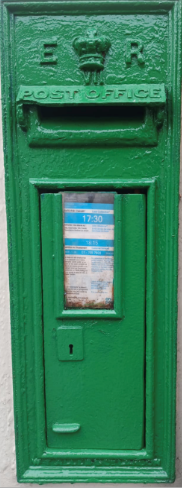
Left: The Post Box on Main Street Quin Village
An interesting part of Ireland’s street heritage are its post boxes. Modern post boxes were introduced into Britain in the 1850’s, and Ireland ‘inherited’ the same style, being part of the British Empire. We did not have a separate postal identity.
Sending letters in the 1840’s was expensive and difficult as the charge depended on the distance the letter had to travel and the route used. Letter writing was mainly confined to business, government, landlords and merchants.
A cathartic moment occurred with postal reform in Britain when in 1840 the ‘Penny Post’ was introduced across the United Kingdom. It was so-called as it was a standard price of ‘one penny’ for a letter up to a certain weight, it didn’t matter what distance it was covering. Letter writing became affordable for almost everyone. Families separated by work or emigration could now stay in touch. Often in a village, not everyone received an education and therefore they often chose one person to write or read the letters and in Quin, this was Fanny Corbett’s husband, Pat.
The system of delivering letters in rural areas was typically by ‘walking postmen’ who walked long routes of up to twenty miles daily or several times a week, delivering from rural post offices to homes, in hail, rain or snow. They also collected ‘outgoing’ letters and brought them back. The rural postman was a welcome sight as they brought the news of the village, be it a birth a death, or a welcome emigrant’s letter. They often sat and had the cup of tea as they imparted their joyous or sad news in equal measure.
Mail coaches and railway made delivery faster. When Ireland became independent in 1922, thousands of cast-iron British post boxes across the country were still in use. They had been installed when Ireland became part of the United Kingdom and were painted the familiar British pillar-box red. They carried the royal cipher of the monarch in power at the time, with a Crown on top.
The ‘ER’ on old green post boxes stands for Elizabeth Regina’ which is Latin for Queen Elizabeth. But one may also see ‘VR’ – Victoria Regina (Queen Victoria) The ‘R’ stands for ‘Queen’.
ER VII Edward Rex V11 (King Edward V11)
GR – George Rex (King George)
After securing independence, the Irish Government decided to repaint the red British post boxes green rather than removing and replacing, it was like a statement acknowledging the break from the Empire. Therefore, the royal insignia has remained – a gentle reminder of the subjugation.