The new community garden is a credit to our local Tidy Towns Committee and a great asset to the community. The background to how it came about through the work of people such as Frank Gordon has been well set out. In this post, we will go back a little further to discuss another previous use of this piece of ground.
Tithe Applotment books
The Tithe Applotment books provide a record of the titheable land in each Church of Ireland parish and were compiled in accordance with the Irish Tithe Composition Acts passed between 1823 and 1838.  They are useful as a census substitute as they contain a listing of rural taxpayers in the 1820s and 1830s. Tithes were the tax paid to the Established Church (Church of Ireland), calculated as one-tenth of the rateable value of one’s agricultural produce. Readers of our ‘Know Your Townland’ series of posts will be familiar with seeing this listing by townland. A parallel list called the ‘Tithe Defaulters’ list was drawn up following the outbreak of the Tithe Wars.
Tithe War 
On March 3rd 1831, the Tithe War began, mostly in Leinster and East Munster. The tithe, one-tenth of agricultural, or other produce, was owed to the minority Protestant Church of Ireland. In a country overwhelmingly Roman Catholic, with a substantial Presbyterian population as well, it was not only an unjustified theft of property but also a sectarian insult. Tenants, barely subsisting, were forced to fund the clergy of a church they did not attend.
The so-called Tithe War was never a conventional war. There were no pitched battles, no generals issuing grand proclamations. Instead, there were cattle drives, boycotts, ambushes, and sporadic killings.The conflict spread across most of Ireland for a decade, stopping only at the predominantly Protestant counties of northeast Ulster, where the religious arithmetic was different and the grievance less acute.
As non-payment increased during the 1830 and 1831, many Church of Ireland clergymen found themselves in serious financial conditions. The Dublin Government established the “Clergy Relief Fund 1831”, by statute in 1832, to alleviate their hardship. But clergymen could only claim for the arrears of 1831, on condition they followed a prescribed process. One consequence of this Act was that the Government then had the job of collecting the arrears of tithes in each parish rather than the clergymen.

 In Clare, this resistance was closely linked to wider agrarian disturbances, notably those led by the “Terry Alts” and “Lady Clare’s Boys,” who protested against oppressive rents, land clearances, and the tithe system. This resistance was not just passive. The Terry Alts, a secret society, and “Lady Clare’s Boys” (who often wore women’s clothes as a disguise) were active in resisting the enforcement of these payments, attacking tithe proctors (collectors), and intimidating those who cooperated with them.
In 1831, a special commission sat in Ennis to try “Whiteboy” offenses, resulting in 111 prisoners appearing, with 6 sentenced to death and most others transported. On April 11, 1831, a petition published in the Clare Journal on behalf of 150,000 tenants in Clare outlined their grievances, including the burden of the tithe and the “parish vestry cess” (local tax). The widespread refusal to pay led to the Tithe Rentcharge (Ireland) Act 1838, which effectively added the cost to the rent paid to landlords, ending the direct, violent confrontations of the “War”. The activities of the ‘Whiteboys’ was a major concern for the local Peace Commissioner and member of the Grand Jury, as noted in his memoirs ‘The Diaries of John Singleton’. It explains the large presence of RIC constables stationed within the wider parish of Quin at the time.

Rev James Hall, in his ‘Tour of East Clare’, 1812 noted:

“In every parish there is a pound-park, to which they take the cows, pigs, calves, and the like, of those who are in arrears for tithes. In eight days after the cattle have been in pound, if the owner do not come and relieve them, by paying the tithe and other expenses, the cow, or whatever it may be, is sold to the highest bidder; and the balance, if any, after paying what had been due, and all expenses, is given to the person to whom the animal, or thing, belonged. There is generally also a pound-park in the parish for the landholders; and middle-men, or receivers, do the same when there happens to be any arrear of rent.”
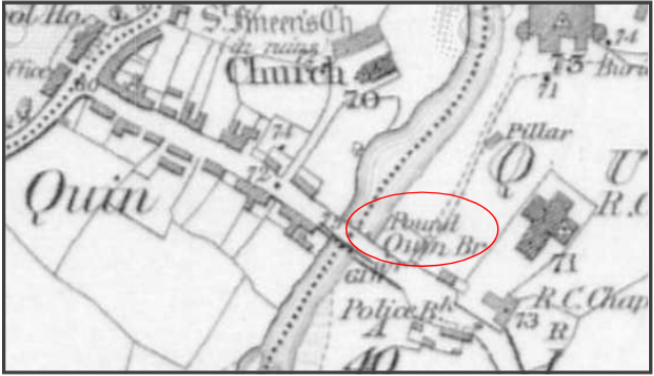
The ‘Pound’ for Quin was located on the site of the present community garden ‘An Tearmann’. It was captured in the first 6” OS map, which was published in 1842 but surveyed about 1839. This would have been at the height of the Tithe Wars and explains the existence of the ‘Pound’, at the time of the OS survey of Quin.
What did the Anglo Normans ever do for us?

We are well aware of the impact of the Anglo-Norman invasion on our history, the undermining of Gaelic society and the replacement of our native structures. Poor old Diarmuid MacMurrough takes a lot of blame for all of this, despite the fact that Henry II in England had already sought and had been given approval by Pope Adrian to invade and civilise us. Henry was just waiting to finish his war in France before sorting us out!

Anyway, in they came, conquered, settled, married and eventually becoming more Irish than even ourselves, ‘níos gaelaí ná na Gaeil féin’! But besides building towns and castles, robbing our women (and probably taking our jobs!), what did the Anglo-Normans do for us – if anything?

Well, for one, they gave us a whole new suite of names, both forename and surname, to choose from.

The Norman influence on Irish surnames

Following the invasion of 1169, a large number of Anglo-French first and last names entered into Ireland. Many, such as Power, Browne, Fleming, Joyce, Burke, Barry, Costello, Nagle, Nugent, D’arcy, Roche and Walsh/Welsh/Wallace, are nowadays considered Irish and are commonly found in Clare. So, too, are those with the Fitz prefix such as Fitzmaurice, Fitzgerald, Fitzgibbon and Fitzpatrick which most people would regard as Irish as the shamrock. Fitz, meaning ‘son of’, can be considered the Norman version of Mac (it derives from the Latin/French ‘fils de’, meaning ‘son of’). Burke came from de Burgh, Roche from de Roiste, Power from de Paor.

In 1366, a law was passed that “Every Englishman do use the English language, and be named by an English name, leaving off entirely the manner of naming used by the Irish.” This was introduced to dissuade the settlers from adopting Celtic prefixes or forms of surname. It didn’t have much affect as many settler families added Mac or ‘O’ and Norman names evolved into an Irish form (eg McHenry, McArthur).

In 1465 a law was passed enacting “that every Irishman that dwells betwixt or amongst Englishmen in the County of Dublin, Myeth, Vriell, and Kildare … shall take to him an English Surname of one town, as Sutton, Chester, Trym, Skryne, Corke, Kinsale; or colour, as white, blacke, browne; or arte or science, as smith or carpenter; or office, as cooke, butler ….”

Many of the trades of the early medieval period such as Archer, Butler, Cooper, Carpenter, Draper, Skinner, Tanner found their way into our surnames. Other introductions from this period came from the mercenary soldiers who accompanied the Norman invasion: Walsh (meaning Welsh), Joyce and Fleming (from Flemish mercenaries) are examples.

Incidentally, the Normans usually took their surnames from the place of their family origins. So, D’arcy originates in Arcy in Normandy. De Clare originates in Clare in Suffolk where the Anglo-Norman family were based. While De indicated their place of origin, Le was used to describe them, eg Le Poer meant ‘a poor person’.

De Burgh – Burke – from a placename in Suffolk, France

Le Botilier – Butler – Occupation bottle steward

De Barra – Barry – from an estate in Wales

Le Waleys – Walsh – the Welshmen

De Angulo – Costello/Nangle – from Nangle Pembrokeshire

What of their influence on forenames?

 Many of the Normans forenames introduced here were of a biblical or European saintly origin.

 In 1922, Reverend Patrick Woulfe wrote extensively on the topic of Irish name origins as follows:

In the same manner Norman and English names became current in Irish families during the thirteenth and subsequent centuries. These have now almost completely supplanted the old Gaelic names. The names borne by the Normans and by them introduced into Ireland, were of three kinds :

 (1) names of Scandinavian origin which their ancestors had carried with them to Normandy ;

(2) names of Germanic origin which the Frankish conquerors had brought across the Rhine and which had ousted the old Celtic and Latin names from France ; and

(3) Biblical names and Latin and Greek names of saints,, which the Normans began to adopt about the beginning of the eleventh century.

Together with these came in a few Celtic names from Brittany, a small number of Anglo-Saxon names, some Danish and Norse names from England, and one or two British or Welsh names. These were nearly all very rare and most of them soon died out. Of the Anglo-Saxon names, only two, Edmund and Edward, survived. Alfred has been revived in recent times. At the period of the Invasion, Frankish names were by far the most popular among the Normans, but Biblical and saintly names were coming rapidly into favour.

The following is a list, in order of frequency, of the more common names borne by the early Anglo- Norman invaders, the Biblical and saintly names of Latin and Greek origin being printed in italics :

William, Robert, Richard, John, Walter, Roger, Ralph, Adam, Hugh, Henry, Thomas, Nicholas, Gilbert, Geoffrey, Elias, Peter (Piers), Osbert, Reginald, Jordan, Simon, Alan, Stephen, Philip, David, Arnold, Alexander, Laurence, Baldwin, Herbert, Martin, Maurice, Godfrey, Andrew, Alfred, James, Samson, Turstein, Warin, Ailward, Daniel, Edward, Gregory, Bernard, Benedict, Hamon, Matthias, Michael, Gerard, Gervase, Lambert, Wilkin, Patrick, Edmund, Edwin, Hubert, Ivor, Joseph, Oliver, Mark.

 The following in alphabetical order were rare :

 Abraham, Adelard, Ailmer, Antony, Augustine, Brian, Clement, Constantine, Estmund, Eustace, Everard, Gocelin, Isaac, Leonard, Luke, Matthew, Miles, Milo, Odo, Osbern, Osmund, Pagan, Ponce, Randulf, Redmund, Rodulf, Silvester, Turold, Ulf, Vincent.

 The following names only came in, or at least became popular, at a later period :

Bartholomew, Christopher, Francis, Gerald, George, Paul, Roland, Theobald.

 Women’s names among the Normans were nearly all of the Biblical or saintly class:

 Agnes, Alice, Amelina, Anastasia, Annabella, Catherine, Cecily, Christina, Dorothy, Egidia, Eleanor, Evelyn, Frances, Honora, Isabella, Johanna, Matilda, Margaret, Susanna.

 The name Mary does not seem to have come into use in Ireland before the end of the16th century. Brigid only began to be used about the same period.


Extracted from ‘Sloinnte Gaedheal is Gall’, Patrick Woulfe 1922

Out with the old, in with the new

The Anglo-Normans also brought with them new animal species such as the rabbit and fallow deer, new foods such as wheat, orchard fruits, mutton and farming practices such as hay-making. They introduced us to continental European religious saints and practices of the Roman Church. European religious orders soon followed such as the Franciscans, Augustinians, Cistercians, Dominicans etc. These replaced the structures of the native Irish Christian Church.

Up to then, the Irish natives did not adopt the name of saints as they considered this to be placing themselves on a par with the saint. Such naming convention was reserved for those of higher status in the monasteries. This was circumvented by use of the prefix Maol or Giolla meaning follower or servant. The Normans changed all of that and it was now acceptable to be called Peter, James, Michael, John, Mary, Brigid or Margaret.

Very few of us to this day do not have either a forename or surname that is not of Norman origin. Eventually, arising from the Gaelic Revival in the late 19th century, new Irish language versions of these forenames appeared such as Séan, Seamus, Peadar, Máire, Bríd, Mícheál, Cathal and many more appeared.

The Irish Church did not condemn the practice of slave-trading by the Irish until the invasion by the Anglo-Normans and the encroachment of the Roman Church. The story of Patrick (Patricius, son of a Roman administrator), which was introduced here after the Norman conquest, presents the native Irish as uncivilised pagan slavers who needed to be brought to heel. So the Normans inadvertently gave us our native saint and a forename for a good chunk of our population for generations following.

Out with the new, in with the old

Children are rarely given these European saint names today. Authentic Gaelic forenames are much more popular. We are nevertheless, unlikely to see the demise of the Anglo-Normans surnames that were introduced here. But all of us Mikes, Jimmies, Johnnys, Paddys, Kittys, Cathys, Maggies and Bridies can thank the Normans for what they brought us!