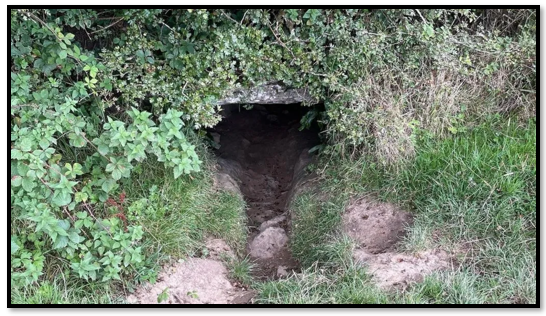
As we draw towards Halloween here is a story, appropriate to the season, based on one of Quin’s wells at Ballymacloon. This is probably the well at Ballymacloon East that also contains a cillín. The story was recorded in the 1930’s in the Clooney school collection, from Michael Clune.

‘There is a well in Ballymaclune Hill (Ballymacloon souterainne) which has this strange feature that it fills up in summer and gets lower and lower in winter. There are underground passages leading from the well under the hill.

It is said that in older times a young man of the wealthy class fell in love with a beautiful maiden of humble extraction, she in her innocence losing her heart to him.

Although warned again and again to “beware” of the gentleman of the upper class and to select a lover from the many excellent young men of her own humble station. They were deeply grieved that she should have set her heart on a rich man and on a man who was bound to prove false to her. Still she persisted in her attachment to the young man.

The courtship went on for many years until a rich heiress arrived at a neighbouring “Big House.” He at once forsook the humble maiden and proposed to the heiress, who accepted. He married her within a few months.

The young maiden was heartbroken, took no interest in anything, never joined in the local amusements, never went to fair or pattern, or took part in the crossroad dances, became moody and silent and went about her work as one in a dream.

On a cold wintery day she went to fetch water from the well. As it was winter the well was almost up to the brink. Before filling her pitcher, she sat on a little seat, where many a time she sat with her false lover. As she sat she thought of many happy hours, now gone forever, that she had by the brink of their little well. The sad reflections made the tears flow copiously and as they flowed down her cheeks they mingled with the waters of the well. The waters of the well began to rise and overflowed the banks and swept the sighing maiden off through the underground passages to the happy landfar beyond the hill.

Often on dark winters nights when the wind is howling, the sad cry of a lonely maiden is borne on the breeze from the blackthorn bushes that surround the well, and when it is heard people say another true hearted maiden is forsaken

When her friends came to the well to seek her, they found no tidings of the maiden, but to their surprise, found, although it was winter, that there was very little water in the well. They searched up and down, high and low, here, there and everywhere, but got no trace of the maiden. At last they “made out” that she was “taken “by the fairies and gave up the search.

The waters mixed with the tears of the dying maiden never came back that winter or any winter since the day she was swept from the banks through the underground passage to the land where faithful lovers are always found.

The false lover was now married several months, and to all appearance seemed to be enjoying life to the full. His wife was everything that could be desired. They spent their time attending receptions, meetings of every kind and hunting. Time passed pleasantly for them.

One day the young man took out his horse to exercise him. He wished to jump across a river that ran by the house of “The Old woman of the wood”. The narrowest part of the river lay near the gable end of the old woman’s house. He wished to get his horse to jump across. Just as he was to set his horse for the river, the old woman appeared in the doorway and said “False thou artand false will be the horse “.

Urged with rage he spurred his horse for the river. The horse sprang but fell short of the bank, throwing the rider against the sharp stones of the bank. He was seriously injured and when help arrived he was placed on a little wagon and driven to the guest house in Quin Abbey, which at that time was the nearest place to get medical assistance. When on the wagon he began to cry that he was suffering from a raging thirst and that he wanted to drink at Ballymaclune Well. His attendant told him that his thirst would soon be quenched as their way to Quin went by the well.

So eager was he to get the water, that as soon as he came within sight of the well and before he could be stopped, he sprang from the wagon, and made for the well. Now it was summer time and the well, being low, he stooped down to quench his thirst. No sooner did he touch the water than the waves of water rushed out of the underground passages and drowned him and overflowed the banks of the well so that the attendant fled in terror. Next day his dead body was taken from the well. Ever since, the waters come out in summer and recede in winter.

People say that the false lover appears from time to time, with a mether in his hand, making for the well, but no sooner does he come near the brink than he runs away again, crying “Give me a cup of tears. Give me a cup of tears.”
What did the Anglo Normans ever do for us?

We are well aware of the impact of the Anglo-Norman invasion on our history, the undermining of Gaelic society and the replacement of our native structures. Poor old Diarmuid MacMurrough takes a lot of blame for all of this, despite the fact that Henry II in England had already sought and had been given approval by Pope Adrian to invade and civilise us. Henry was just waiting to finish his war in France before sorting us out!

Anyway, in they came, conquered, settled, married and eventually becoming more Irish than even ourselves, ‘níos gaelaí ná na Gaeil féin’! But besides building towns and castles, robbing our women (and probably taking our jobs!), what did the Anglo-Normans do for us – if anything?

Well, for one, they gave us a whole new suite of names, both forename and surname, to choose from.

The Norman influence on Irish surnames

Following the invasion of 1169, a large number of Anglo-French first and last names entered into Ireland. Many, such as Power, Browne, Fleming, Joyce, Burke, Barry, Costello, Nagle, Nugent, D’arcy, Roche and Walsh/Welsh/Wallace, are nowadays considered Irish and are commonly found in Clare. So, too, are those with the Fitz prefix such as Fitzmaurice, Fitzgerald, Fitzgibbon and Fitzpatrick which most people would regard as Irish as the shamrock. Fitz, meaning ‘son of’, can be considered the Norman version of Mac (it derives from the Latin/French ‘fils de’, meaning ‘son of’). Burke came from de Burgh, Roche from de Roiste, Power from de Paor.

In 1366, a law was passed that “Every Englishman do use the English language, and be named by an English name, leaving off entirely the manner of naming used by the Irish.” This was introduced to dissuade the settlers from adopting Celtic prefixes or forms of surname. It didn’t have much affect as many settler families added Mac or ‘O’ and Norman names evolved into an Irish form (eg McHenry, McArthur).

In 1465 a law was passed enacting “that every Irishman that dwells betwixt or amongst Englishmen in the County of Dublin, Myeth, Vriell, and Kildare … shall take to him an English Surname of one town, as Sutton, Chester, Trym, Skryne, Corke, Kinsale; or colour, as white, blacke, browne; or arte or science, as smith or carpenter; or office, as cooke, butler ….”

Many of the trades of the early medieval period such as Archer, Butler, Cooper, Carpenter, Draper, Skinner, Tanner found their way into our surnames. Other introductions from this period came from the mercenary soldiers who accompanied the Norman invasion: Walsh (meaning Welsh), Joyce and Fleming (from Flemish mercenaries) are examples.

Incidentally, the Normans usually took their surnames from the place of their family origins. So, D’arcy originates in Arcy in Normandy. De Clare originates in Clare in Suffolk where the Anglo-Norman family were based. While De indicated their place of origin, Le was used to describe them, eg Le Poer meant ‘a poor person’.

De Burgh – Burke – from a placename in Suffolk, France

Le Botilier – Butler – Occupation bottle steward

De Barra – Barry – from an estate in Wales

Le Waleys – Walsh – the Welshmen

De Angulo – Costello/Nangle – from Nangle Pembrokeshire

What of their influence on forenames?

 Many of the Normans forenames introduced here were of a biblical or European saintly origin.

 In 1922, Reverend Patrick Woulfe wrote extensively on the topic of Irish name origins as follows:

In the same manner Norman and English names became current in Irish families during the thirteenth and subsequent centuries. These have now almost completely supplanted the old Gaelic names. The names borne by the Normans and by them introduced into Ireland, were of three kinds :

 (1) names of Scandinavian origin which their ancestors had carried with them to Normandy ;

(2) names of Germanic origin which the Frankish conquerors had brought across the Rhine and which had ousted the old Celtic and Latin names from France ; and

(3) Biblical names and Latin and Greek names of saints,, which the Normans began to adopt about the beginning of the eleventh century.

Together with these came in a few Celtic names from Brittany, a small number of Anglo-Saxon names, some Danish and Norse names from England, and one or two British or Welsh names. These were nearly all very rare and most of them soon died out. Of the Anglo-Saxon names, only two, Edmund and Edward, survived. Alfred has been revived in recent times. At the period of the Invasion, Frankish names were by far the most popular among the Normans, but Biblical and saintly names were coming rapidly into favour.

The following is a list, in order of frequency, of the more common names borne by the early Anglo- Norman invaders, the Biblical and saintly names of Latin and Greek origin being printed in italics :

William, Robert, Richard, John, Walter, Roger, Ralph, Adam, Hugh, Henry, Thomas, Nicholas, Gilbert, Geoffrey, Elias, Peter (Piers), Osbert, Reginald, Jordan, Simon, Alan, Stephen, Philip, David, Arnold, Alexander, Laurence, Baldwin, Herbert, Martin, Maurice, Godfrey, Andrew, Alfred, James, Samson, Turstein, Warin, Ailward, Daniel, Edward, Gregory, Bernard, Benedict, Hamon, Matthias, Michael, Gerard, Gervase, Lambert, Wilkin, Patrick, Edmund, Edwin, Hubert, Ivor, Joseph, Oliver, Mark.

 The following in alphabetical order were rare :

 Abraham, Adelard, Ailmer, Antony, Augustine, Brian, Clement, Constantine, Estmund, Eustace, Everard, Gocelin, Isaac, Leonard, Luke, Matthew, Miles, Milo, Odo, Osbern, Osmund, Pagan, Ponce, Randulf, Redmund, Rodulf, Silvester, Turold, Ulf, Vincent.

 The following names only came in, or at least became popular, at a later period :

Bartholomew, Christopher, Francis, Gerald, George, Paul, Roland, Theobald.

 Women’s names among the Normans were nearly all of the Biblical or saintly class:

 Agnes, Alice, Amelina, Anastasia, Annabella, Catherine, Cecily, Christina, Dorothy, Egidia, Eleanor, Evelyn, Frances, Honora, Isabella, Johanna, Matilda, Margaret, Susanna.

 The name Mary does not seem to have come into use in Ireland before the end of the16th century. Brigid only began to be used about the same period.


Extracted from ‘Sloinnte Gaedheal is Gall’, Patrick Woulfe 1922

Out with the old, in with the new

The Anglo-Normans also brought with them new animal species such as the rabbit and fallow deer, new foods such as wheat, orchard fruits, mutton and farming practices such as hay-making. They introduced us to continental European religious saints and practices of the Roman Church. European religious orders soon followed such as the Franciscans, Augustinians, Cistercians, Dominicans etc. These replaced the structures of the native Irish Christian Church.

Up to then, the Irish natives did not adopt the name of saints as they considered this to be placing themselves on a par with the saint. Such naming convention was reserved for those of higher status in the monasteries. This was circumvented by use of the prefix Maol or Giolla meaning follower or servant. The Normans changed all of that and it was now acceptable to be called Peter, James, Michael, John, Mary, Brigid or Margaret.

Very few of us to this day do not have either a forename or surname that is not of Norman origin. Eventually, arising from the Gaelic Revival in the late 19th century, new Irish language versions of these forenames appeared such as Séan, Seamus, Peadar, Máire, Bríd, Mícheál, Cathal and many more appeared.

The Irish Church did not condemn the practice of slave-trading by the Irish until the invasion by the Anglo-Normans and the encroachment of the Roman Church. The story of Patrick (Patricius, son of a Roman administrator), which was introduced here after the Norman conquest, presents the native Irish as uncivilised pagan slavers who needed to be brought to heel. So the Normans inadvertently gave us our native saint and a forename for a good chunk of our population for generations following.

Out with the new, in with the old

Children are rarely given these European saint names today. Authentic Gaelic forenames are much more popular. We are nevertheless, unlikely to see the demise of the Anglo-Normans surnames that were introduced here. But all of us Mikes, Jimmies, Johnnys, Paddys, Kittys, Cathys, Maggies and Bridies can thank the Normans for what they brought us!