
TOONAGH INAUGURATION MOUND – MAGH ADHAIR
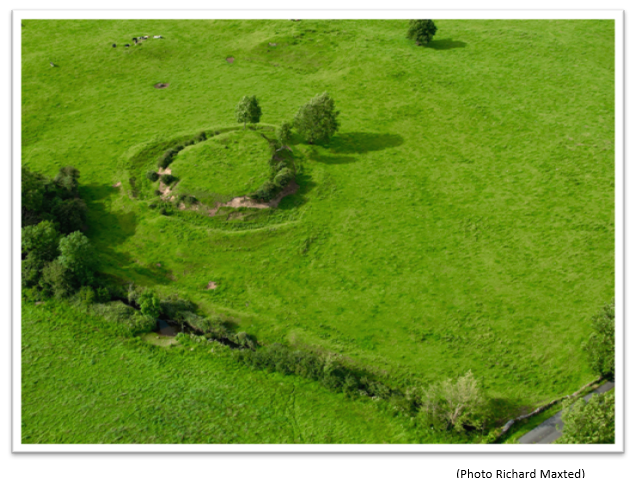
Magh Adhair, Toonagh, Clare
At this spot in the year 1311, Dermot, the “tower-like hero” of the O’Briens, was inaugurated as their chieftain. With the other leaders of the clan assembled around him, his bard commemorated the event:
“Let us give the title of King,
(Which will be of much fame
To the land which has chosen him)
To the valorous warrior
The son of the fair-formed Donogh
Of the sealed secrets
Generous heir of generous Blood.”[i]
Caithréim Thoirdhealbhaigh or Triumphs of Torlough, 14th century.
[i]John Donovan and Eugene O’ Curry, Letters Containing Information Relative to the Antiquities of the County of Clare, Collected during the Progress of the Ordnance Survey in 1839. Ed. Michael O’ Flanagan, Bray, 1927.
Magh Adhair – The Local Setting
Across the Irish landscape are the remnants of royal inauguration sites, utilised by the various septs of Gaelic Ireland until the end of the sixteenth century. Here the local tribe appointed its next chieftain. The most famous inauguration site of this kind is in Tara, County Meath, with its celebrated Lia Fail stone.
In Clare we retain a fine example of a ceremonial site at Toonagh, approximately three miles north-east of Quin village. Known locally as Magh Adhair, the principal structure is a man-made mound (CL034-095007) which has a buried ring-barrow (CL034-095001). It was here the Dalcassian inaugurations took place from the ninth to the end of the sixteenth century.
MAGH ADHAIR INAUGURATION SITE
The plain of Adhar is named for Adhar, son of Umor and brother of Aengus, the Firbolg chieftain. The great stone fort of Dún Aonghasa on Inis Mór is most prominently associated with Aengus. Adhar gave his name to the plain here, and the mound is his possible tomb or at least his memorial. From its name, Aenach (mod. Ir. Aonach) Muighe Adhair, it was a place of assembly.
‘The iraghts, or gatherings at the mound Moy Eir (Magh Adhair) were originally the O’Brien’s traditional tribal gathering place, known in Irish as an tulach tinóil, or hill of gathering, where oireachtais or parleys were held. Later the title Oenach [ii] was applied to the assembly and the various activities held there. It was a common feature of most tribal landscapes. It is estimated ‘that between 600 and 1,500 assembly sites existed at any time.’[iii] Only later did it take on the role of royal inauguration site, at which formal ceremonies were performed. Oireachta/assemblies continued until 1838, but in a diminished capacity from the end of the sixteenth century. Tribal laws were no longer enacted and no new edicts were issued after the sixteenth century. Fairs and commerce continued but in a less formal way. Sports, including feats of strength and races, especially horse racing, still went on.
‘They were still very faintly remembered by old people in 1890 as having died out in the Famine years, with so much of the social brightness of the people … The name Magh Adhair (phonetically Moy Eir) at first covered the whole central plain of east Clare but steadily shrank to that of a small tribal territory, and then, in 1584 and 1655, to the two townlands of Corbally and Toonagh (Tuanagh-Moyree). By 1838 it was attached only to two fields, — ‘Moyross, or Moyree parks’—in the former, and is now confined to a single field, ‘Moyars Park,’ and to the ‘rath’ or mound in Toonagh, across the brook. Notices of inaugurations are numerous from 1275 to 1311 and occur sporadically from 877 onwards.’ [iv]
A UNESCO paper spoke of Gaelic inauguration sites stating that ‘They are located in largely intact pastoral landscapes, which have contributed to the retention of a unique sense of place, spirit and feeling.’[v] This is true of Magh Adhair, woven into the landscape of East Clare. Scrutinizing the remaining ceremonial landscape, many of its features offer clues to the function of the site. First up is its location – it is in the lands of the Mac Namara’s, members of Clann Chuileáin, descendants of the Ui gCaisin and vassals to the Uí Bhriain dynasty.
The Dál gCais sept first came to prominence in the year 934, as mentioned in the Annals of Inisfallen.[vi] As a new tribe in search of a pedigree, they opted to be associated with Cormac Cas, son of Oillil Ólom, king of Munster, thus declaring their ambitions for future power.
As an inauguration site, Magh Adair is a little unusual in that many similar sites are on high ground, offering a view of the sept’s territories. However, views from the summit of the ceremonial mound offer glimpses of Slieve Bearnagh, Knocknaphunta and Woodcock Hill to the east.
‘Chiefs were inaugurated at the Oenach of Magh Adair down to the reign of Edward II (1307-1327), and very possibly to that of Elizabeth (1558 to 1603). Assemblies called Oireachta gathered there yearly up to the time of the great Famine in 1844.’[vii] After the collapse of the Gaelic order in the 17th century the tulach tinóil lost its purpose and centrality. Most sites were abandoned and forgotten. Throughout Ireland dozens of assembly sites lay idle, no longer visited and in some instances, no longer remembered.
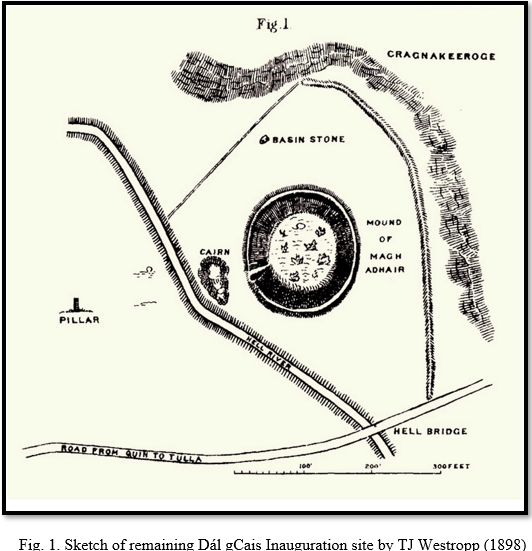
Location: Lying deep in Mac Conamara lands, beside Hell River and within view of the triple-walled ringfort, the mound was the perfect location for the Ua Briain inauguration site. The mound on which the key ceremonies were performed has a short ramp at the west side, leading to the earthen platform at the flat-topped summit. This platform was first and foremost the ‘throne mound,’ accommodating the royal Ua Briain candidate and his official inaugurator Mac Con Namara and some close friends. O’ Brien was seated in the designated inauguration ‘chair’ or else stood, placing his foot in a carved stone, as part of the ritual performance.
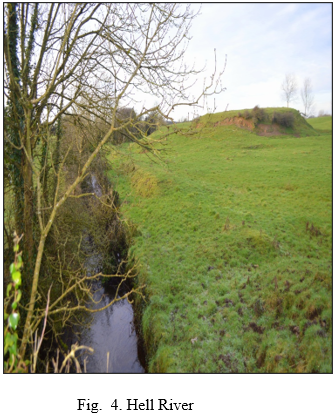
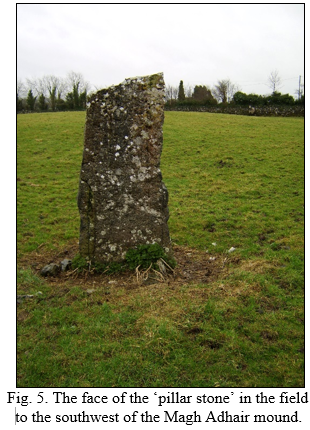
To the west of the mound at about 25 metres, are the remains of a cairn, immediately outside the fosse hedge. This may have been a viewing platform for dignitaries or a stage from which ceremonies were directed. Behind it lies the stream, Abhainn an Ifrinn/Hell River that separates the western field. This space once had a role in the ceremonies. On a rise in the field, southwest of the brook, lies one remaining stone of some antiquity. The stream delineates the modern ritual boundary.
The naming of the stream as Hell River is also significant. Several inauguration sites have a subterranean feature such as a cave or stream. Cruachain/Rath Croaghan, home of Maeve in Tulsk, County Roscommon, for example, has its famous underground chamber, Uaimh na gCait, accessed by clambering down an earth tunnel.
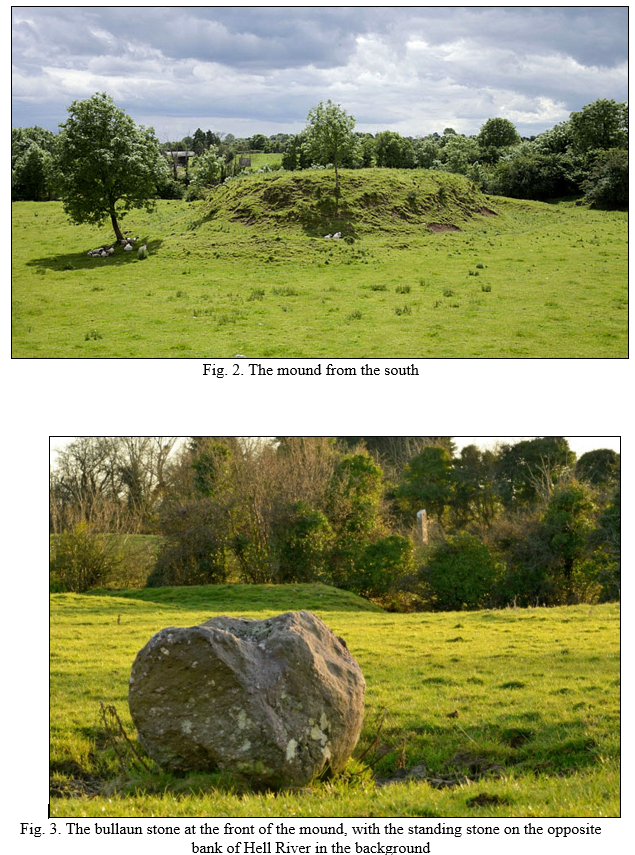
About 300 metres north of the Magh Adhair mound, towards the front of the ceremonial area is a bullaun/basin stone (CL034-095001). Bullaun stones remain something of an enigma. Most are located near early churches and appear to have had a spiritual or ritual role in Gaelic life. The stone here is described as being ‘a conglomerate Old Red Sandstone block (L 1.7m; Wth 0.9m; H 0.75m) with porphyritic and quartzite inclusions, uncharacteristic of the otherwise limestone geology of the district. It is aligned East-West.’ [viii] The stone has two small basins at the top. ‘The function of the stone in relation to the inauguration site is unknown.’ FitzPatrick (2004, 56)[ix] .
Further east, there is Craggnakeeroge, an augmented ridge that curves around the mound area. Almost an amphitheatre, this tiered section served as a dais for those túath members attending ceremonies.
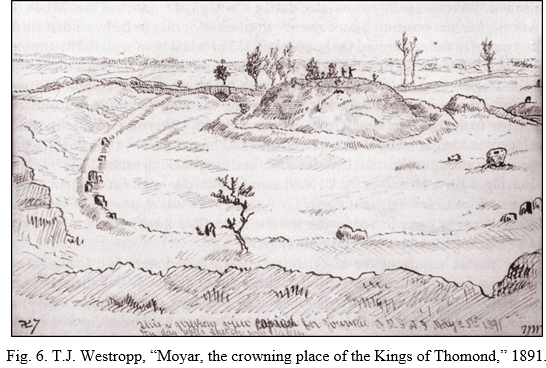
Although some features have eroded since Westropp’s late 19th century measurements, he would still recognize the flat-topped rampart ‘6 m (20 ft) tall, with its diameter on top ranging from 26 m (85 ft) to 30.5 m (100 feet). Around it can still be seen a bank, in places 1.6 m (5.2 ft) high and a 3 m (10 ft) wide ditch.[x]’ A sloping causeway leads across the bank and onto the earthen platform. To the west and adjacent to the mound lies a cairn, shaded by bushes, about one third the size of the mound and slightly lower in height. It is about 25 metres from the mound, close to Hell River. On the opposite bank of the river in the field is a pillar stone, 1.9 m (6.3 ft) high, in alignment with the principal mound and the causeway. The shattered base of a second pillar is located close to the standing stone.
The causeway, its sides faced with rough stone, gives access to the platform for ceremonial occasions. Around the mound is a fosse, with the remains of a low earthen wall that may have served as a separation feature between the ceremonial internal space and the public area outside.
Early history:
In 976 Brian Boroimhe was inaugurated as king of Thomond on the death of his elder brother Mathgamain mac Cennétig. In the internecine clashes of the Gaelic Irish tribes, Magh Adhair, as the totemic home of the Dalcassians, was sometimes raided by opposing factions.
In 877 Flan Sunagh of the Uí Néill tribe, set up a chessboard on the inauguration mound and invited one of his chiefs to a game of chess. This provocation infuriated the Dalcassians so that Lorcan, their king, mounted a fierce attack, destroyed the Ard Righ’s gaming table, and left him lost in the wood, “worn out with cold, hunger, and fighting.”[xi]
Again in 982 Máel Sechnaill mac Domnaill of the Uí Néill, on a scorched earth campaign in Thomond, stormed Magh Adhair and destroyed the bile, the sacred inauguration tree “after it had been dug from the earth, with its roots.”[xii]
A new bile was planted but the annals report that this tree too was cut down a couple of generations after Brian Boroimhe, when Aed O’Connor, King of Connaught, ravaged the site in 1051.
There were several inaugurations at Magh Adhair to the end of the sixteenth century. The account of the Uí Bhriain[xiii] dynasty is gleaned from the Catherim Thoirdhealbhaigh (Triumphs of Torlough) written by Séan Ruaidhrí Mac Craith, the ancestral historian, in the 14th century.[ivx]The account spans from 1194 to 1318 and notes seven inaugurations of Uí Bhriain’s that took place at Magh Adhair between 1242 and 1313.
We have a brief description of the inauguration of Conor O’ Brien in 1242: ‘After Donogh Cairbeach O’Brien had exchanged this mortal life for the happiness of angels with the victory of Unction and Penance, a Chieftain of (from) every tribe, a leader of every people, and a commander from every sept assembled around his son Conor at Moy-Eyre to inaugurate him King in the place of his good father. It was the noble pillar of numerous hosts Sioda (Sheedy Mac Namara) who first proclaimed him (Chief or King of his people) and the rest of the Chiefs expressed their consent immediately after.’[vx]
The final blow to the O’ Brien clan at their hallowed ceremonial site came in 1395 when they found themselves no longer a match for their Anglo-Norman rivals.
During Christmas 1394 Brian O’ Brien, Prince of Thomond, with other Irish leaders had to swear fealty to Richard II at Dublin Castle. In March 1395 in the fields of the great ceremonial centre of Magh Adhair, the place where he had received his power according to Irish custom, O’Brien, in the presence of Thomas Earl of Nottingham, restated his pledge. The ruler and ‘other Irishmen who came to the said Lord Thomas from a wooded place distant about two staves, where many armed Irishmen were gathered together, gave their allegiance to the English crown.
This slow diminishment of power led to Murchadh Carrach Ó Briain in a legal act of ‘surrender and regrant’ yielding his realm of the Kingdom of Ireland in 1543, accepting instead the advised English titles of Baron Inchiquin and Earl of Thomond.
2014 was the one thousandth anniversary of the death of Brian Boroimhe, the most famous of the Dalcassian O’ Brien’s. He was Árd Righe, the last high king of Ireland, ‘Emperor of the Irish’, who died at the Battle of Clontarf in 1014. He is still a folk figure to this day, with his family colours of saffron and blue adorning the county Gaelic teams. 2014 came and went. At Magh Adhair there was no new signage, no much-needed car park, no explorative excavations, no attempt to conserve a critical national monument. In short, no nothing.
Today, Magh Adhair, is without a formal protective presence. No information board relates the history of the location. Access is limited and only available to the nimble-footed. The site continues to be privately owned as far as I can determine. Being part of a working farm, animals are moving freely around the area. No fault of the farmer who works the land here. At least the animals manage to keep the grass low and prevent brambles overtaking the site.
INAUGURATION DAY
There are no precise records remaining of the proceedings at the Magh Adhair mound or of any of the Dál gCais inaugurations, except a brief reference in the 14th century. What we do have is a large body of information from Gaelic Ireland, where similar ceremonies were performed between the ninth and sixteenth centuries by the various túatha. Once ‘Sacral kingship’ determined the next chieftain. It was a political and religious system where a ruler held power through a sacred or divine link.
There was a high degree of uniformity in the accounts. They took place at an open-air site, usually concentrated on a rampart or large cairn, often close to the inaugurator’s hostel, with the second in succession (Tanaiste) presiding over the ceremony. Present were the subordinate chieftains, the local clergy, acting as coarbs and large numbers of the local tribe. As with all royal events at the time there was formality and protocol to obey.
Using this information and the remaining historic accounts, an attempt has been made to create what may (or may not) have been an inauguration ceremony of the Ua Briain/O’ Brien at Magh Adhair up to the end of the sixteenth century. It’s a speculative approach, based strictly on what has been gleaned from extant accounts of other inaugurations across Ireland. Some minor rituals have been excluded for brevity. What remains is a synthesis of pieces brought together to reflect a one-time inauguration day at Toonagh.
Professor Michael Herity analysed several historically designated royal sites to determine what features they shared. He noted that many had barrows, while others had cairns or standing stones. He also noted literary sources that celebrated these sites as cemeteries. The mound and circular enclosure were mostly found at royal sites only. Less regular features were the sacred trees (bileadha), stone chairs, inauguration stones, bullauns basins, and churches.
The new O’Brien candidate was elected by tanistry. In other words, he was chosen for his ability to lead the clan. In this system, the appointed candidate would receive titles and lands on merit, and not as the first born.
The Mac Con Mara’s/ Mac Namara’s on whose land the Magh Adhair site stood were vassals of the royal Dalcassians Ua Briain. The principal hostel of the Ua Briain’s was in Ennis, somewhere close to what is now Clonroad, whereas the triple-walled ring fort and home of the Mac Con Namara’s lies about 500 metres to the south-west of the mound, in Cahercalla.[vxi] This was the starting point of the inauguration ceremonies.
Here the Ua Briain designate prepared for his inauguration. Dressed in white or in some instances, wearing light body armour of leather, he mounted his horse and make his way along the processional route from Cahercalla fort to Magh Adhair. He was accompanied by a Mac Conmara as second in command, who would act as the inaugurator on the day.
There are still some standing stones on the reputed route, with one significant ‘pillar’ stone towards the end of the march. This lies west of Hell River and opposite the small cairn close to the mound. The individuals awaiting the ceremony on the cairn were first to see the approaching royal procession. There is a slight slope from the field towards the river, leading to a shallow ford, just north of the Magh Adhair mound. It is possible that the procession crossed here onto the central ritual space.
The arrival of the O’ Brien designate in the inauguration field would have been a high point in the ceremony. Here was the next Ua Briain, all dressed in white on his splendid charger. Behind him, hanging back a few paces, was his vassal and Tánaiste, the Mac Conmara, about to ratify him as An Righe. Having crossed the stream, the party moved across the front of the mound, possibly pausing at the bullaun stone to receive a splash of water and a blessing from a senior coarb,[vxii] one of several priests present. Onwards then, passing the main gathering of followers on Craggnakeeroge ridge.
By tradition, the procession always moved deiseal – sunwise – to draw the good fortune from the land. TJ Westropp’s sketch from 1891 (Fig.6.) shows that the fosse at the foot of the mound served to create a deliberate separation between the ceremonial and public spaces. The royal parade would approach from the east flank and pause at the area between the cairn and the mound. The cairn here offered an excellent vantage point, which may have been reserved for privileged guests. At the foot of the ramp stood three of the O’Brien’s chosen warriors guarding the approach. They were there to ensure that no-one got onto the rampart without permission.
The processional riders dismounted and after acknowledging those present climbed onto the platform using the causeway. It is possible that a low palisade encircled the mound summit. As the dignitaries came into view, they would be enthusiastically greeted by fellow tribe members on the ridge, in the park (faiche) and to the west. In the large ceremonial fields that then existed, followers of the O’ Brien would number several hundreds.
On the platform was at least one sacred tribal tree – an bile, (‘bil-le’), most likely an ash or hazel. There was the leacht or large stone on which the regal candidate would sit. Other than a small number of stones in the north of Ireland that were roughly hewn chairs, the seats were not fashioned in any elaborate way. Nevertheless, the inauguration stones were considered venerable. Some of the oldest ones contain rock etchings/motifs of an earlier age or prints hollowed into the stone, in which the royal candidate would rest his foot.
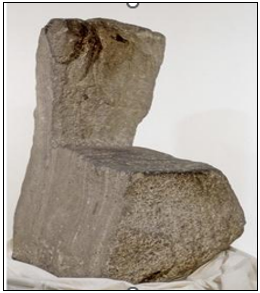
Left: The reputed O’Neill inauguration chair, which stood on Castlereagh Hill, County Down, until c.1750. (Ulster Museum).
No identifiable inauguration-stone remains at Magh Adair. In the very few excavations of ceremonial mounds, large stones were uncovered that may have once been inauguration seats? Who knows what a test excavation at Toonagh might throw up? Elsewhere we have a mention of the creation of a seat to ensure that the royal candidate always sat higher than those attending. A passage reads ‘A heap of stones was erected in the form of a pyramid, on the top of which the young chieftain was plac’d, his friends and followers standing in a circle round about him, his elevation signifying his authority over them, and their standing below, their subjection to him. One of his principal friends delivered into his hands the sword worn by his father, and there was a white rod delivered to him….’[vxiii]
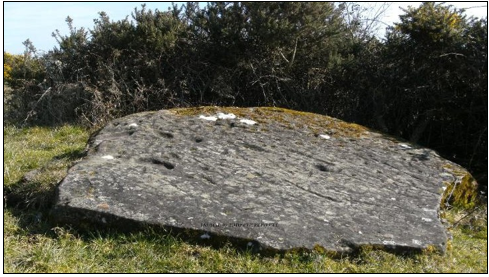
Fig. 7. The Inauguration Stone of the Clandeboye O’Neills of Tyrone. Now in the village of Cadamstown, County Offaly.
Fig. 8. The Inauguration Stone of the O’Conors, Kings of Connacht, located outside Clonalis House in Castlerea, Roscommon.
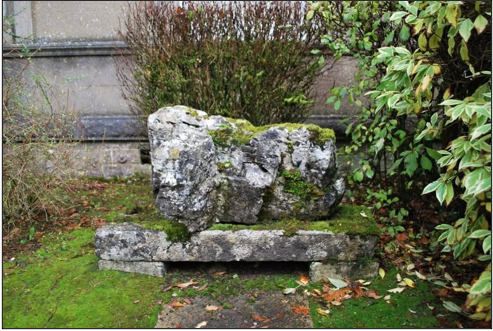
As the ceremony continued, the Ua Briain remained visible to his followers on Craggnakeeroge ridge and in the park. While on the ancestral seat he faced north. After a pause, he rose from his throne and solemnly turned sunwise (deiseal) three times, or alternatively his vassal Mac Conmara moved around him three times. This was described by author Katherine Simms as the ‘cosmical rotation’[ixx] and was possibly more nuanced than we now appreciate. It was also an opportunity for the king-elect to view his territory.
As a high point in the ceremony the Ua Briain would be offered the all-important symbol of sovereignty by Mac Conmara. This was the slat na ríghe (the king’s rod), a branch cut from the sacred tree/bile. It was straight and white to symbolise truth and justice.
A phrase sometimes used to describe these inauguration ceremonies was ‘bainis Righe’ – the King’s wedding. The notion was that the candidate married the land ( and in earlier times, the sovereignty goddess). It was his duty thereafter to honour and protect it. In Gaelic writings of the time the health of the land was reflected in the health of the king and vice versa.
Through a declaration delivered by the sept’s file or ollamh, the tribal members were now reminded of the worthiness of the nominated candidate, pointing out his achievements and reciting Ua Briain genealogical sources to demonstrate his legitimacy to his title of Ríghe. This was followed by a praise-poem in his honour by the resident ollamh. When finished, the Mac Conmara inaugurator would loudly proclaim the O’ Brien candidate as the new king of the Dalcassians, to the acclaim of all those present.
A final act at many inaugurations was the surrender of the new king’s horse and ceremonial garments to the ollamh or possibly the comharba/priest. This would demonstrate the generosity of the new leader and his ability to provide material wealth to his followers.
Once the formalities were concluded, feasting, drinking and sports would begin. These might continue for days. While most of the activities took place in the fields adjacent to the inauguration mound, the Mac Conmara fort at Cahercalla provided a nexus of the activities. As well as officiating at the inauguration ceremony, the Mac Conmara’s were the principal hosts on the day, with many venerable guests to look after. It fell to them to ensure that everything went well.
*
I have viewed several inauguration sites in the country and can only say that Magh Adhair, despite its limitations, ranks high in the list of impressive Gaelic Ireland locations. Together with its archaeology, its landscape and the Ua Briain associations, it tells a huge story. It is a venerable place that has momentarily grown silent. Perhaps we can awaken it once more?
Michael Houlihan,
24/07/2026.
- John Donovan and Eugene O’ Curry, Letters Containing Information Relative to the Antiquities of the County of Clare, Collected during the Progress of the Ordnance Survey in 1839. Ed. Michael O’ Flanagan, Bray, 1927.
- Oenach, modern Irish Aonach, was retained in the rural vocabulary into modern times. Loosing most of its formal functions it came to describe street fairs where animals and merchandise were bought and sold.
- Gleeson, P., 2018 Gathering communities: locality, governance and rulership in early medieval Ireland. World Archaeology 50 (1), 100–20.
- A Folklore Survey of County Clare by Thomas Johnson Westropp, Clare County Library
- World Heritage Cultural Landscapes A Handbook for Conservation and Management Nora Mitchell, Mechtild Rössler, Pierre-Marie Tricaud (Authors/Ed.), 1992.
- Sean Duffy, Ireland in the Middle Ages, Gill & Macmillan Ltd, 1997.
- Thomas J. Westropp (Thomas Johnson), ‘The Ancient Places of Assembly in the Counties Limerick and Clare’, Journal of the Royal Society of Antiquaries of Ireland; Vol. 44 (1), Dublin, 1919
- B Michael Moore and Leo Morahan Bullaun stone, Toonagh, (Bunratty Upper), National Monument Services, June 2018.
- Elizabeth FitzPatrick, Royal Inauguration in Gaelic Ireland c.1100-1600: A Cultural Landscape Study, Boydell and Brewer, 2004.
- FitzPatrick, Elizabeth. Royal Inauguration in Gaelic Ireland C. 1100-1600: A Cultural Landscape Study. Woodbridge, Suffolk, UK: Boydell, 2004. 52-59.
- TJ Westropp, ‘Killaloe, Its Ancient Palaces and Cathedral’, The Journal of the Royal Society of Antiquaries of Ireland, Dublin, Vol 2, 1892.
- T.J. Westropp, ‘Magh Adhair, Co. Clare, The Place of Inauguration of the Dalcassian Kings’, The Journal of the Royal Society of Antiquaries of Ireland, Dublin, Vol 4, 1898.
- Both Ua Bhriain and Uí Bhriain naming conventions used.
- Sean Mac Ruaidhrí Mac Craith, ‘Caithreim Thoirdhealbhaigh or Wars of Torlogh’ , 1369
- The Annals of Clonmacnoise, being annals of Ireland from the earliest period to A.D. 1408. Translated into English 1627 by Conell Mageoghagan.
- It lies northeast of Quin and about 0.5 kilometre south of Magh Adhair mound. The townland was in the possession of John and Conor MacNamara up to 1641.
- The coarb was the spiritual heir or successor of a saint who founded a church or monastery. From the Irish comarbae, meaning “heir” or “successor”.
- Proceedings of Antiquaries of Scotland, 1879.Sean O’Dowda Stephens, Gaelic Inaugurations: What They Tended to Include (1100–1600), , 2025.
- Katharine Simms, Gaelic Ulster in the Middle Ages: history, culture and society . Four Courts Press, Dublin, 2020