
Land abundant with holly
This townland had one of the lowest populations in the parish. It was largely rural and agricultural and remained so until ribbon development along the lenght of the Newline road opened it up in the last 25 years. Records for the townland are as sparse as the population numbers, hence this post will shed little light on its past.
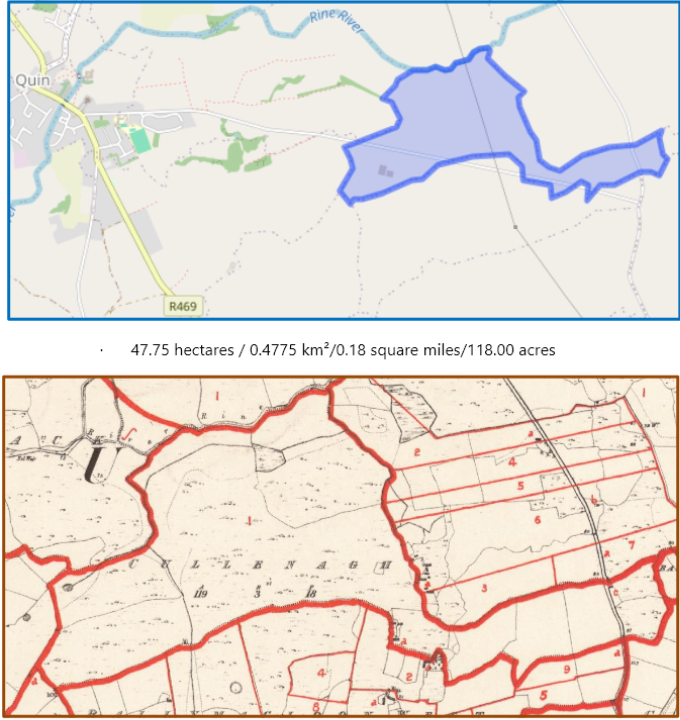
Census records for Cullenagh
1841 Census records (4 households; 25 persons)
1851 Census records (3 households; 25 persons)
1855 Griffiths Valuation record:
Clune Cornelius Cullenagh
1861 Census records (3 households; 23 persons)
1871 Census records (1 household; 6 persons)
1881 Census records (1 household; 6 persons)
1891 Census records (1 households; 6 persons)
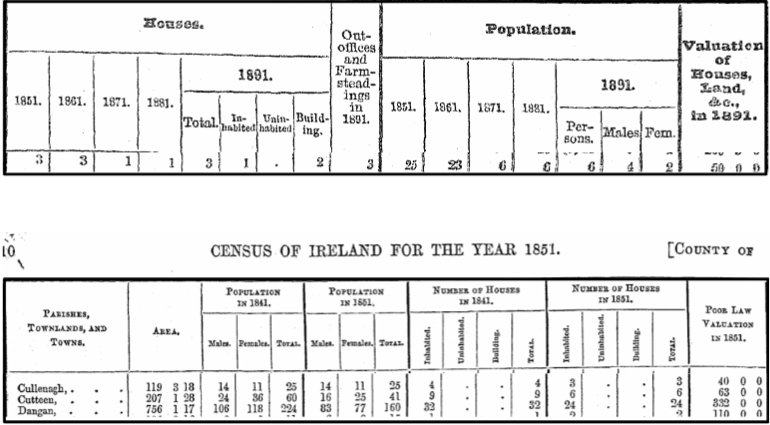
1901 Census records (2 households; 13 persons)
Patrick & Margaret Hayes, brother John, sons John, Patrick, James, daughters Mary Kate, Gretta, Nora.
John & Catherine Nihill, son John, daughter Anne.
1911 Census records (2 households; 11 persons)
Patrick & Margaret Hayes, sons John, Patrick, James, daughters Mary Kate, Margaret, Nora.
John & Catherine Nihill, son John.
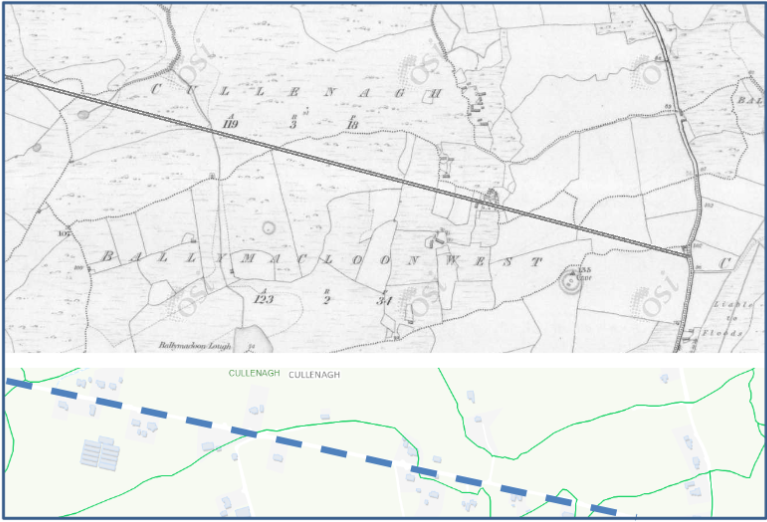
The Newline Road through Cullenagh
The Newline Road was constructed in the late 1840s as a famine-era public works project to connect the village with the Tee-junction at Cutteen. Absent in 1842 but present by 1890, it was part of a broader infrastructure effort that included roads to Ennis, Kilmurry, Clarecastle to Lissane and Clarecastle via Noughaval/Doora.
Key Historical Details
· Construction: Likely built as famine relief in the late 1840s. John Singleton mentions in his diary an intention to identify suitable projects in Quin to relief the distress of locals. The Government provided very little money for these relief projects so most of the money had to be raised locally and was levied on the large land owners such as John Singleton and Tom Steele. Another such road from Finanagh to Clarecastle was built to facilitate the transport of materials from the mines in Ballyhickey and Kilbreckan.
· Original Scope: Extended from the village to the Tee-junction at Cutteen.
· Intended Path: Plans appeared to connect it to the entrance of Tom Steele’s demesne at Cullaun (Lough O’Connell), potentially linking Dangan to Quin.
Impact on Area: Prior to its construction, Danganbrack and Cullenagh were largely undeveloped and sparsely populated. Cullenagh remained sparsely populated following the construction of the road as emigration continued to decimate rural parts of the country.
Some baptismal records from 1800’s
|
Date |
Child’s name |
Father’s F/N |
Mother’s name |
Sponsors |
||
|
22.01.1817 |
Patrick |
Carney |
James |
Clune |
Margaret |
Pat Corbett, John Nash |
|
06.10.1839 |
Michael |
Clune |
Matt |
McMahon |
Bridget |
Brien and Mary McMahon |
|
08.05.1844 |
Bidy |
Clune |
Mat |
McMahon |
Bidy |
Martin Clune, Kity Meany |
|
05.10.1819 |
Michael |
H(?)y |
|
Clune |
Peggy |
James Murphy, Peggy Nash |
|
22.03.1821 |
Margaret |
Hogan |
John |
McDonnell |
Nancy |
Patt Commane, Margaret McDonnell |
|
27.03.1819 |
Mary |
Hogan |
John |
McNamara |
Nancy |
John McNamara, Betty McNamara |
|
02.10.1834 |
Michael |
Hynes |
James |
Hennessy |
Bridget |
Samuel Taylot, Judy Nash |
|
01.03.1820 |
Mary |
Molony(?) |
Patt |
Ca(?) |
Mary |
Patt Nash, Biddy Brien |
|
21.02.1822 |
Margaret |
Nealan |
Patrick |
Quillinan |
Nancy |
Michael O’Neal, Frances McInerney |
|
28.06.1855 |
Thomas |
Clune |
Conor |
McGuiness |
Ellen |
James Woulfe, Jane Woulfe |
|
30.10.1860 |
William |
Clune |
Cornelius |
McGuiness |
Ellen |
Michael Clune, Honora Clune |

