
The concept of common land stems from ancient Gaelic management of land, where certain areas were not owned by individuals but were held for the benefit of the community for grazing cattle or cutting turf or timber.
Villages adjacent to “commons” originated primarily from the Gaelic clachan system, often paired with rundale farming where land was held in common for use by all. These settlements were often located near marginal land or on the edges of lands managed by landlords where tenant farmers maintained traditional, communal grazing rights. The enclosure of these commons by landlords was a major driver of agrarian unrest in the 18th century, with Whiteboys and other secret societies tearing down fences to protect traditional grazing rights.
Commons townland in Quin is marginal land, liable to flooding and so today is devoid of residents, but this was not always the case. As with other townlands, the population here increased immediately following the famine but dropped sharply for each 10-year return thereafter as emigration took a hold of the younger family members.
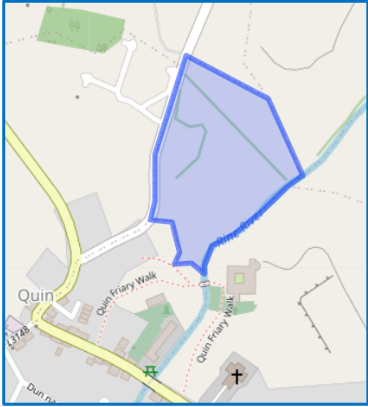
Coimín – commonage, common land; little hollow, glen
This small townland is located on the right-hand side of the Tulla road after you pass the village picnic benches.
It has an area of just 3.44 hectares / 8.49 acres / 0.01 square miles
1819 Freeholders in Commeen
Timothy Considine, Michael Considine.
Landlord: James Butler
Names of Lives or other Tenure: Pat Halloran Snr; Pat Halloran Jnr; Heniher?
1825 Tithe Applotment Book
Land Occupiers in Commons townland:
John Moran, James Corry, Michael McMahon, Patt Halloran, Patt Moylan, William Moylan, Patt Gorman, Michael Rotchford, John Keefe.
1855 Griffiths Valuation
Land Occupiers in Commons townland:
1. Cornelius Halloran
2. John Singleton, James Moylan, Patrick Gorman, Patrick Carmody, Catherine Moran,
3. James Moylan,
4. Michael Carmody, Judith Neill, Sarah McNamara, Michael Lynch, John Kane.
See right-hand map numbers below for 4 land parcels.
Landlord: William Vance
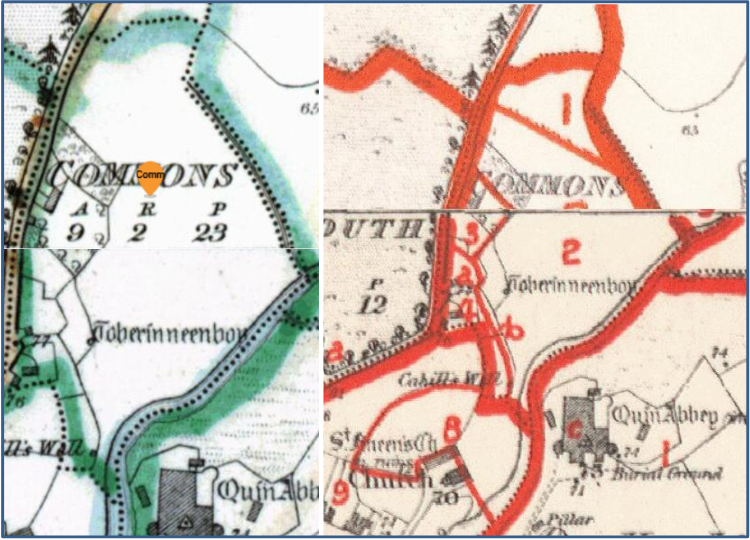
Census records for 1841: Population 22, Households 5
Census records for 1851: Population 31, Households 8
Census records for 1861: Population 8, Households 2
Census records for 1871: Population 6, Households 2
Census records for 1881: Population 4, Households 2
Census records for 1891: Population 7, Households 2
Census records for 1901: Population 4, Households 2
Census records for 1911: Population 2, Households 1
1901 Census Record
Patrick O’Brien (Postman) age 23, sister Mary O’Brien age 25.
Michael & Eliza Neville, ages 52, 50
1911 Census Record
Michael & Eliza Neville, ages 73, 70
Old age pension
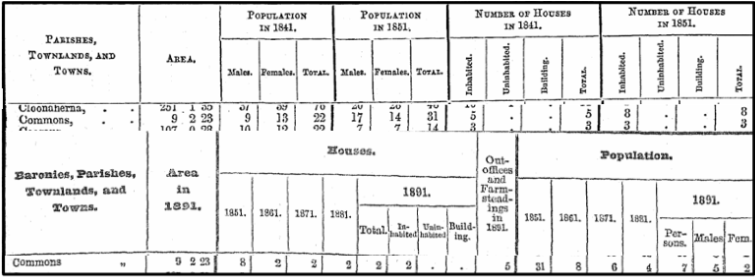
This was introduced in 1908. Followers of the Townland posts may sometimes notice a discrepency in the recorded ages from 1901 to 1911. While it was not always the case, and there is no suggestion that ocurred in the above return, there was an incentive to add on years in order to be eligible to claim the old age pension. This must be borne in mind when researching or tracing relatives through these returns.
National Monuments:
Toberinneenboy CL042-027005- : Ritual site – holy well
Description: On an E-facing slope on the NW bank of the River Rine in an undulating field with some rock outcrop. Named ‘Toberinneenboy’ on the 1840 OS 6-inch map and ‘Toberinneenboy (Site of)’ on the 1922 edition. An overgrown area (diam. c. 4m) around a tree at this location has some rocks at the base but no stone setting is evident and there is no sign of a spring.
INGHEAN BAOITH of Kilnaboy, wells at Kilnaboy, Commons, Glensleade, Quakerstown, Killavella, Dulick in Templemaley, Kiltachy, Kilshanny, Aglish, Moy Ibricane, Magowna, Ballycoree, Shallee (two), Cullaun, Castletown (Clooney), Drumumna and Quin.
Cahill’s Well
There is nolonger any trace of the well marked on the early OS maps as Cahill’s Well. There is, however, remnants of what may have been a well or spring alongside the wall seperating Commons from the site where St Finghins Church is located. The association of the well with this particular surname is interesting. As can be seen from the above records, there is no mention of a Cahill family having lived there. Might this be a misinterpretation of ‘Cathal’, or similar, by the OS surveyor? If so, it still will not bring us any closer to the origin of this feature name!
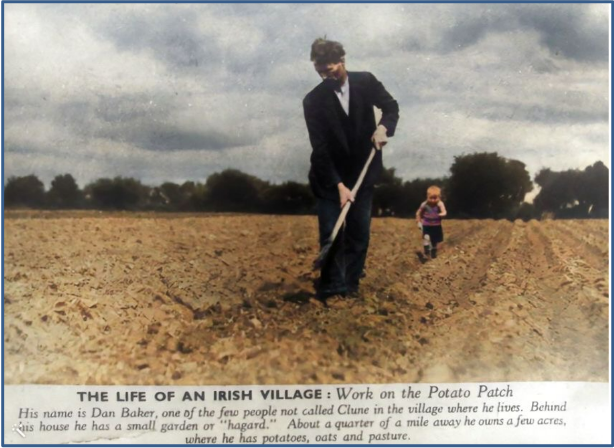
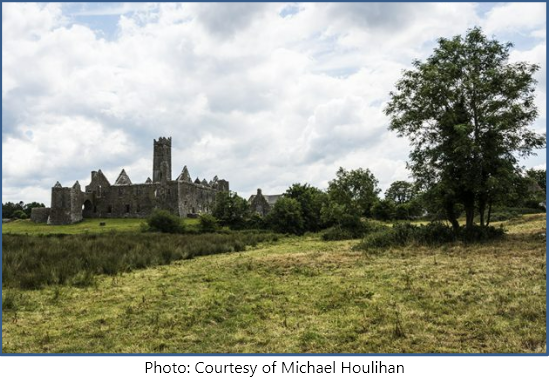
Left: Toberinneenboy/Tober Inghean Baoith where tree is standing in the field.
