
Thomas Lacy, Sights and Scenes in County Clare, 1859
Thomas Lacy of Wexford, sometimes styled ‘the dacent Lacy’ was the author of two books on England and Ireland: Home Sketches on Both Sides of the Channel (1852), and Sights and Scenes in Our Fatherland (1863). In the 1840s Lacy was employed as assistant to the solicitor responsible for negotiating rights of way for the extension of the railway from Dublin to Wexford. The railway afforded him the opportunity to tour extensively in Leinster and Munster. In his accounts he ‘always looked upon the sunny side of the picture’ and avoids scenes of poverty and deprivation.
While proceeding from Ennis to Limerick, I stopped at the Quin station, and availed myself of the interval between the passing of the mid-day train and that of the evening, to visit the celebrated ruins of Quin Abbey, which are situated about two miles from that place. This abbey, which is one of the most perfect and complete ruins that I have seen in this country, is situated on a gentle elevation, which slopes down to the eastern bank of the clear river that flows before its western front, which in its southward course, after passing beneath a handsome bridge of three arches, becomes ultimately lost in the Fergus. . . .
Quin is a parish in the barony of Bunratty, about six miles from Ennis.
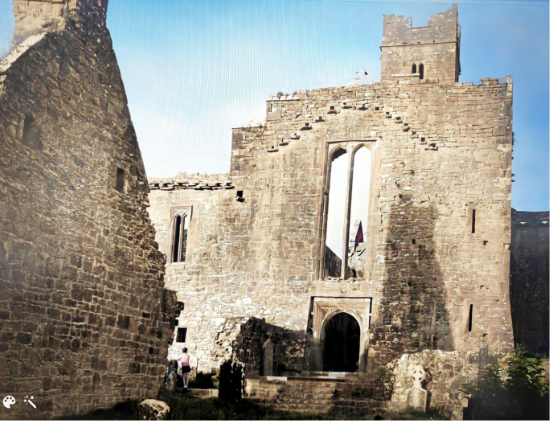
In the village, which is near the ruins of the grand abbey, there is little worthy of the tourist’s notice, save the Protestant and Catholic churches. The Protestant church, which is of long standing, but which has recently undergone considerable improvement, is a plain structure with a square tower. It is handsomely situated on the western bank of the Quin river, at a short distance east of the ruin which, as an appendage of the celebrated abbey, was rendered subservient to the purposes of charity and benevolence, affording shelter and hospitality to the poor and the stranger in the old monastic times.
Left: The gable wall of the ‘appendage’ referred to above
The Catholic church is a handsome and spacious cruciform structure in the Gothic style of architecture, with a nice portico of cut stone. It was erected about twenty years ago, at an expense of £2,000, which was defrayed by general subscription. At the time I paid my visit it was undergoing considerable improvements, chiefly confined to internal decoration and embellishment. The angles of the nave and transepts are strengthened on the outside by fine buttresses, from each of which rises an ornamental pinnacle; while the apex of each transept, as well as that of the nave, is decorated with a highly wrought Gothic cross. The interior is very beautiful, the fine clustered columns that adjoin the altar, and the part that connects the transepts with the nave, being alike remarkably grand and striking; while the altar itself – which is of Caen stone, with columns of the Cork, Galway, and Armagh marbles – and the elegant statuary command the attention and the warmest commendation of the visitor. The doors leading into the nave and transepts are of elliptic character, with label-mouldings. The windows, three in each side of the nave, are high, and of two mullions; while those above the transept doors, and the three in each of their sides, are of a single mullion. . . .
On my return from Quin Abbey to the Ardsollous and Quin station, I availed myself of the time still at my disposal, and proceeded to take a view of Dromoland, the seat of Lord Inchiquin, which is about two miles in an opposite direction from this station. It is a very handsome place, and the mansion, a fine castellated structure, one of the most magnificent specimens of a modern baronial building to be seen in any part of Ireland. . .
The Quin river, in its devious windings, flows through portions of this fine demesne. Returning from Dromoland, I was just in time for the last train to Limerick, by which I proceeded to that fine city. . . .
