
The so-called Tithe War was never a conventional war. There were no pitched battles, no generals issuing grand proclamations. Instead, there were cattle drives, boycotts, ambushes, and sporadic killings.The conflict spread across most of Ireland for a decade, stopping only at the predominantly Protestant counties of northeast Ulster, where the religious arithmetic was different and the grievance less acute.
In Clare, this resistance was closely linked to wider agrarian disturbances, notably those led by the “Terry Alts” and “Lady Clare’s Boys,” who protested against oppressive rents, land clearances, and the tithe system. This resistance was not just passive. The Terry Alts, a secret society, and “Lady Clare’s Boys” (who often wore women’s clothes as a disguise) were active in resisting the enforcement of these payments, attacking tithe proctors (collectors), and intimidating those who cooperated with them.
In 1831, a special commission sat in Ennis to try “Whiteboy” offenses, resulting in 111 prisoners appearing, with 6 sentenced to death and most others transported. On April 11, 1831, a petition published in the Clare Journal on behalf of 150,000 tenants in Clare outlined their grievances, including the burden of the tithe and the “parish vestry cess” (local tax). The widespread refusal to pay led to the Tithe Rentcharge (Ireland) Act 1838, which effectively added the cost to the rent paid to landlords, ending the direct, violent confrontations of the “War”. The activities of the ‘Whiteboys’ was a major concern for the local Peace Commissioner and member of the Grand Jury, as noted in his memoirs ‘The Diaries of John Singleton’. It explains the large presence of RIC constables stationed within the wider parish of Quin at the time.
Rev James Hall, in his ‘Tour of East Clare’, 1812 noted:
“In every parish there is a pound-park, to which they take the cows, pigs, calves, and the like, of those who are in arrears for tithes. In eight days after the cattle have been in pound, if the owner do not come and relieve them, by paying the tithe and other expenses, the cow, or whatever it may be, is sold to the highest bidder; and the balance, if any, after paying what had been due, and all expenses, is given to the person to whom the animal, or thing, belonged. There is generally also a pound-park in the parish for the landholders; and middle-men, or receivers, do the same when there happens to be any arrear of rent.”
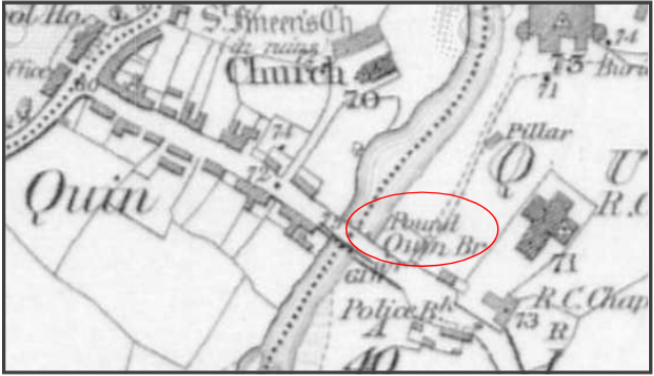
The ‘Pound’ for Quin was located on the site of the present community garden ‘An Tearmann’. It was captured in the first 6” OS map, which was published in 1842 but surveyed about 1839. This would have been at the height of the Tithe Wars and explains the existence of the ‘Pound’, at the time of the OS survey of Quin.
